The walls and handles of medieval vessels are often covered in characteristic graffiti marks. As a rule, these are symbols deliberately made by owners of such vessels or customs officers.
The historian Vadim Vladislavovich Maiko wrote that the study of such marks is “an interdisciplinary topic”, which requires “knowledge of specific archaeological material, as well as special philological training, [knowledge of] the Greek language and the meaning of ancient Byzantine ligatures. ”In addition, the fragmentary nature of the graffiti complicates their identification, and it is virtually impossible to establish the connection of the marks “with the name of the owner… or workshops <…> or what ethnicity or family the owner or the craftsman belonged to.” These marks also do not provide any information on the volume and contents of the container.
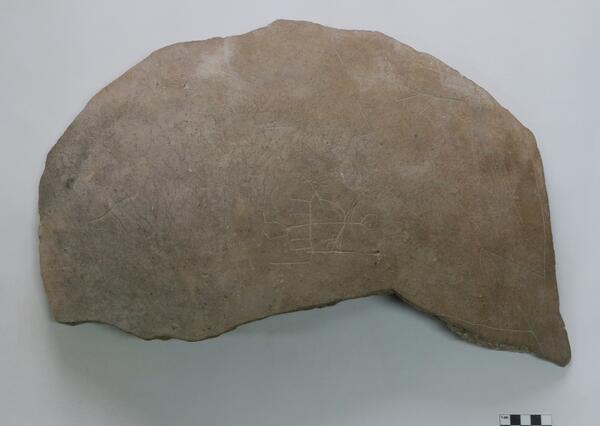
Narrative graffiti depicting events of medieval life, just like on the presented fragment of a pithos, is a rarer occurrence.
The clay surface shows a battle scene between cavalry and infantry soldiers against the background of ships. Despite the schematic nature of the image, the shields and spears of the horsemen, elements of harness and girth, reins and saddles of horses are clearly distinguishable. It is obvious that the drawing depicts a clash between the indigenous people of a wild island and warriors who came to replenish water supplies.
The drawing is of interest as it illustrates the history of navigation. According to written sources, in antiquity, merchant ships traveled from Chersonesus to Theodosia coastwise. This seems strange, given the fact that the navigation was well-developed and sailing along the coasts increased the odds of meeting pirates or colliding with underwater reefs.
The answer to the question was provided by the underwater archaeological research carried out in the basins of the Black and Mediterranean seas, and observations of the routes of sailing ships along the southern coast of Crimea. It turned out that by keeping closer to the shore, ships were protected from the winds blowing from the Main Ridge. The winds were so strong that they could carry a heavily laden ship out into the open sea, and there, if the ship was not able to approach the shore again, it would almost certainly perish — the probability of that was higher than being captured by Tauri pirates.
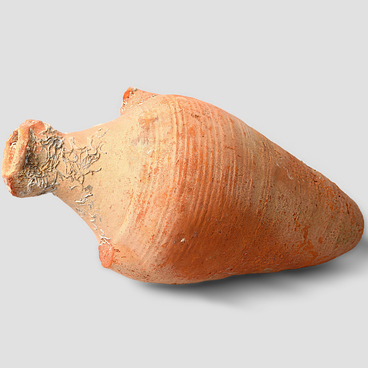
Such cases are confirmed by numerous whole amphorae, pithoi and other items of ship cargo, found at the depth of 60 to 80 meters at two to three kilometers from the shore and raised in trawl nets by seiners.
The study of these shipwreck sites, scattered along the southern coast of Crimea, can be carried out in the near future when new underwater technologies are developed.