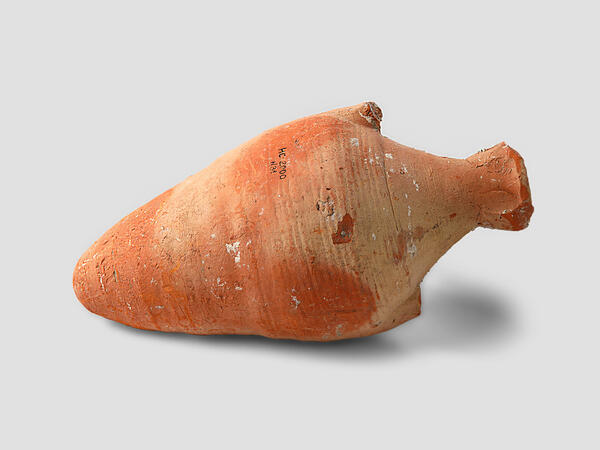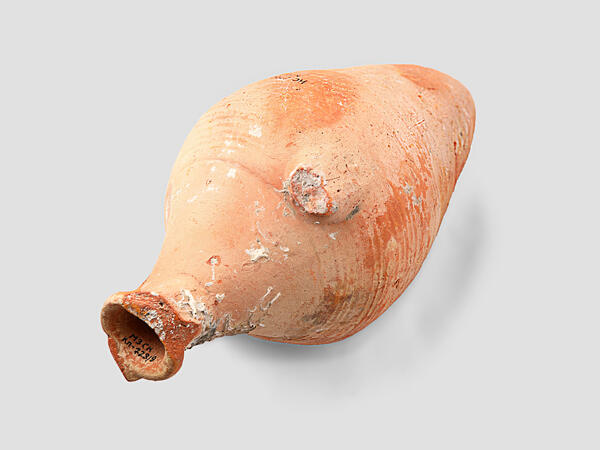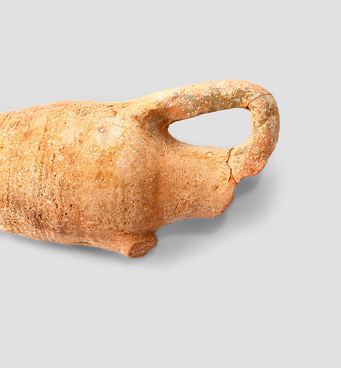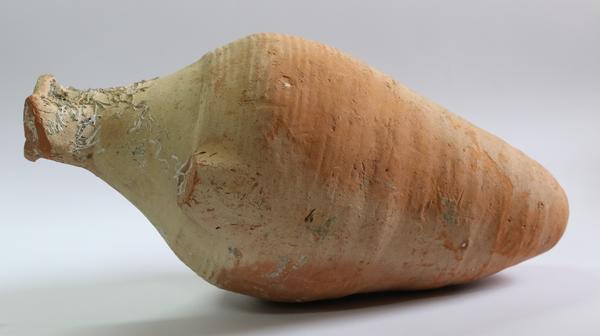
Amphorae are ceramic vessels with two high vertical handles. They come in a variety of shapes and can perform a range of functions.
As a rule, amphorae were elongated or egg-shaped and had a sharp or, rarely, round bottom. Often, they had a smaller foot or even were flat-bottomed. The oldest method of making amphorae was hand molding from clay coils.
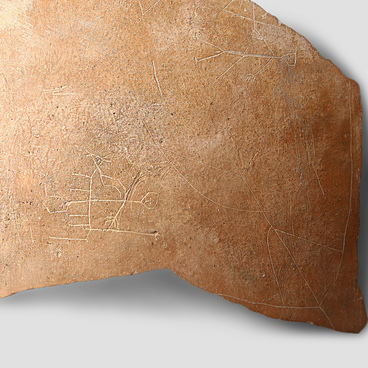
The peculiarities of the shapes, characteristic of different centers of amphora production, and stamps help scientists to date and reconstruct sea and land routes of international trade.
Amphorae of the Black Sea kind are divided into two types: five to ten liters in volume with all-round grooved ribbing and over ten liters in volume with smooth or fine zonal ribbing.
Amphorae were primarily intended for the storage and transportation of liquids, such as wine and olive oil. In order to keep the containers hermetically sealed and prevent the wine from souring, the necks were made as narrow as possible and corked with wax or cork plugs. Amphorae were also used for carrying dyes, olives, grapes, and possibly grain, preserved fish, spices, wool and other goods.
Once the vessel reached its destination, it was emptied and often broken, and the fragments were thrown away. It could also be filled with new contents, such as honey, wax, or salted fish, and sent back. The preserved amphorae were either sold or used in households in the Northern Black Sea region for storing liquid and bulk products, carrying water and building drainage pipes (for this purpose, the bottoms of the vessels were chipped off and they were inserted one into another).
It is also worth mentioning that amphorae were used in funeral rites. Funeral urns in the form of amphorae with chipped necks were found in rich graves at an ancient cemetery in the Roman port of Ostia. The Greeks had a tradition of placing vessels with broken bottoms on the graves and filling them with wine and honey on feast days to “treat” the deceased. Children’s burials are often found in the cellars of ancient Greek dwellings: infants were laid in the embryo position in amphorae with a chipped wall. The vessel was used for this purpose as it symbolized the womb, as well as both the beginning and the end of life.