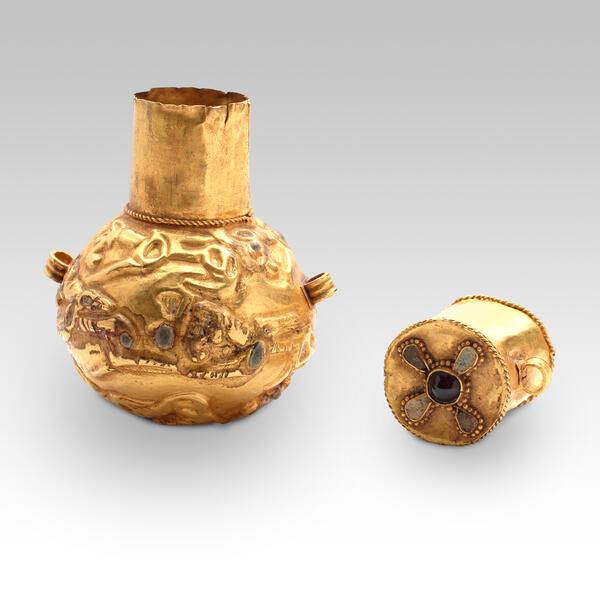
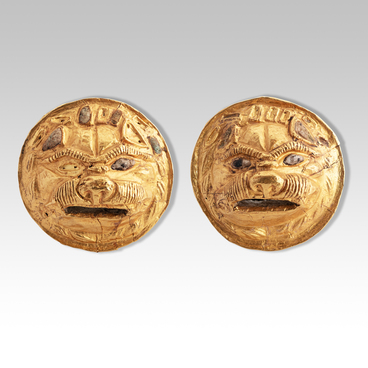
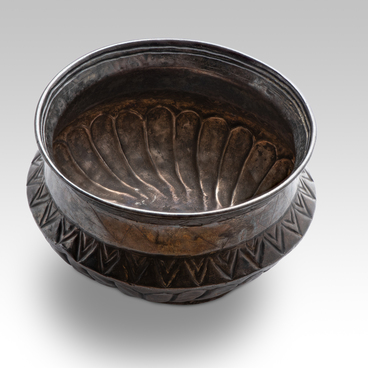
The artifact on display was discovered in 1987 in kurgan No. 10 of the Kobyakovsky burial site, which is located on the eastern outskirts of Rostov-on-Don. The burial contained the remains of a wealthy nomadic woman from the Sarmatian aristocracy. The vial lay near the right hand of the deceased.
The item can be classified as an example of the unique zoomorphic Bosporan style. Its origin can be traced back to the involvement of craftsmen from the Bosporan kingdom — the ancient state located in the northern Black Sea region. Those craftsmen specialized in toreutics, artistic metalworking, and were commissioned to create gold artifacts for the Sarmatian aristocracy. At the same time, the upper part of the lid features a rosette design that is consistent with the Hellenistic art of the Roman period.
The gold vial belongs to the precious pieces from the period between the 1st and 3rd centuries that are known in scientific literature as vessels used for storing aromatic substances as well as medicinal herbs and various poisons. Such containers typically have a rounded, oval, or ovoid shape, a cylindrical short or long neck, and a tightly fitting lid, making them leak-proof.
This specific vial has a cylindrical neck that is soldered onto a spherical body. A twisted gold wire runs along the weld line from above, concealing it. The body is decorated by a relief design of three lying griffins with wings, which is repeated three times.
The vial is inlaid with inserts made of paste of light blue and green shades.
The container has a cylindrical lid that screws on tight. At the top of the lid, there is a central setting for a cabochon soldered in place — it is a smooth, convex, polished gemstone (garnet). A four-petaled rosette frames the stone, consisting of four elliptical settings that are soldered onto the lid. Inserts made of light blue and light green pastes are also fitted onto the lid. All settings are additionally decorated with granulation.
Twisted gold wires surround the edges on the lid on the top, bottom, and along the sides. This form of intricate metalwork is called filigree.
The container has paired vertical loops on the body for hanging, each ornamented with fluted grooves. Loops are present on the lid as well.