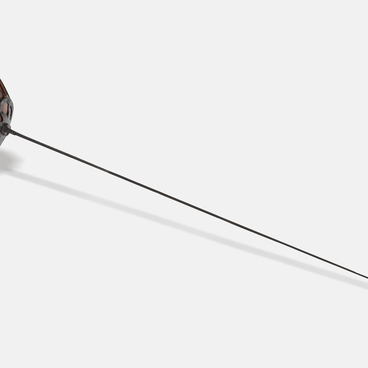
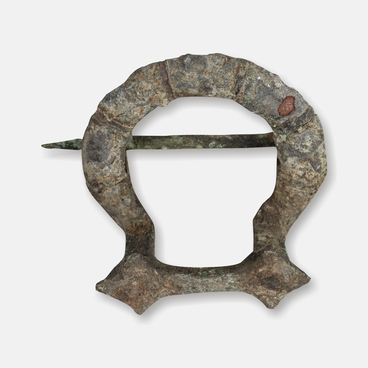
A fibula is a metal clasp that serves as decoration and has a pin with a lock to fasten clothing. Fibulae of various shapes were common from the Bronze Age to the late Middle Ages.
The Zelenogradsk Museum of Local Lore houses a unique fibula with a star-shaped foot, an oblique cross, and a solar element in its décor. This fibula testified to the connections between Samland and Scandinavia. Richly decorated female burials of the Baltic region, which date back to the second half of the 4th century and the early 5th century, feature fibulae made of bronze, silver, and iron, called “star-shaped” fibulae because of their distinctive form. They were often decorated with elaborate stamps and differed significantly in size from earlier Roman fibulae. Although this form of fibula is recognized as typical of this particular region, similar items are sometimes found in southern Scandinavia. This indicates that the inhabitants of the Baltic region had connections with other peoples, living as far as the south of Norway.
The important research area of the world of images and symbols used in Prussian decorative art has not been studied sufficiently. However, there is some information about trends in such art. The oblique cross is often found among the elements of decorative patterns. For the first time, this motif appeared on fibulae made at the turn of the 5th century, which have been found among Vidivarii artifacts. The question arises as to what kind of nation the Vidivarii belonged to. According to the historian Jordanes, it was a melting pot of tribes, “But on the shore of Ocean, where the floods of the river Vistula empty from three mouths, the Vidivarii dwell, a people gathered out of various tribes. Beyond them the Aesti, a subject race, likewise hold the shore of Ocean.”
As it is known from the Getica by Jordanes, the
territory of the Vidivarii during the Great Migration included part of modern
northeastern Poland. Having appeared in the Vistula delta in the 5th century and later migrated eastwards to Sambia, the Vidivarii laid the
foundations of the Prussian culture, which was formed by the mid-5th century. Its symbol is a fibula with a star-shaped foot, which appeared in the
land of the Aesti-Prussians as a result of the Scandinavian ethno-cultural
developments and reflected a myth that became part of the spiritual culture of
the Baltic peoples for centuries.