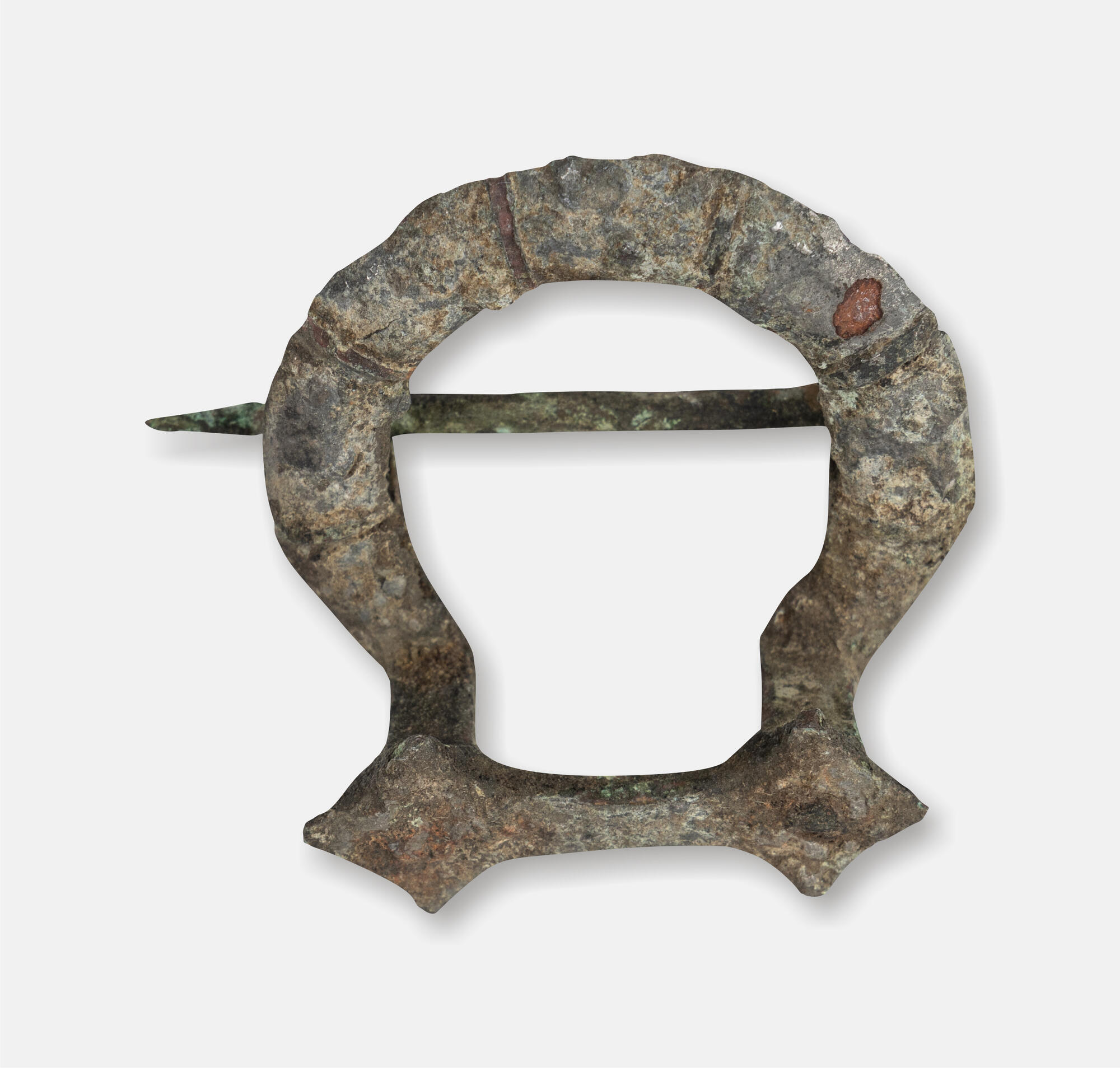


Among the unique items in the archaeological collection of the Zelenogradsk Museum of Local Lore is a Curonian-type fibula.
A fibula is a metal clasp that serves as decoration and has a pin with a lock to fasten clothing. Fibulae of various shapes were common from the Bronze Age to the late Middle Ages.
One kind of artifact that archaeologists often find at the sites of Viking Age settlements is a horseshoe-shaped fibula. Many of these objects are Gotland-style fibulae. They appeared in the south-eastern Baltic region thanks to the inhabitants of the Gotland Island which is located in the center of the Baltic Sea.
Single large horseshoe-shaped fibulae were used as clasps for men’s cloaks, while paired fibulae with a smaller diameter were used by women to fasten clothing or to attach parts of their accessories, such as jewelry, keys, knives, or sharpening stones. In the 10th century, the tops of the fibula bows were facetted, the cross-section of the bow was hexagonal, and the bow itself was decorated with a plaited “braid”. Such fibulae were found in the burial mounds of the Viking settlement Kaup, which was located not far from modern Zelenogradsk. Later, in the 11th century, Curonian-type fibulae began to spread, which were characterized by quadrangular bows with transverse bands. Often, the bow fused together with the pin. The horseshoe design was abandoned, and the hinged fibula operated like a pin.
Such fibulae appeared in the Baltic region as a result of its inhabitants’ connections with northern peoples. It can be assumed that at the beginning of the 11th century, the Prussians adopted from the Curonians this type of jewelry which has Scandinavian origins.
The design of fibulae has changed over time, but a typical fibula still consists of a pin for fastening clothes, a pin catch (a groove or a narrow holder for fixing the end of the pin), and a body (bow).
The pin and pin catch of this Curonian-type fibula in
the Zelenogradsk Museum of Local Lore have been preserved completely.