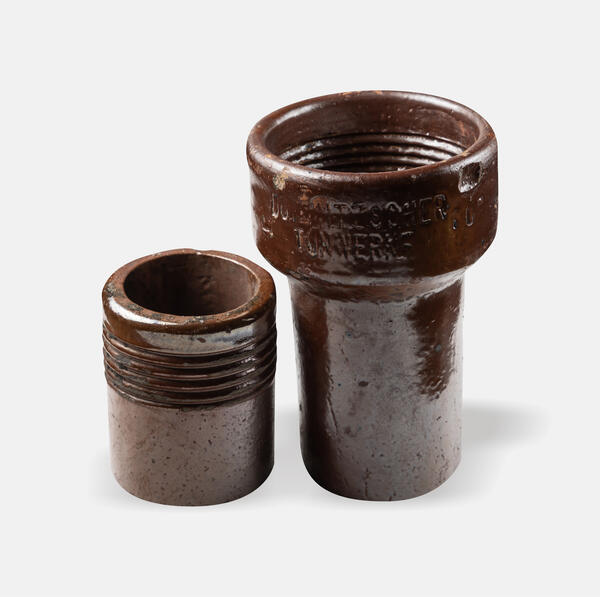
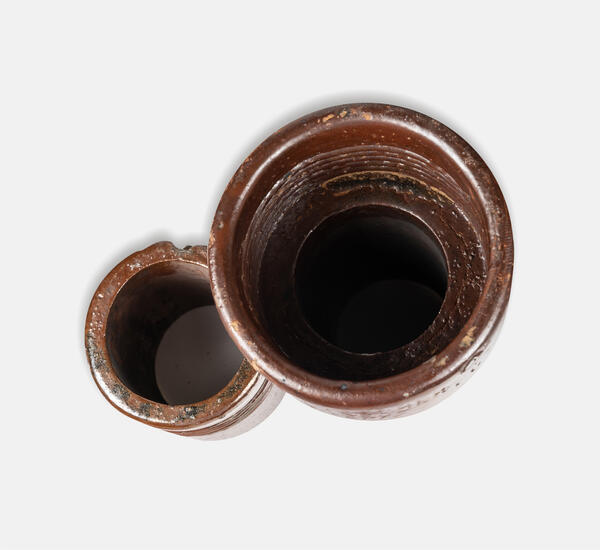
Ceramic drainage pipes with threaded joints were used to drain the land. The displayed pipes served to move water away from the foundation of the Villa Krell building which currently houses the local lore museum. The pipes have been cut for convenience of display: their original length was about 1.5 meters. Because of the humid climate and the prevalence of clay rocks in the soil, the fields of East Prussia had to be drained to remove excess water. Drainage works began during the times of the Teutonic Order. Dutch experts, who had extensive experience in that area, were invited to settle there and help perform such works.
According to Soviet land reclamation services, the region had 365 drainage systems and around 145 pumping stations which drained 108 polders (low-lying tracts of land enclosed by dikes) with a total area of 103,000 hectares. The length of coastal dams and protection dikes exceeded 625 kilometers.
Soviet settlers were puzzled by the German land reclamation system. Ceramic drainage pipes, found in the ground throughout the area, were sometimes mistaken for unfinished combat engineering works. As a result, the pipes were often considered dangerous and were removed from fields and gardens. Deep plowing also interfered with the drainage systems — although unsuitable for local conditions, it was used everywhere. Inconsistent plowing was among some of the improper agricultural techniques. Such works destroyed the organized surface runoff system that had been built over many centuries.
Later, Kaliningrad land and
water administrations regularly conducted awareness activities, in particular
in printed media, to inform the population. They organized the so-called land
reclamation months, trying to convince people to preserve the reclamation
system. There were many inconsistencies and difficulties in restoring the
reclamation network. These remained throughout the 1990s, but since the early
2000s, the regional government has implemented major steps to keep the land
reclamation system in working condition. Many fields in the Kaliningrad Region
are still drained using the German systems: the open one (canals) and the
closed one (drainage pipes).