World War II brought significant changes to fashion both in Europe and the Soviet Union. After the war, women made coats from their husbands’ overcoats, while men continued wearing their uniforms. Women’s shoes became elegant and feminine — featuring rounded toes and decorated with embroidery or a bow. High shoes that extended above the ankles also came into fashion. In summer, many women wore wedge heel sandals and platform shoes. However, practical military shoes also remained popular until the 1960s.
Everything changed overnight when in 1947, Christian Dior presented a new aesthetic called “the New Look” in Paris. It turned out that people had longed for the beauty, bright colors, and exuberant luxury of pre-war fashion. The first pump shoes, or pumps, were heavily inspired by the fashion of the previous decade — they had rounded toes, fairly stable mid-heels, and ankle straps. Along with such elegant shoes used for going out, practical and comfortable footwear also continued to develop: rubber soles became popular in everyday footwear, although previously they had been considered a sign of poverty, and both men and women started wearing loafers for outdoor activities. The Italian fashion industry recovered after the war and began to reshape the global market, surpassing the French in the areas of casual and summer footwear.
In 1951, Charles Jourdan introduced the first heel of the new shape made of steel and wood. Italian shoemakers came up with the name stiletto for their own invention in 1953. However, it is the 1955 model designed by Roger Vivier that is considered the true prototype of modern evening shoes. The height of stiletto heels peaked in 1958 and started decreasing after that. Although the houses of Givenchy and Chanel tried to go against the trend and presented low-heel shoes, in 1957, Coco Chanel, together with the shoemaker Raymond Massaro, introduced her signature beige slingback pump shoes with a black toe and a heel.
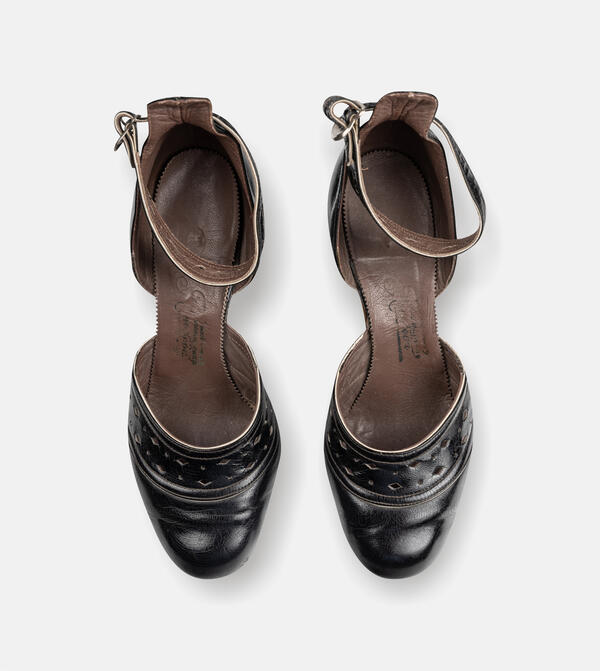
The Soviet women’s shoes from the museum’s collection are made in the spirit of the post-war period: while modest, they are exquisitely feminine, equipped with a stable high heel, a beautiful strap, and decorative perforations. The sole is bound with small nails.