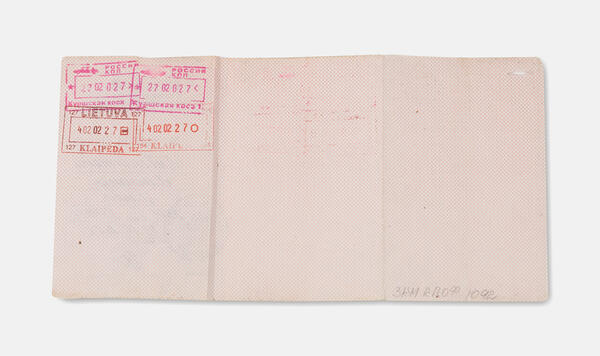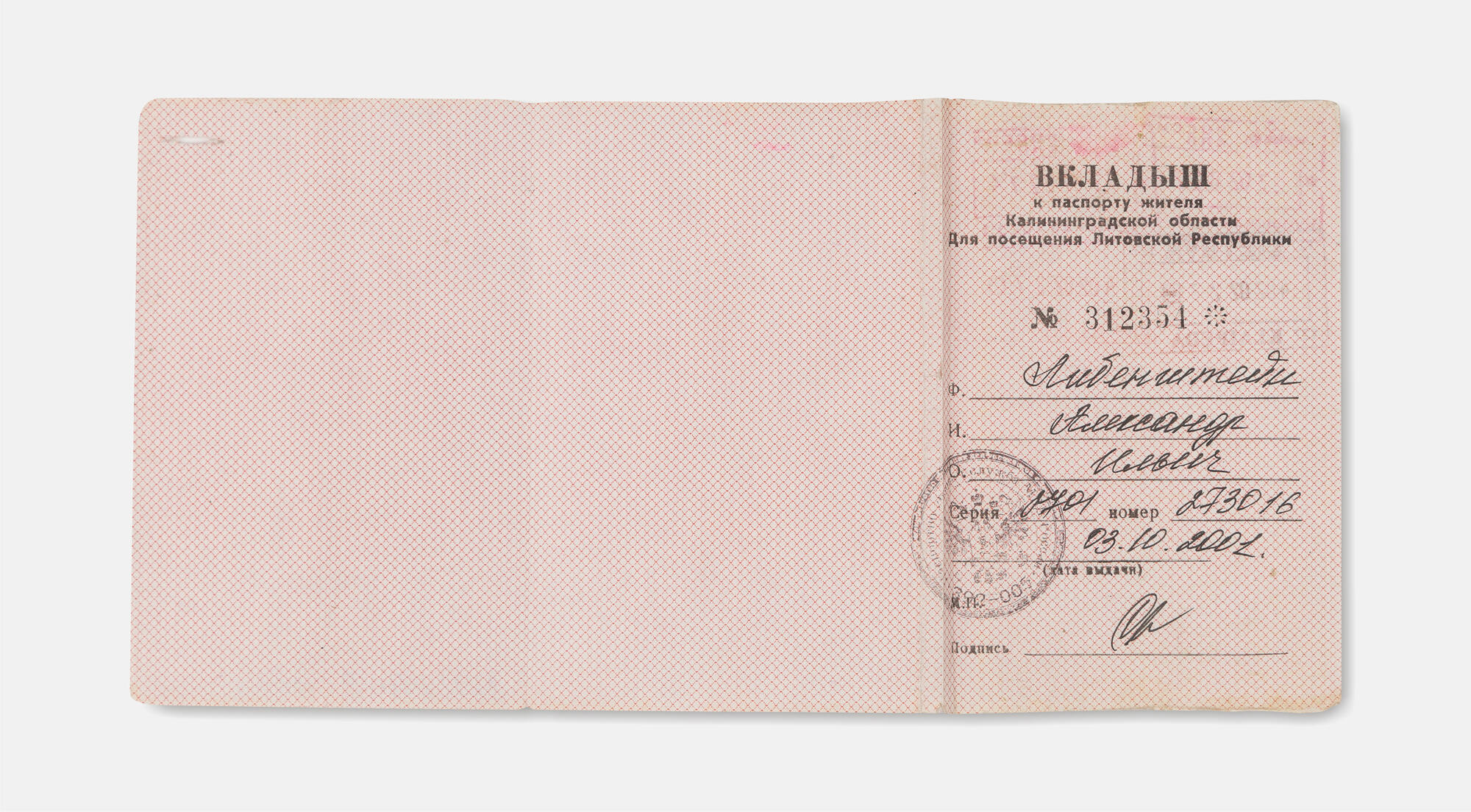


This exhibit from the museum’s collection is a legacy of the procedure residents of the Kaliningrad Region had to use to travel to Lithuania in the 1990s and early 2000s.
In the USSR, the region’s inhabitants did not need passports or visas to travel overland by car, bus, or train to anywhere else in the Soviet Union. However, after the dissolution of the Soviet Union, mass tourism became a thing of the past. Moreover, the region ended up being surrounded by other countries — independent Lithuania and Poland.
Residents of Kaliningrad and the region traveled eastward to Lithuania and southward to Poland. People queued up at visa and registration offices to receive an international passport. They went abroad with blue service passports and even old red Soviet passports — although there was no such country as the USSR any longer, the government simply did not have the money to print new documents. Underage children could be registered in the passports of their parents with the photo certified by seal. Yuri Matochkin, the first Kaliningrad Governor, established a committee for the development of the Yantar Special Economic Zone under the region’s administration. It issued “coupons” for crossing the border to travel agencies and individuals. These passes were provided free of charge. To obtain one, a person had to indicate the purpose of the trip.
After 1992, passport control officers of independent Lithuania were required to
stamp documents with an entry stamp. Since such marks could not be made in
internal Russian passports, a special insert of a Kaliningrad Region resident
accompanied the internal passport of the USSR. This procedure was used during
the period of transition to international passports and visas. Visa
requirements for the region’s residents were introduced on July 1, 2003, based
on an agreement between Lithuania and the Russian Federation. The region’s
residents were able to obtain a year-long visa to Lithuania without an
invitation and free of charge. Lithuanian citizens could visit Kaliningrad
under the same conditions. For other residents of the Russian Federation, the
standard visa regime was introduced back in 1994. Schengen visas appeared later
— on January 1, 2007, after Russia and the European Union signed an agreement regarding
mutual trips of citizens in Sochi.