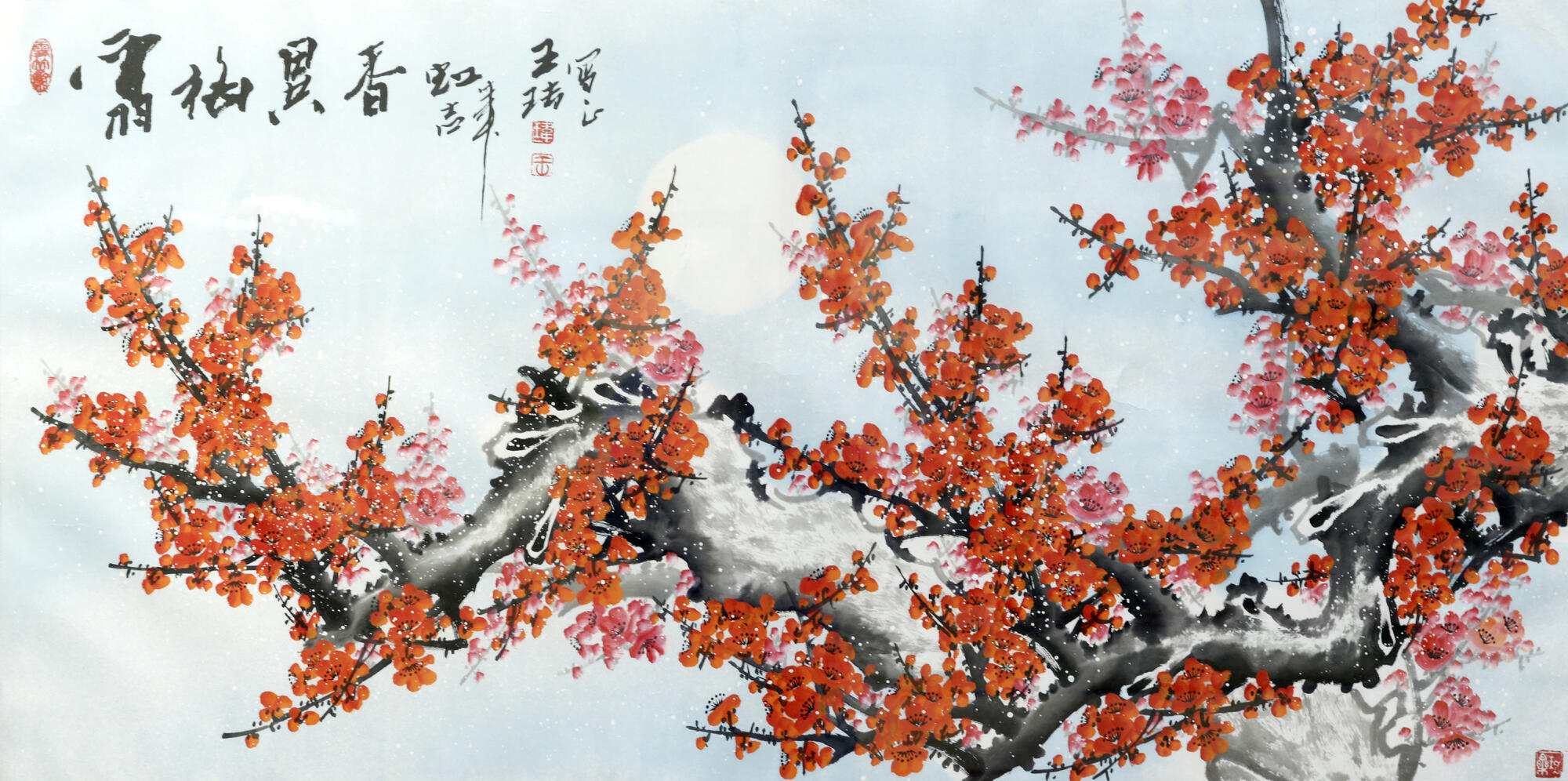


The presented scroll depicts a branch of cherry blossoms against a gray-blue background; the curved gray trunk is covered with thin branches and flowers. In the center of the picture is a stylized image of a white sun against a blue sky. Scroll is on a mount made of light turquoise fabric with floral ornaments. Above, on the left, horizontally, there is an inscription in hieroglyphs and two red seals of the artist.
The Cherry Blossom Festival in China is less known to Europeans than Sakura blossom viewing in Japan, but it is held with the same scope. The season starts in mid-March and lasts about a month. In honor of this event, bloom festivals are held in the parks, and photographs of the gardens are published in the press and personal blogs of numerous visitors. Interestingly, three countries call themselves the birthplace of cherry trees and the tradition of admiring their flowering: Japan, China and South Korea.
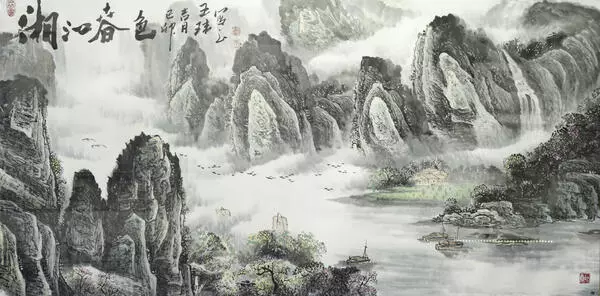
The author of the work is the contemporary Chinese artist Wang Wei, he is the founder of monochrome landscape painting, which uses the tonal possibilities of ink. This is a landscape-picturesque direction, new for the national fine arts.
Admirers of Chinese painting know Wang Wei as a landscape painter. He changed the principles that were used when depicting nature: instead of many trees and rocks, he depicts a soft landscape that combines mountains, air and water.
Chinese painting is inextricably linked with calligraphy, as lines are applied in both. They perform not only contours, but also express the concept of a particular artist, as well as his emotional experiences. Own lines have been developed for various purposes and subjects. They can be curved or straight, soft or hard, dark or paler. Strokes and lines are exactly what makes Chinese painting unique, endows it with inimitable nature.
Traditional Chinese painting is a kind of symbiosis of several arts collected in one work. In ancient times, the clear majority of masters were not just artists, they combined knowledge of calligraphy and poetry.
The work entered the funds of the Amur Regional Museum of Local Lore in 2003 after an exhibition of artists from Beijing.
The Cherry Blossom Festival in China is less known to Europeans than Sakura blossom viewing in Japan, but it is held with the same scope. The season starts in mid-March and lasts about a month. In honor of this event, bloom festivals are held in the parks, and photographs of the gardens are published in the press and personal blogs of numerous visitors. Interestingly, three countries call themselves the birthplace of cherry trees and the tradition of admiring their flowering: Japan, China and South Korea.
The author of the work is the contemporary Chinese artist Wang Wei, he is the founder of monochrome landscape painting, which uses the tonal possibilities of ink. This is a landscape-picturesque direction, new for the national fine arts.
Admirers of Chinese painting know Wang Wei as a landscape painter. He changed the principles that were used when depicting nature: instead of many trees and rocks, he depicts a soft landscape that combines mountains, air and water.
Chinese painting is inextricably linked with calligraphy, as lines are applied in both. They perform not only contours, but also express the concept of a particular artist, as well as his emotional experiences. Own lines have been developed for various purposes and subjects. They can be curved or straight, soft or hard, dark or paler. Strokes and lines are exactly what makes Chinese painting unique, endows it with inimitable nature.
Traditional Chinese painting is a kind of symbiosis of several arts collected in one work. In ancient times, the clear majority of masters were not just artists, they combined knowledge of calligraphy and poetry.
The work entered the funds of the Amur Regional Museum of Local Lore in 2003 after an exhibition of artists from Beijing.