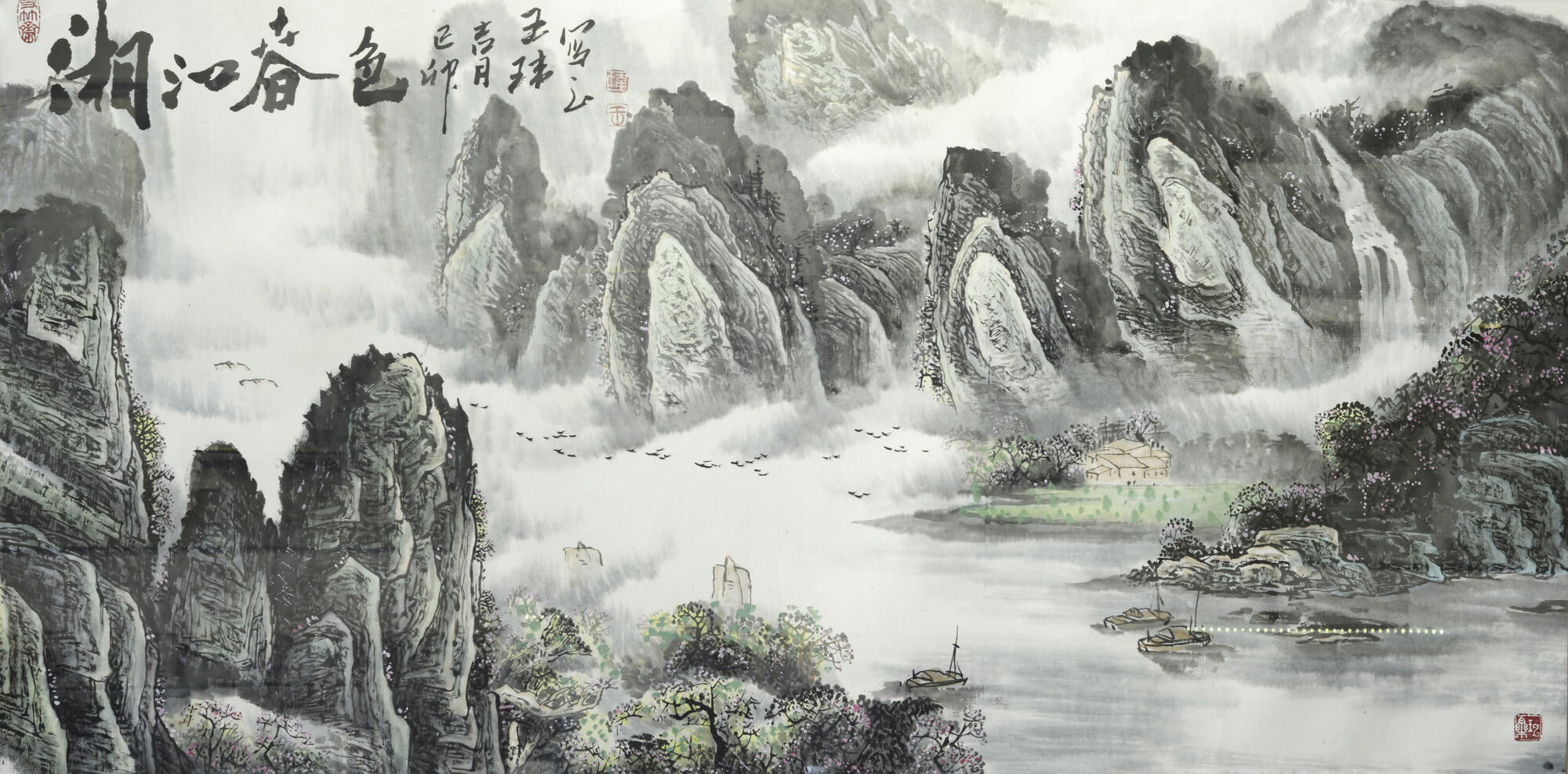


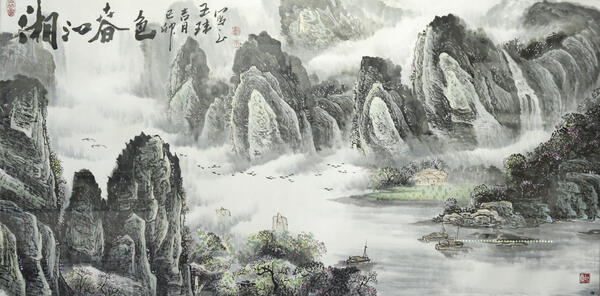
The scroll depicts a reservoir framed by rocks. On the right, on a green island, there are several houses; in the foreground, three boats seem to stand on the mirror-like surface of the river. There is a flowering shrub with pink flowers everywhere on the rocks. Above is the sky with cumulus, which look like a dense white cotton wool falling directly on the mountains. Waterfalls run down from the rocks with a seething roar, filling the river with water from the mountains. Birds fly in a group over the river. The painting is created in cold gray and white colors.
Top left horizontally is an inscription in hieroglyphs and a red seal of the artist, the second is in the lower right corner. The scroll is decorated in a passe-partout of beige fabric with floral ornaments. The author of the work is the contemporary Chinese artist Wang Wei, he is the founder of monochrome landscape painting, which uses the tonal possibilities of ink. This is a landscape-picturesque style, new for the national fine arts.
The work is created in guóhuà tradition- Chinese national painting with paints on a vegetable and mineral basis or black ink on silk and paper scrolls, fans, screens, album sheets. The term ‘guóhuà’ appeared at the turn of the 19th-20th centuries, but the main forms of traditional Chinese painting appeared in the 4th-5th centuries. In the 8th century, various painting styles were formed: careful ‘gongbi’, which recorded even the smallest details and all the details, and free, as if unfinished, ‘xieyi’, which was sometimes called ‘painting of an idea’. The latter gave the viewer the opportunity to fantasize about what the artist put into his work and what he was trying to tell us.
The background in Chinese painting is not filled. The surface of the paper or silk of a painting is considered by painters either as a space of air, or as a surface of water. Scroll paintings in general and their individual details, as a rule, have their own interpretation. In the 9th-10th centuries, the leading place among genres was occupied by landscape — ‘mountains and streams’, which was inextricably linked with poetry and calligraphy. The vast experience accumulated by many generations of outstanding master painters was carefully preserved by descendants.
The pantheistic views of the Chinese associated with the ancient worship of nature — mountains, rivers, lakes, trees — formed the basis of the traditional attitude towards the world. The Chinese have always perceived nature as great, divine and eternally renewing, and human life in comparison with this universe was obscure. Man was a just a small dust in this world, a small but necessary part of it, so he tried to live in harmony and at one with nature, honoring it as a spiritual and aesthetic ideal. In medieval art, the ideas of pantheism were embodied in the traditional genre of landscape, so it is no coincidence that painting became the leading art form at that time.
The scroll entered the Amur Regional Museum of Local Lore in 2003, at the end of the exhibition of Beijing (PRC) artists.
Top left horizontally is an inscription in hieroglyphs and a red seal of the artist, the second is in the lower right corner. The scroll is decorated in a passe-partout of beige fabric with floral ornaments. The author of the work is the contemporary Chinese artist Wang Wei, he is the founder of monochrome landscape painting, which uses the tonal possibilities of ink. This is a landscape-picturesque style, new for the national fine arts.
The work is created in guóhuà tradition- Chinese national painting with paints on a vegetable and mineral basis or black ink on silk and paper scrolls, fans, screens, album sheets. The term ‘guóhuà’ appeared at the turn of the 19th-20th centuries, but the main forms of traditional Chinese painting appeared in the 4th-5th centuries. In the 8th century, various painting styles were formed: careful ‘gongbi’, which recorded even the smallest details and all the details, and free, as if unfinished, ‘xieyi’, which was sometimes called ‘painting of an idea’. The latter gave the viewer the opportunity to fantasize about what the artist put into his work and what he was trying to tell us.
The background in Chinese painting is not filled. The surface of the paper or silk of a painting is considered by painters either as a space of air, or as a surface of water. Scroll paintings in general and their individual details, as a rule, have their own interpretation. In the 9th-10th centuries, the leading place among genres was occupied by landscape — ‘mountains and streams’, which was inextricably linked with poetry and calligraphy. The vast experience accumulated by many generations of outstanding master painters was carefully preserved by descendants.
The pantheistic views of the Chinese associated with the ancient worship of nature — mountains, rivers, lakes, trees — formed the basis of the traditional attitude towards the world. The Chinese have always perceived nature as great, divine and eternally renewing, and human life in comparison with this universe was obscure. Man was a just a small dust in this world, a small but necessary part of it, so he tried to live in harmony and at one with nature, honoring it as a spiritual and aesthetic ideal. In medieval art, the ideas of pantheism were embodied in the traditional genre of landscape, so it is no coincidence that painting became the leading art form at that time.
The scroll entered the Amur Regional Museum of Local Lore in 2003, at the end of the exhibition of Beijing (PRC) artists.