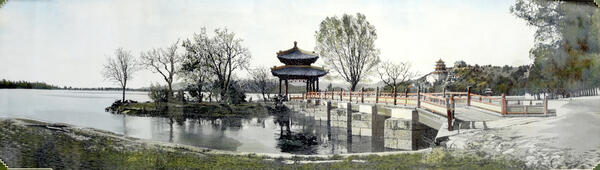
The panel is made in the technique of satin stich embroidery. It depicts a summer city landscape, in the center of which is a lake with an island connected to the shore by a stone bridge. On the island, there is a gazebo with a traditional Chinese figured roof on supports, trees and shrubs grow. On the right, on the shore, a pagoda and several buildings are barely visible. A red-railed bridge stands on massive stone bulls. On the left is the far shore of the lake with a strip of green. The water reflects the sky, dark tree trunks and the roof of the gazebo. The panel is fixed on a plywood backing under glass in a wide frame.
China is the first country in the world to use silk. According to legend, the wife of the emperor was drinking tea in the garden when a silkworm cocoon fell into her cup. In the hot drink, a thread stretched out of the cocoon, the length of which made it possible to walk around the palace. Since then, Empress Su Ling Chi, who discovered the secret of the silk thread, is considered a deity in China. Those who wanted to take the cocoons out of the country were executed as criminals.
In medieval France, Marquise de Pompadour introduced the fashion for silk bedding, and the Emperor Charlemagne raised the country’s economy by producing silk in Rouen and Lyon.
The making of silk thread and fabric led to the development of Chinese embroidery. This traditional applied art appeared in the country more than 2000 years ago. The embroidery technique is based on the use of non-twisted threads. At the same time, it is required to observe the accuracy and pinpoint precision of each stitch, such work is given only to craftswomen with solid experience. There are four main styles of Chinese silk embroidery, and they developed in different regions of the country based on local traditions. One of them is famous for its contrasts of black and white tones with transitions to gray shades, which gives the canvas a three-dimensional effect. The other is called “free stitch” and is characterized by its colors and stitches of different lengths and directions — such embroidery has received the highest recognition all over the world. For each silk panel, the threads were dyed separately.
Nowadays, Suzhou needlewomen are engaged in silk embroidery on an industrial scale, and their products are highly valued by tourists. In ancient times, such embroidery was available only to rich people. They were used to decorate the interiors of palaces and the clothes of the nobility. But time passed, and beautiful embroidered items came into the life of ordinary Chinese, filled with stories from fairy tales, myths, legends about beautiful women and kind dragons.
The panel was received by the Amur Regional Museum of Local Lore in 1958 from the Amur Regional Committee of the CPSU and the Regional Executive Committee.
China is the first country in the world to use silk. According to legend, the wife of the emperor was drinking tea in the garden when a silkworm cocoon fell into her cup. In the hot drink, a thread stretched out of the cocoon, the length of which made it possible to walk around the palace. Since then, Empress Su Ling Chi, who discovered the secret of the silk thread, is considered a deity in China. Those who wanted to take the cocoons out of the country were executed as criminals.
In medieval France, Marquise de Pompadour introduced the fashion for silk bedding, and the Emperor Charlemagne raised the country’s economy by producing silk in Rouen and Lyon.
The making of silk thread and fabric led to the development of Chinese embroidery. This traditional applied art appeared in the country more than 2000 years ago. The embroidery technique is based on the use of non-twisted threads. At the same time, it is required to observe the accuracy and pinpoint precision of each stitch, such work is given only to craftswomen with solid experience. There are four main styles of Chinese silk embroidery, and they developed in different regions of the country based on local traditions. One of them is famous for its contrasts of black and white tones with transitions to gray shades, which gives the canvas a three-dimensional effect. The other is called “free stitch” and is characterized by its colors and stitches of different lengths and directions — such embroidery has received the highest recognition all over the world. For each silk panel, the threads were dyed separately.
Nowadays, Suzhou needlewomen are engaged in silk embroidery on an industrial scale, and their products are highly valued by tourists. In ancient times, such embroidery was available only to rich people. They were used to decorate the interiors of palaces and the clothes of the nobility. But time passed, and beautiful embroidered items came into the life of ordinary Chinese, filled with stories from fairy tales, myths, legends about beautiful women and kind dragons.
The panel was received by the Amur Regional Museum of Local Lore in 1958 from the Amur Regional Committee of the CPSU and the Regional Executive Committee.