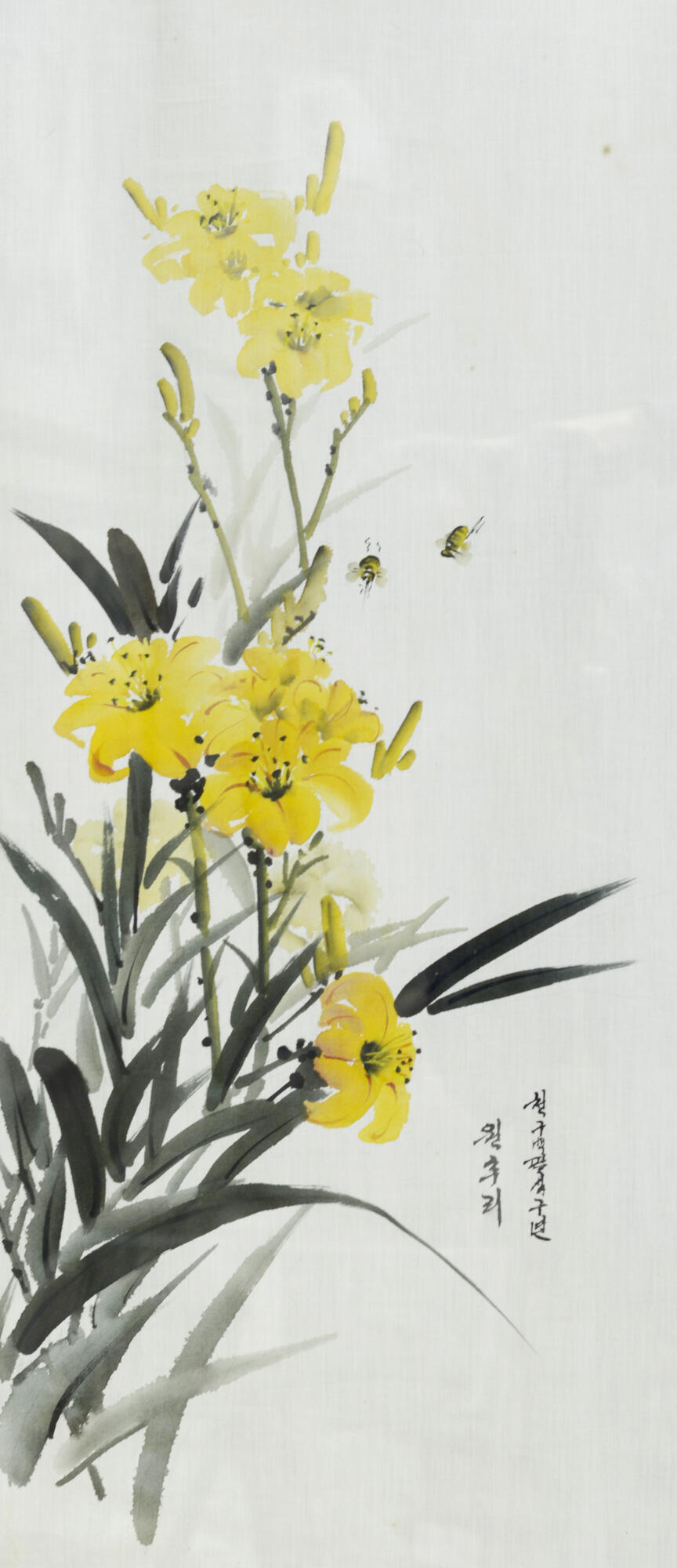


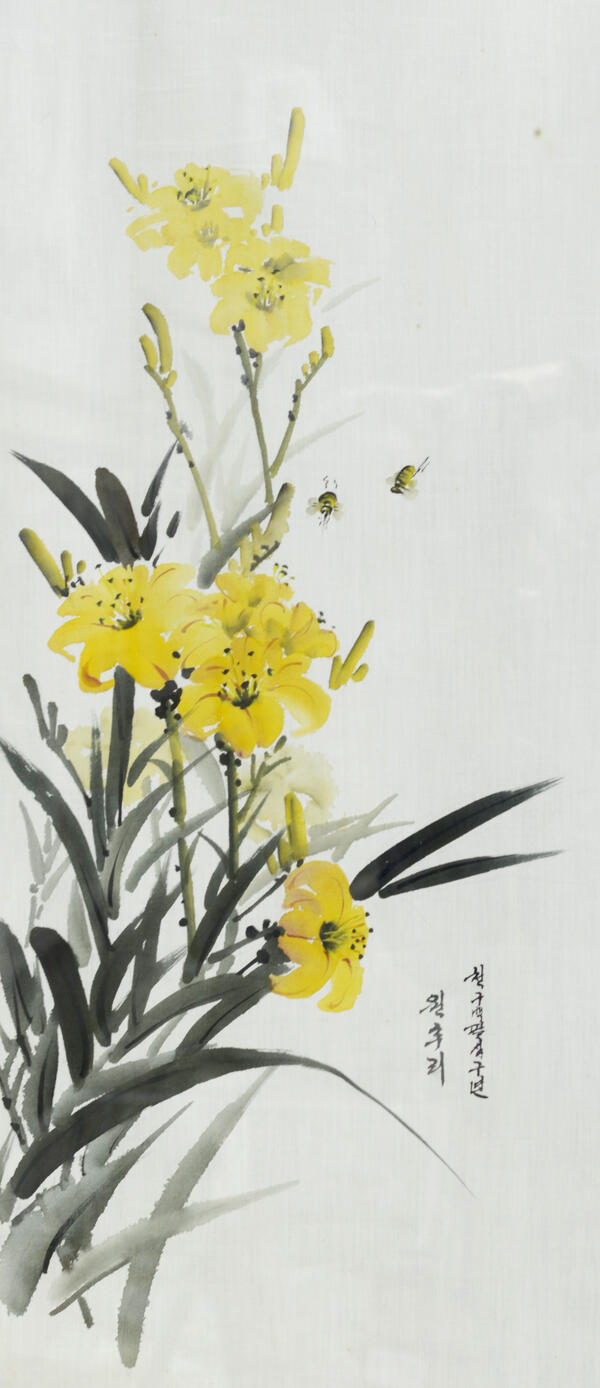
In 1990, an exhibition of decorative and applied arts of North Korea was held in the Amur Regional Museum of Local Lore. After its closure, the museum was presented with books, albums, photo cards and scrolls, among which was ‘Blooming lily and the bees’.
The scroll features yellow lilies framed by dark leaves and two bees on a white background. In the foreground, the flowers are depicted very clearly. On the right is the inscription in Korean. The framing of the picture is rectangular, under the picture there is a stamp — Democratic People’s Republic of Korea.
It is generally accepted that Korean painting found its nature during the Goryeo Dynasty (918-1392). Back then, two directions appeared in the works of Korean artists: the first mainly depicted nature, the adherents of the second specialized in people and their characteristics. Since Korean painting was influenced by China, which was more developed in this regard, the main genres of painting were transferred from there. But, at the same time, the genres were reworked, considering the peculiarities of the perception of the surrounding world by Koreans. It is generally accepted that such a genre as “flowers and birds” was supplemented in Korea with images of the inhabitants of the sea and insects.
It is important to understand that the painting style of the Korean masters was different from that of their Chinese colleagues. The methods of representation were linear, but there was a kind of perspective in the landscapes, that is, the image could not be considered completely flat. This painting can now be found everywhere. Wealthy people try to decorate their homes with similar paintings. In landscapes, Korean artists did not reflect abstract nature, transferred from imagination to canvas, but quite specific views of their native country.
Painting in Korea can be described as a type of artistic culture with its own characteristics. Firstly, painting is not done on plain paper, since paper does not absorb paint well, and the work sometimes does not turn out very successful, therefore, for a long time, Koreans painted on thin silk or on very thin paper. Secondly, painters use black ink with white shades, watercolors, as well as lines, unlike European painters who use brush strokes. Thirdly, Korean painters create a special combination of colors: they are used to painting so that black paint shows shadows, and green paint, for example, saturation.
Fourth, Korean artists are good at conveying spiritual wealth and people’s feelings through images.
Already in the ancient times, an academy of painting appeared in Korea, where artists improved their level and local nobility studied. Masters painted landscapes, portraits, often depicted animals and plants: plum tree, bamboo, orchid, which symbolized virtues.
The scroll features yellow lilies framed by dark leaves and two bees on a white background. In the foreground, the flowers are depicted very clearly. On the right is the inscription in Korean. The framing of the picture is rectangular, under the picture there is a stamp — Democratic People’s Republic of Korea.
It is generally accepted that Korean painting found its nature during the Goryeo Dynasty (918-1392). Back then, two directions appeared in the works of Korean artists: the first mainly depicted nature, the adherents of the second specialized in people and their characteristics. Since Korean painting was influenced by China, which was more developed in this regard, the main genres of painting were transferred from there. But, at the same time, the genres were reworked, considering the peculiarities of the perception of the surrounding world by Koreans. It is generally accepted that such a genre as “flowers and birds” was supplemented in Korea with images of the inhabitants of the sea and insects.
It is important to understand that the painting style of the Korean masters was different from that of their Chinese colleagues. The methods of representation were linear, but there was a kind of perspective in the landscapes, that is, the image could not be considered completely flat. This painting can now be found everywhere. Wealthy people try to decorate their homes with similar paintings. In landscapes, Korean artists did not reflect abstract nature, transferred from imagination to canvas, but quite specific views of their native country.
Painting in Korea can be described as a type of artistic culture with its own characteristics. Firstly, painting is not done on plain paper, since paper does not absorb paint well, and the work sometimes does not turn out very successful, therefore, for a long time, Koreans painted on thin silk or on very thin paper. Secondly, painters use black ink with white shades, watercolors, as well as lines, unlike European painters who use brush strokes. Thirdly, Korean painters create a special combination of colors: they are used to painting so that black paint shows shadows, and green paint, for example, saturation.
Fourth, Korean artists are good at conveying spiritual wealth and people’s feelings through images.
Already in the ancient times, an academy of painting appeared in Korea, where artists improved their level and local nobility studied. Masters painted landscapes, portraits, often depicted animals and plants: plum tree, bamboo, orchid, which symbolized virtues.