Font
Color
Graphics
Изображение точки

To see AR mode in action:

1. Install ARTEFACT app for iOS or Android;

2. Find the exhibition «The Indigenous People: Lifeways and Trades»

3. Push the «Augmented reality» button and point your phone's camera at the exhibit;

Скрыть точки интересаПоказать точки интереса

Iron,Jug,Smok,Stirrup,Flax,Bridle,horses,Rubel

0
Open in app
#1

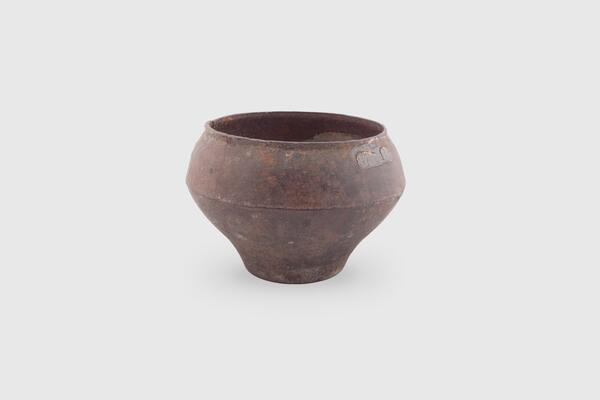
Cast iron casserole dish

#2

In the second half of the 19th— early 20thcenturies, the Shors used wooden, birch bark, clay, and metal kitchen utensils for storing food and cooking in the oven and in the hearth. The latter included all kinds of frying pans and kettles, pokers and grips that could be purchased or made.

To cook food over a fire, the ingredients placed in a cast iron casserole dish, which was placed in the oven or on a metal tripod over the fire. A grip was used to move it.

Cast iron is a durable material that resists corrosion and overheating, although it can crack due to a sudden temperature change or accidental mechanical damage. Cast iron cookware heats up quickly and evenly and retains heat for a long time, so food simmers in it, retaining its beneficial properties, and does not become burned.

Cast iron casserole dishes were used to stew potatoes, rutabaga, beets, carrots, cabbage (since the beginning of the 20thcentury they were grown near the house), simmered blood sausage, steamed viburnum, currant, and meadowsweet leaves. Round “kalash” bread was baked on another cast iron product — a frying pan.

In the first half of the 20thcentury, cast iron braziers came into use in Shor households near cities and large settlements. Local blacksmiths made parts of grips, tripods, frying pans and other metalware commissioned by the locals.

In his monograph “Gornaya Shoria. Historical and Ethnographic Essays”, Valery Makarovich Kimeyev and Alexander Ivanovich Kopytov also describe other cast iron products popular with the Shor people. Those include, in addition to the items already mentioned, “goose casserole dishes… and washstands. Until now, the Shors use flat koorgush cauldrons and deep cauldrons, frying pans, kapkysh grips, kosege pokers, teapots, and handicraft samovars.” “Roche” vessels were also mentioned — they look like jugs with a high neck and “components of a moonshine still.”

As trade in Siberian cities developed, the products of the Abazinsky, Guryevsk and Tomsk metallurgical plants began to appear at fairs.

The exhibited cast iron casserole dish was brought to the museum from an expedition to the Shor village of Uchas, Orton territorial administration.
#3
Name: Cast iron casserole dish
№: 25458764
Date of creation: the first half of the 20th century
Place of creation: Gornaya Shoria, Russia
Technique: cast iron, handicraft
Dimensions: 11,5×13,5×11,5 cm
#4
Milk jug
#5

Places unsuitable for grazing and haymaking (and therefore for storing feed for the winter) did not allow the Shors to develop cattle breeding. Only short horses and cows were bred, and dairy products were often exchanged with neighbors who were more prosperous in this regard, for example the Khakass.

Nevertheless, milk has long played an important role in Shor cuisine. It was added to the broth, and the roots of edible wild plants were boiled in it. A nutritious drink was prepared based on milk with the addition of roasted barley talkan.“They took the mixture with them when hunting, drank it periodically, and a feeling of fullness quickly set in, ”old-timers recall.“And talkan… helped out during the war… Entire villages drank it.”

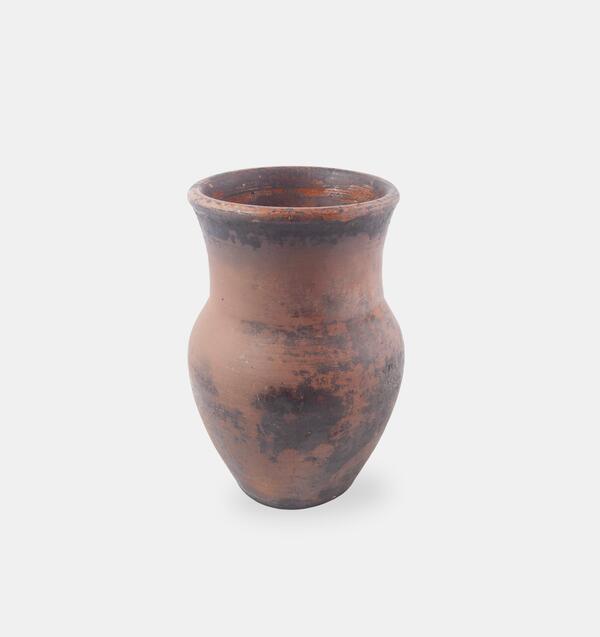
Housewives collected milk into buckets — wide-necked vessels made of clay, wood or copper, and then filtered and stored in clay jugs. This kitchen utensil, common in villages, is shaped like a jug without a handle or a lid, with walls that flare upward and a tapering neck that smoothly turns into a rounded body.

The shape of the neck, its diameter, as well as the height of the entire jug, were made in such a way that the vessel could be comfortably taken with one hand. At the same time, the neck was not too narrow so that the housewife had the opportunity to thoroughly wash the inside of the jug.

In addition to talkan, other national drinks were also stored in jugs: abyrtka (a low-alcohol drink brewed from talkan) and kvass. As a rule, instead of lids, these vessels were covered with gauze or a thin canvas cloth.

Milk in such containers was not only stored for a long time, but also acquired new qualities. The flat bottom made it possible to conveniently position the jug in the oven: there the milk simmered without burning until a characteristic beige or light brown hue appeared. The most delicious part was the foam that formed on the surface.

In the narrow part of the vessel, the cream settled well, became dense and thick, and was easily removed with a spoon. From such cream butter was churned.

The milk jug presented in the exhibition was brought by museum employees from the remote Shor village of Uchas, which is part of the Orton territorial administration.
#6
Name: Milk jug
№: 36728027
Date of creation: the mid-20th century
Place of creation: Kemerovo Oblast, the USSR
Technique: clay; firing, handmade
Dimensions: 21×12×20,5 cm
#10
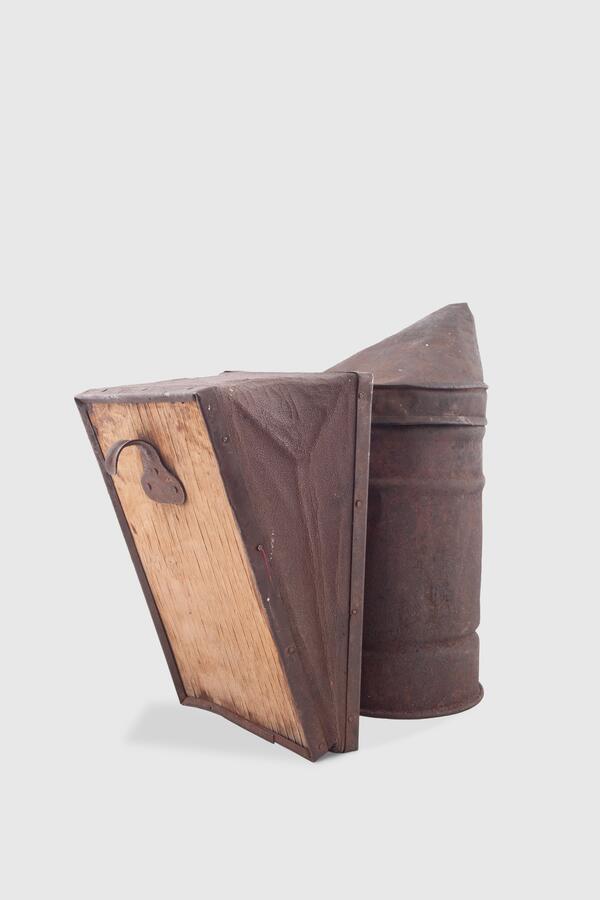
Bee smoker
#11

Beekeeping was widely practiced in the region inhabited by the Shors. The largest apiaries were in the lower reaches of the Kondoma River and its tributary the Antrop — they could consist of up to 1,000 hives. In the 19thcentury, the Altai missionary and ethnographer, Archpriest Vasily Ivanovich Verbitsky, noted that mountains “that were covered with shrubs: meadowsweet, acacia, raspberries, lush plants about the size of a person, mainly fireweed, produce a lot of white, aromatic honey.”

The Shors built beehives near their uluses: in lowlands near reservoirs, as well as on the sunny hill and mountain slopes sheltered from prevailing winds. Dry branches and poles wrapped in birch bark were surrounded by pole fences. They were placed at some distance from each other to attract bee swarms.

In addition, the Shors also practiced honey hunting or honey harvesting in the taiga: they gathered honey from wild bee colonies as well as from domestic bees that had left the man-made hives. According to Verbitsky, “up to 20 nests of these wandering bees” could be found in the spring. Such hives were considered perfect for producing offspring.

During winter, the hives were put away into an “omshanik” — a log house with each wall consisting of seven or eight horizontal logs. The structure was “sunk” into the ground and had a sod roof. A few hives were kept directly in the basement or in other clean utility rooms.

Russian settlers introduced beekeeping in the territories along the Tom River. In the first half of the 20thcentury, the indigenous people used their methods and devices to keep bees and collect the products of the hives. A bee smoker was an indispensable device known since ancient times. It was used in beekeeping to calm honeybees when inspecting the hive.

During a beekeeper’s inspection, the bees experience anxiety and release an alarm pheromone to alert others and to signal an attack. Two or three big puffs of smoke spread in all directions through the hive, disorient the insects and stimulate them to consume as much honey as possible in case the fire forces them to abandon the hive.

The smoker was commonly designed as a tin cylinder with bellows and a lid that tapered to a small gap at the top. The cylinder was filled with rotten wood: unlike fresh wood, it produced a lot of cool smoke. The bellows ensured that the fuel in the smoker’s burner would continue smoldering.

Having opened the nest box or hive, the beekeeper fumigated the bees and used a knife to cut away a full portion of the honeycombs in the middle. However, the honeycombs next to the walls remained untouched — they stored bee bread (pollen) and included cells with larvae.

Some Shor families might use a smoldering piece of rotten wood instead of the smoker.

#12
Name: Bee smoker
№: 36727993
Date of creation: 1959
Place of creation: Taganrog, the USSR
Technique: metal
Dimensions: 21×23×11,5 cm
#7
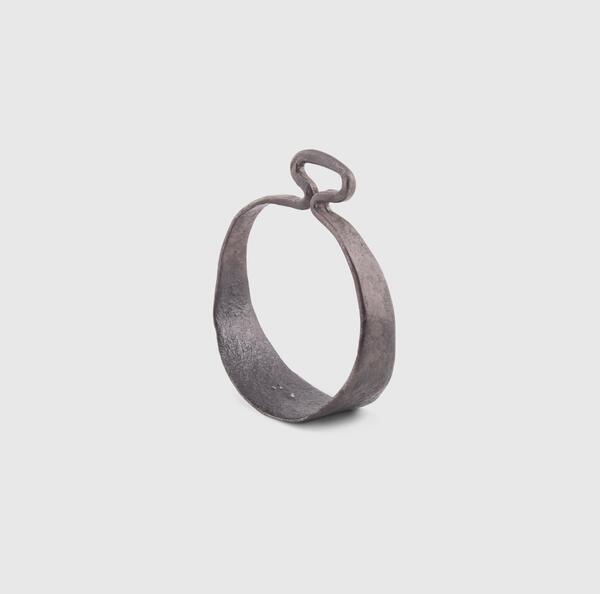
“Agash izene” stirrup
#8

Stirrups are a pair of devices that help the rider mount a horse and maintain balance while riding. These are iron loops with a base, suspended by straps from the saddle to support the rider’s feet.

Stirrups were invented in the 4thcentury by nomads and quickly spread throughout the world. With stirrups, the rider could deliver saber blows and shoot bows more accurately. This allowed the nomads to change the tactics and strategy of military operations as well as the weapons.

Stirrups have two serious disadvantages. Firstly, their design is such that if a rider falls, his leg is trapped regardless of his skills and experience.

If the stirrup is poorly fitted (the stirrup is too wide and the rider’s foot slips through or it is too narrow and it is difficult to release the foot), then the risk of serious injury in the case of falling increases significantly.

The second disadvantage is that excessive stress on the foot in the stirrup while riding can lead to muscle and tendon damage, and eventually to deformation of the rider’s feet. Therefore, if a rider needs to stay in the saddle for a long time, stirrups with a wider base are used.

In the 19thand 20thcenturies, 90% of the Shors in Gornaya Shoria had horses, which were used as riding and draft animals. The Shors from remote uluses still use horses as a means of transportation.

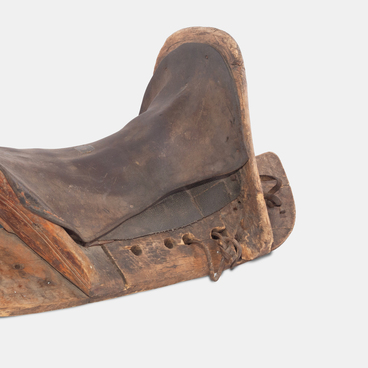
To determine the elements of horse equipment, the researchers of the transport culture of the Shors D.V. Emelyanov and I.I. Nazarov studied documentary photographs taken in the first half of the 20thcentury by G.I. Ivanov. Apart from people, there is a horse in the photo “Shor Family at the Yurt”. Based on those photographs, Emelyanov and Nazarov concluded that the usual horse equipment of the Shors included a bridle, consisting of “a forehead, cheek, and chin straps, as well as bits and reins”; a wooden saddle with a felt padding, a girth and a chest strap; harnesses with iron stirrups, which the Shors called “agash izene”.

The horse equipment of other peoples of the Northern Altai looked similar.

#9
Name: “Agash izene” stirrup
№: 36867039
Date of creation: the early 20th century
Place of creation: Kuznetsk, the Russian Empire
Technique: iron, forging

Dimensions: 15×13×4,5 cm

#13
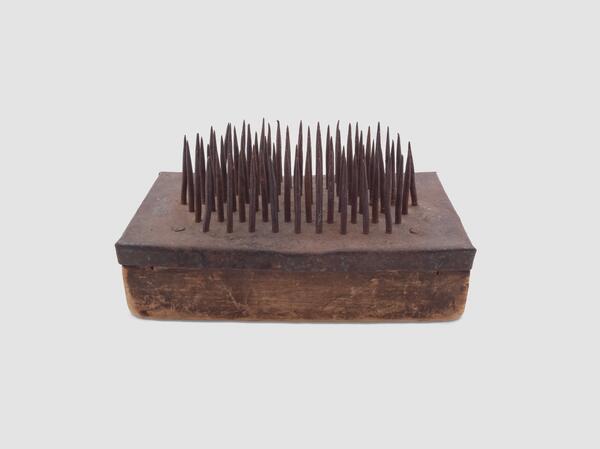
Flax heckling comb
#14

The taiga Shors have long collected kendyr (hemp and nettle), but under the influence of their Russian neighbors they began to grow hemp along with wheat and barley, using the slash-and-burn method of agriculture. Hand-picked and dried kendyr stems (“pipes”) were broken in half, the fiber was peeled off with hands and teeth, the “kylysh” was scutched with wooden boards and tied into “tudam” bundles. They were placed in “ulan kendyr” birch bark boxes and sprinkled with barley chaff to prevent tangling. Then the fibers were joined ​​into threads, wound into tubes, and bleached in boiling water with birch and aspen bark. This was the end of the preparation for spinning.

In the 19thcentury, flax growing began to actively develop in the south of Western Siberia, and at the same time distaffs and flax heckling combs necessary for processing this product came into use among locals.

The southern Shors tried but failed to grow flax due to difficult natural conditions and primitive methods of cultivating the land. However, the tools and technology of flax production turned out to be suitable for scutching kendyr — nettle and hemp.

Shor women did the heckling in winter. The fibers were placed between the teeth of the brush and pulled through them several times. Each time, coarse fibers remained on the brush, which were not thrown away, but were used to create lower quality threads or weave ropes.

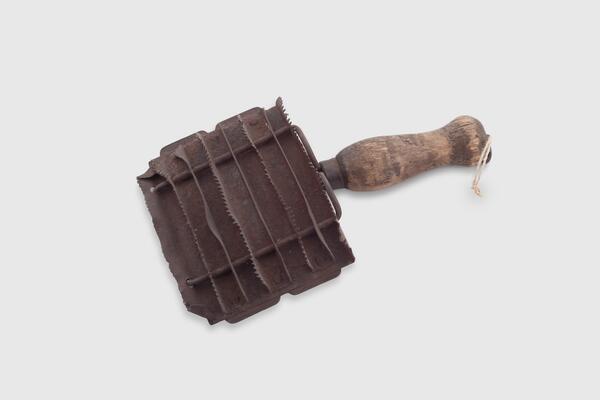
The fibers were divided into short, medium, and long ones: the longer the fiber, the thinner the yarn and the better the quality of the fabric woven on primitive kendyr-tabeg looms. The presented comb, or iron brush, was intended for the first, rough combing.

In Rus, heckling combs have been used since the 11th–12thcenturies, as evidenced by archaeological finds. The in-demand profession of a comber probably appeared at the same time. In different areas, wool and plant fibers were combed with varying degrees of care. It is believed that repeated combing was characteristic only of the Middle Volga and northeastern governorates of Russia.

#15
Name: Flax heckling comb
№: 
Date of creation: the mid-20th century
Place of creation: Gornaya Shoria, the USSR
Technique: wood, leather

Dimensions: 10,5×20×12 cm

#16
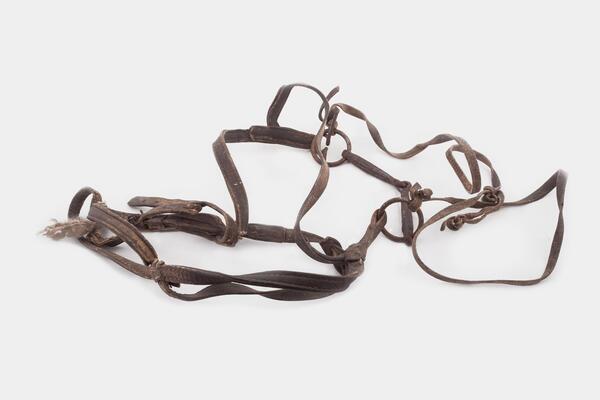
Bridle
#17

In his article “Traditional Means of Transportation of the Turkic Peoples of Sayano-Altai in the 19th–20thcenturies”, the ethnographer Artur Alekseyevich Kyrzhinakov divided the transportation means of the indigenous population of Siberia into water (dugout boats and rafts) and land ones, including sledges and skis (runner), sleighs and carts (harness) and pack-riding. While sledges and water vehicles were most common in the mountain-taiga regions, the people living in the mountain-steppe zone preferred to travel on horseback.

Apart from the Tuvan reindeer herders, most Turkic peoples bred and rode horses.

Depending on the time of year and road conditions, the Shors harnessed horses to a sleigh, cart or sled to transport hay, logs for building houses and various cargoes. In winter, cattle were kept in an open pen or under a shed made of poles with hay piled on the roof. The horses were fed twice a day, in the morning and evening. During snowy winters, the animals quenched their thirst with snow and fed directly from the haystacks in the yard, trampling down most of the hay.

The Shors learnt to make harnesses from Russian peasants. When transporting cargo, a person sat on a horse or led it behind him by a chugen (sugen) bridle made of narrow leather straps.

The nose strap prevents the horse from opening its mouth wide; the cheekpiece supports the mouthpiece. The throat latch strap passes under the rear corners of the horse’s jaw, and the headpiece goes behind its ears. There is a forehead strap on the animal’s forehead. It is usually adorned with braids and other decorations.

The bit and bridle are the main elements of controlling the horse. The bit is needed to manipulate the toothless edge of the horse’s mouth. The bridle that is attached with iron rings supports the bit and transmits the rider’s commands to the horse. Sometimes the Shors made do with only a halter made of rawhide belts or one woven from horsehair.

After each use, a good owner washed the bits, made of iron, with water and hung the bridle to dry on a special hook. From time to time, the headband also required washing with soap and water and lubricating with special care products, without which the leather could dry out and crack.

#18
Name: Bridle
№: 36728000
Date of creation: the first half of the 20th century
Place of creation: Gornaya Shoria, Russia
Technique: leather, metal

Dimensions: 60×2×0,5 cm

#19
Winter horseshoe
#20

Horses were the first type of livestock in the northern Shor economy. They were used mainly for riding and pulling wheeled vehicles. Wealthy traders who were interested in delivering goods were the first to appreciate the advantages of this means of transportation. As for the southern Shoria, horses were brought there later.

The Soviet ethnographer Leonid Pavlovich Potapov noted that horses were mainly used in the autumn, when it was necessary to transport hunting supplies to the temporary houses in the taiga or deliver bags of pine nuts back to the village. The elements of the Shor harness were neither particularly beautiful nor reliable.

However, breeders took horseshoes seriously. According to Tatyana Viktorovna Mayorova, at the beginning of the 20thcentury, in Kuznetsk alone there were “13 private forges, where [among other things] they forged horseshoes and horseshoe nails.” The Shor word for a horseshoe is “takka”; the past participle is “takkalyg”; the verb is “takkala”.

A horseshoe that protects a horse’s hooves is a flat piece of mild steel, processed and bent to fit the shape of the “sole” of the hoof.

The hooves of wild horses become hard enough since the animals are very active and able to choose the road and avoid obstacles such as sharp stones. Domestic horses have limited physical activity, and they must tread on a variety of surfaces, often while carrying a load.

All these conditions lead to rapid wear of the hoof, as well as cracks, and penetration of dirt and pathogens. As a result, the horse begins to experience pain when walking and it starts to lame until it refuses to move at all. Horseshoes can prevent such injuries and help the horse tread easily even on hard roads.

To attach horseshoes to the hooves, horseshoe nails are used. Such a nail consists of a neck, a head, a pin (or blade) and a point with a bevel, so that the nail would come out of the horseshoe at the intended height. The surface of the nail is smooth, without roughness or irregularities.

The horseshoe has the outer and inner part, the upper (adjacent to the hoof) and lower (facing the ground) surfaces, the outer and inner edges.

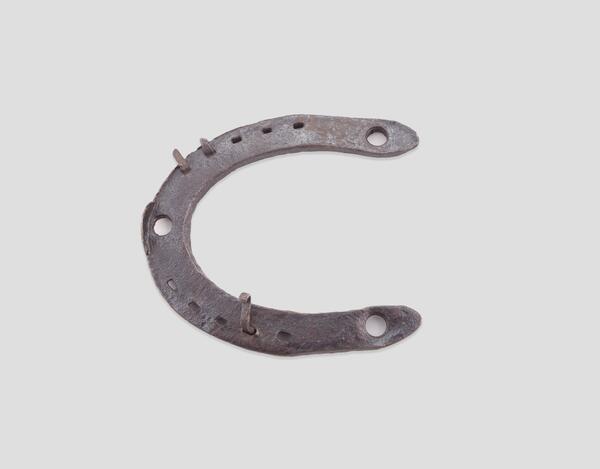
The museum exhibit features a thick winter metal horseshoe with replaceable screw-in studs for the horse’s hind leg.

#21
Name: Winter horseshoe
№: 
Date of creation: 1929–1945
Place of creation: the USSR
Technique: metal, forging

Dimensions: 12,5×12×0,5 cm

#22
Horsehair rope
#23

The Shors belong to the indigenous Turkic-speaking peoples of Southern Siberia, who have lived in the Kemerovo region, the Republic of Khakassia, and the Altai Territory. Historically, there were two ethnic groups: the Aba, who were farmers and cattle breeders and inhabited the forest-steppe, and the mountain-taiga Shors, who mainly practiced fishing, gathering, hunting, and various crafts, including weaving, dressing leather and carving horns.

The tallgrass, which sometimes is as tall as a rider on horseback, does not supply enough nutrients; there are mosquitoes, midges, horse flies, and gadflies galore; the summers are short — all this did not contribute to the development of cattle breeding, so the Shors used to keep only small numbers of cows and sheep. However, short, hardy horse breeds were commonly used for riding, and horsehair was suitable for many household needs.

The historian and archaeologist Dmitry Evgenyevich Kichigin claims that horsehair is one of the three most common natural materials used by the peoples of the Cis-Baikal region, along with wild nettle (or hemp) and tendons. Horsehair was used for sewing together and making nets, seines, lassos, reins, crossbow strings, as well as for fastening birch bark objects. According to the scientist, horsehair began to be used in the Cis-Baikal region no later than the end of the Bronze Age, and “the possibility of obtaining horsehair from a wild horse at an even earlier time” cannot be ruled out.

The Siberian ethnographer Vatslav Leopoldovich Seroshevsky noted that products made from this material are durable, “light, strong, dry quickly, and do not decay much.” The specific strength and stiffness of horsehair can be compared to those of steel wire with the same diameter.

To make ropes, horses’ manes and tails are cut. Dmitry Kichigin cites Viktor Butanov and Vyacheslav Darzh and describes two methods of weaving that different indigenous peoples have. The Tuvans have a simple practice of knotting a thread from several hairs, folding it in half and twisting a thin cord. The Khakass first twist strands of hair into rings, moisten and connect ​​their ends; then women twist the threads in their palms, and the men make lassos.

Such ropes were used not only in everyday life, but also in shamanic rituals — they served as amulets and helped summon and capture evil spirits.

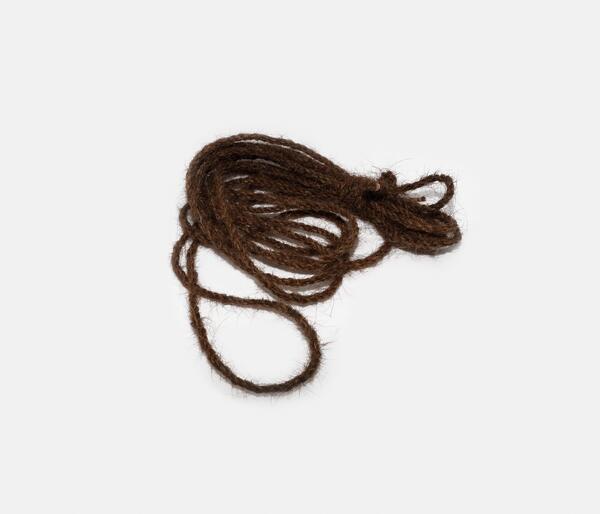
The horsehair rope that is on display at the museum is made from two thinner horsehair ropes that are mostly light yellow and gray, with some parts being black. The ends of the ropes are woven together.

#24
Name: Horsehair rope
№:
Date of creation: the early 20th century
Place of creation: Tomsk Governorate, the Russian Empire
Technique: horsehair

Dimensions: 200×3 cm

#25
Horse sweat scraper
#26

Deer were the first riding animals domesticated by the ancestors of the Shors. Researchers find evidence of this in legends and elements of shamanic practices. Shamanic drums were considered a symbolic horse, transporting to the world of spirits; in the Shor culture, those horses, as well as the “heavenly horses” of the spirits themselves, were the deer. Over time, they were replaced by horses, although from the modern point of view, horse breeding was not particularly widespread in the Shor communities.

The Russian and German traveler, ethnographer, and naturalist Johann Gottlieb (Ivan Ivanovich) Georgi wrote that the Shors, like the Aba people,“have… small cattle breeding, and feed mostly on wild animals and wild plants.”

However, in the late 19thand early 20thcenturies, horse breeding was practiced by the taiga Shors who had already settled down. The most suitable places were the valleys of the lower reaches of the Kondoma River and the middle reaches of the Mrassu River.

Horses were used for riding and transporting loads on sleds, such as hay or bags of pine nuts, as well as for delivering hunting supplies to temporary houses in the autumn. During the winter, animals were placed in pens near their homes.

Domestic horses, unlike wild ones, require constant grooming and people taking care of their coat, mane, and hooves. Working animals should be given daily dry brushing and periodic bathing. Extra attention should be paid to the areas under tack. Sebum and sweat are secreted through the skin glands and form a layer on the surface of the skin that makes sweating difficult and prevents the skin from breathing normally.

Special brushes and scrapers are used to clean the horse and remove dead hairs, dust and dirt particles.

Grooming starts with the horse’s head, followed by the neck, front legs, shoulders, body, croup, and the hind legs. Regular dirt is removed with a brush. A metal scraper is used to clean the brush and remove dirt from the muscular parts of the body and neck. In addition to its main purpose, it functions as a massage tool. Scrapers come in a variety of shapes; the number and rows of bristles differ as well. The Shors borrowed the practice of using this tool from the Russians.

The mane, which protects the animal’s neck and head from blood-sucking insects, also requires care. First, groomers comb it with their hands, removing large particles of detritus and grass, and only then they begin to brush it with a comb, starting with the ends and only then combing from the

#27
Name: Horse sweat scraper
№: 36866724
Date of creation: the first half of the 20th century
Place of creation: Russia
Technique: wood, metal

Dimensions: 20,5×13×3 cm

#28
Rubel
#29

Before irons came into use, homespun, linen and hemp towels, tablecloths and other household items were treated after washing with a rubel. Without this, the fabric became rough and creased.

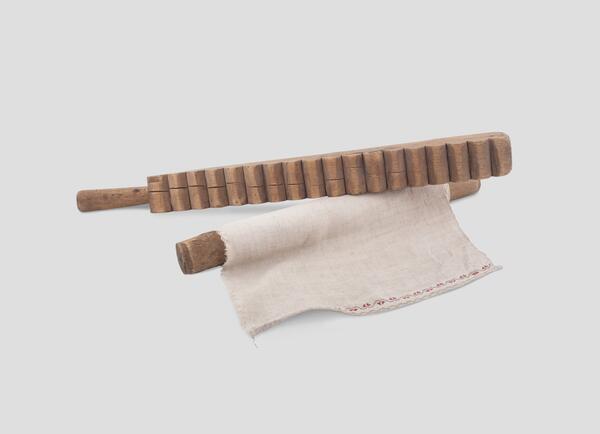
A rubel is a long wooden board with cut-out transverse grooves. The wooden blank was processed manually: the ends of the rubel were smoothed, the sharp corners on the edges were rounded using a file. The handle was carved from the same blank. Rounded notches were cut across on one side of the board, the other was left smooth, and sometimes decorated with intricate carvings. A rubel was used along with a roller — a smooth wooden cylinder with a diameter of 4–6 centimeters and a length of about 80 centimeters. Sometimes an ordinary kitchen rolling pin was used instead.

After washing and rinsing, the Shors wrung out the linen and wound onto a roller, trying to fit its size. Then the rubel was rolled with force along the resulting roll several times with the jagged side. With this mechanical method of ironing, not only was the water squeezed out of the washed item, but at the same time the small remaining pieces of dirt were expelled.

The rubel is also known as a musical instrument. In the old days, artisans left a hollow space in its handle and put dried peas inside: in the Russian North there was a belief that the rumble during operation drives evil spirits away. Over time, the sound of the rubel began to be used outside of the ritual space.

The musical rubel, unlike the household rubel, is made somewhat shorter, completely hollow, and the notches have sharper edges. A non-through resonator cavity is drilled into one of the end sides, which produces a loud sound. The handle, as before, can be made hollow and filled with peas or other small objects.

The performer holds the handle with one hand, and with the other runs a wooden spoon or stick along the ribbed surface with a characteristic “crackling” sound. Nowadays, musical rubels are found in folk instrument orchestras or folk groups.

#30
Name: Rubel
№: 
Date of creation: the early 20th century
Place of creation: Uchas village, the Russian Empire
Technique: wood; sawing, handmade

Dimensions: 61×5,5×4,5 cm

roller — 45×4×4 cm

#31
read morehide

Iron,Jug,Smok,Stirrup,Flax,Bridle,horses,Rubel

0
Point your smartphone camera to open in the app
Share
VkontakteOdnoklassnikiTelegram
Share on my website
Copy linkCopied
Copy
Open in app
To see AR mode in action:
  1. Install ARTEFACT app for 
  2. iOS or Android;
  3. Find and download the «Paintings in Details» exhibition
  4. Push the «Augmented reality» button and point your phone's camera at the painting;
  5. Watch what happens on your phone screen whilst you flip through the pictures.
 
We use Cookies
Cookies on the Artefact Website. We use cookies to ensure that we give you the best experience on our website. If you continue without changing your settings, we'll assume that you are happy to receive all cookies on the Artefact website. However, if you would like to, you can change your cookie settings at any time.
Learn more about useHide
Content is available only in Russian

X

Нашли опечатку?...

%title%%type%