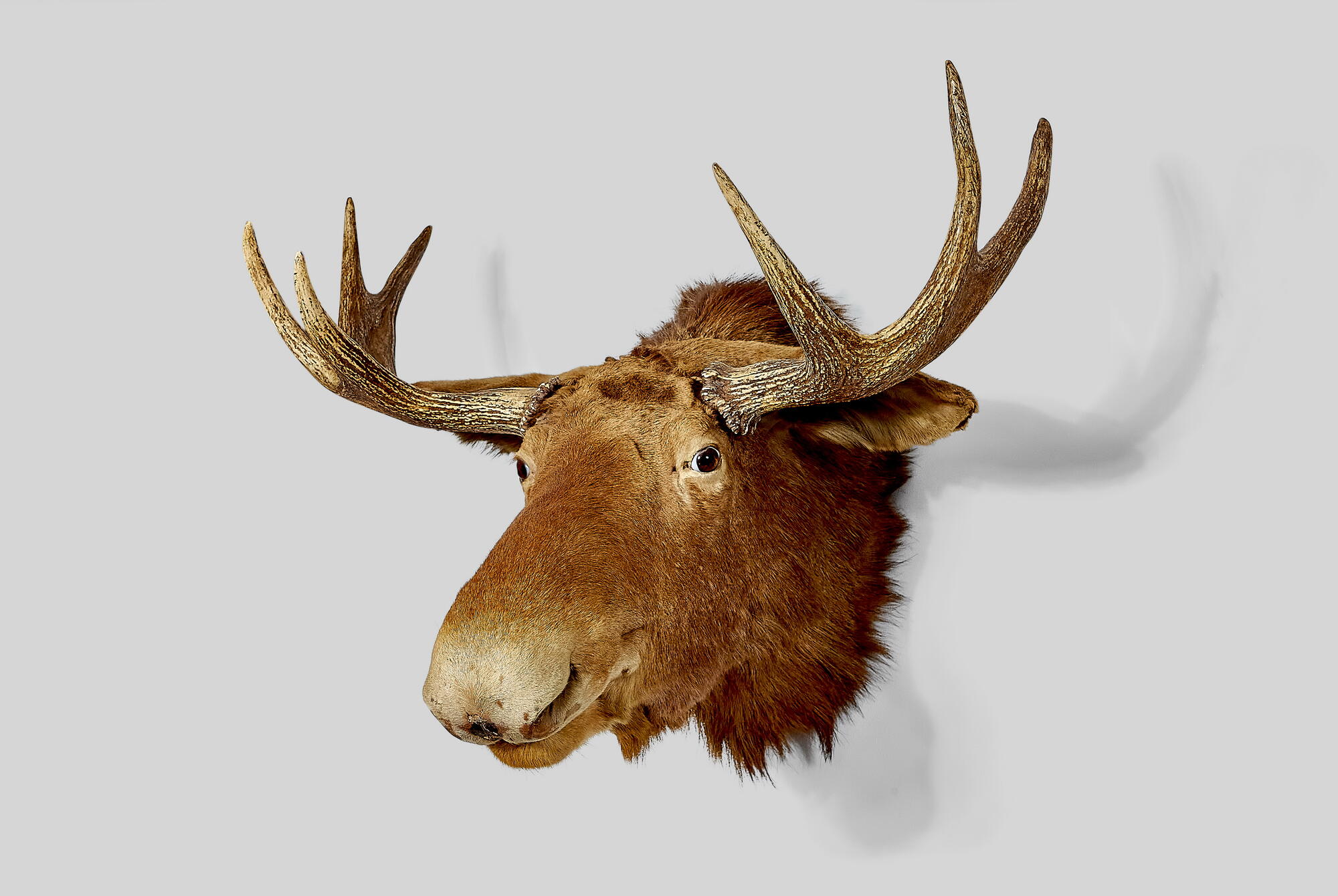


The moose mount was donated to the museum “for the benefit of education” by the famous Kaluga collector and traveler Mikhail Mikhailovich Mestergazi in 1914.
Mikhail Mestergazi was born in Kaluga in 1884. His paternal grandfather was a Hungarian nobleman and a captain of the Russian army. Mikhail’s father fought in the Russo-Turkish War of 1877–1878, in particular in the famous Siege of Plevna. His maternal grandfather worked as the personal physician of Imam Shamil when the latter stayed in Kaluga, in the house of the merchant Ivan Galaktionovich Bilibin where the museum is located nowadays.
Mikhail Mestergazi graduated from the Natural Department at the School of Physics and Mathematics of Moscow University, specializing in zoology. As a student, he worked at the biological research stations in Murmansk, Naples, Sevastopol, and Villafranca (Italy). Between 1908 and 1914, he traveled through Europe, North, Central, and South America, and visited several Asian countries, islands in the Pacific Ocean, and North Africa.
In 1914, Mikhail Mestergazi co-founded the first natural science museum in Kaluga. The museum’s collection contained 714 items collected by Mestergazi during his first journeys in 1908–1910. It is likely that the moose, whose head mount became an exhibit in the museum, was killed by Mikhail Mestergazi or his brothers while hunting.
The moose is a large animal. A male moose stands approximately 2 meters high at the shoulder and weighs 600 kilograms. The body length can reach up to 3 meters. The moose looks different compared to other representatives of the deer family. Its body and neck are short, and the shoulder hump is high. The legs are elongated.
Male moose are distinguished by huge palmate antlers which are larger than those of any other mammal living today. They weigh approximately 20–30 kilograms. After the rutting and mating that occurs in September and October, the males shed their antlers. A new set of antlers then regrows in the spring. Female moose do not have antlers.
Predators of moose include wolves and bears who usually kill young, sick, and old animals. Healthy adult moose are rarely attacked by wolves. Moose are hunted legally throughout Eurasia, and the population increases every year.
Mikhail Mestergazi was born in Kaluga in 1884. His paternal grandfather was a Hungarian nobleman and a captain of the Russian army. Mikhail’s father fought in the Russo-Turkish War of 1877–1878, in particular in the famous Siege of Plevna. His maternal grandfather worked as the personal physician of Imam Shamil when the latter stayed in Kaluga, in the house of the merchant Ivan Galaktionovich Bilibin where the museum is located nowadays.
Mikhail Mestergazi graduated from the Natural Department at the School of Physics and Mathematics of Moscow University, specializing in zoology. As a student, he worked at the biological research stations in Murmansk, Naples, Sevastopol, and Villafranca (Italy). Between 1908 and 1914, he traveled through Europe, North, Central, and South America, and visited several Asian countries, islands in the Pacific Ocean, and North Africa.
In 1914, Mikhail Mestergazi co-founded the first natural science museum in Kaluga. The museum’s collection contained 714 items collected by Mestergazi during his first journeys in 1908–1910. It is likely that the moose, whose head mount became an exhibit in the museum, was killed by Mikhail Mestergazi or his brothers while hunting.
The moose is a large animal. A male moose stands approximately 2 meters high at the shoulder and weighs 600 kilograms. The body length can reach up to 3 meters. The moose looks different compared to other representatives of the deer family. Its body and neck are short, and the shoulder hump is high. The legs are elongated.
Male moose are distinguished by huge palmate antlers which are larger than those of any other mammal living today. They weigh approximately 20–30 kilograms. After the rutting and mating that occurs in September and October, the males shed their antlers. A new set of antlers then regrows in the spring. Female moose do not have antlers.
Predators of moose include wolves and bears who usually kill young, sick, and old animals. Healthy adult moose are rarely attacked by wolves. Moose are hunted legally throughout Eurasia, and the population increases every year.