In the 19th century, inkstands were an essential accessory in every wealthy household. They occupied a special place on the desk. Back then, ink was used for writing business and personal letters, keeping diaries, drawing up documents, and recording expenses.
Apart from an inkwell, the writing set could include many other items, such as a sandbox, a paperweight, pen and pencil stands, pen wipers, wax seal boxes, and other accessories.
Sometimes writing sets were designed to look like sculptural compositions. They were made of a variety of materials, including metal, stone, glass, crystal, faience, and porcelain. Aside from their primary function, such accessories often served as decoration.
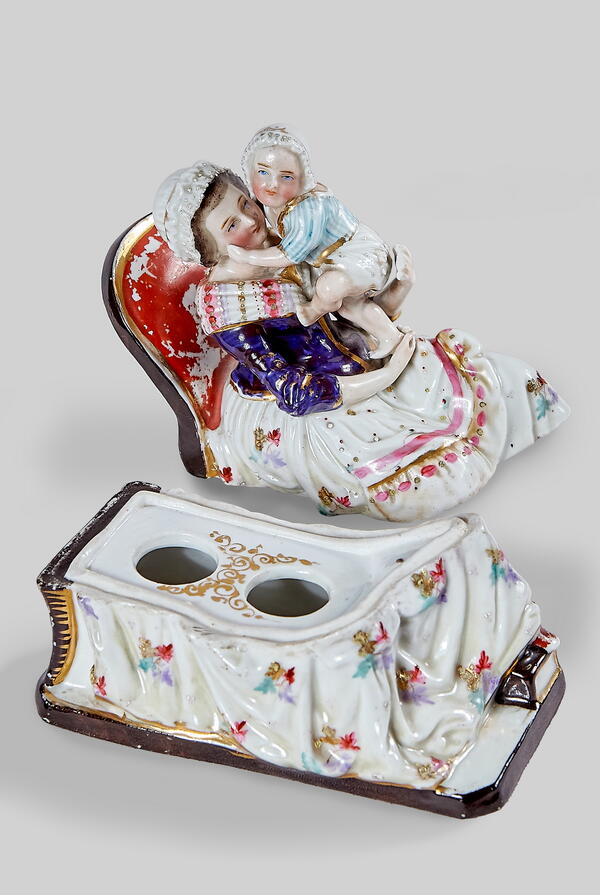
At first glance, the inkstand from the museum’s collection could be mistaken for a decorative porcelain statue. It is a painted figure of a woman holding a baby in her arms. The stand consists of two parts.
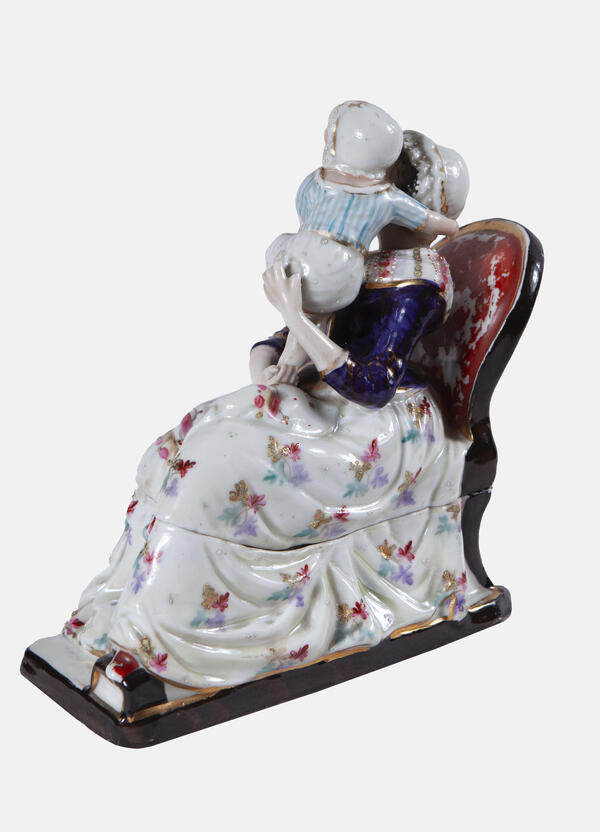
The upper part is the inkstand’s lid. It is a sculpture of a woman sitting in a large round-back armchair and holding a baby in her arms. The woman wears a dark blue slim-fitted blouse, a light-colored full skirt with floral patterns, and an apron. Her shoulders are covered with a scarf with bright stripes, and her hair is tucked under a light-colored cap. The baby wears a striped shirt and a cap.
The bottom part of the inkstand is a base with two round holes. Two cylindrical porcelain containers were placed into the holes: a sandbox with small holes in the lid and an inkwell.
The sandbox was filled with the finest boiled dust-free sand. At the time, it was used instead of blotting paper. The sand was sprinkled onto a freshly written page to absorb an excess of liquid and was then shaken off.
Such an inkstand was most likely used in the women’s quarters of the house. Porcelain inkstands shaped like figures of people or animals enjoyed great popularity in the 19th century and were produced both in Europe and Russia.
Apart from an inkwell, the writing set could include many other items, such as a sandbox, a paperweight, pen and pencil stands, pen wipers, wax seal boxes, and other accessories.
Sometimes writing sets were designed to look like sculptural compositions. They were made of a variety of materials, including metal, stone, glass, crystal, faience, and porcelain. Aside from their primary function, such accessories often served as decoration.
At first glance, the inkstand from the museum’s collection could be mistaken for a decorative porcelain statue. It is a painted figure of a woman holding a baby in her arms. The stand consists of two parts.
The upper part is the inkstand’s lid. It is a sculpture of a woman sitting in a large round-back armchair and holding a baby in her arms. The woman wears a dark blue slim-fitted blouse, a light-colored full skirt with floral patterns, and an apron. Her shoulders are covered with a scarf with bright stripes, and her hair is tucked under a light-colored cap. The baby wears a striped shirt and a cap.
The bottom part of the inkstand is a base with two round holes. Two cylindrical porcelain containers were placed into the holes: a sandbox with small holes in the lid and an inkwell.
The sandbox was filled with the finest boiled dust-free sand. At the time, it was used instead of blotting paper. The sand was sprinkled onto a freshly written page to absorb an excess of liquid and was then shaken off.
Such an inkstand was most likely used in the women’s quarters of the house. Porcelain inkstands shaped like figures of people or animals enjoyed great popularity in the 19th century and were produced both in Europe and Russia.