The taiga Shors have long collected kendyr (hemp and nettle), but under the influence of their Russian neighbors they began to grow hemp along with wheat and barley, using the slash-and-burn method of agriculture. Hand-picked and dried kendyr stems (“pipes”) were broken in half, the fiber was peeled off with hands and teeth, the “kylysh” was scutched with wooden boards and tied into “tudam” bundles. They were placed in “ulan kendyr” birch bark boxes and sprinkled with barley chaff to prevent tangling. Then the fibers were joined into threads, wound into tubes, and bleached in boiling water with birch and aspen bark. This was the end of the preparation for spinning.
In the 19th century, flax growing began to actively develop in the south of Western Siberia, and at the same time distaffs and flax heckling combs necessary for processing this product came into use among locals.
The southern Shors tried but failed to grow flax due to difficult natural conditions and primitive methods of cultivating the land. However, the tools and technology of flax production turned out to be suitable for scutching kendyr — nettle and hemp.
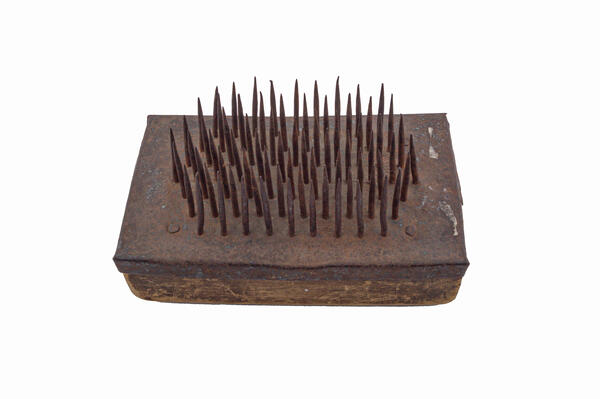
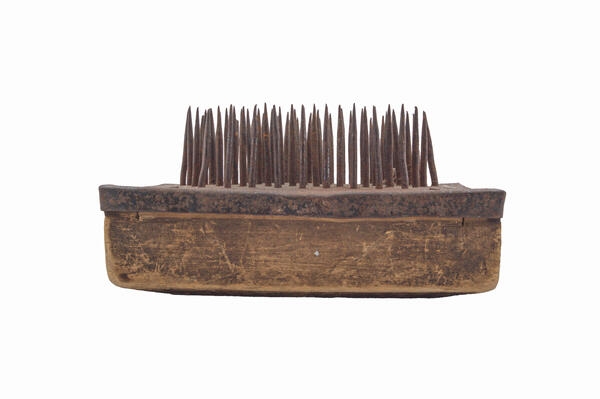
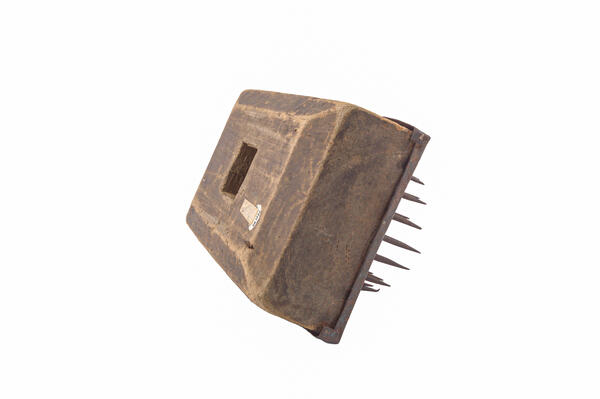
Shor women did the heckling in winter. The fibers were placed between the teeth of the brush and pulled through them several times. Each time, coarse fibers remained on the brush, which were not thrown away, but were used to create lower quality threads or weave ropes.
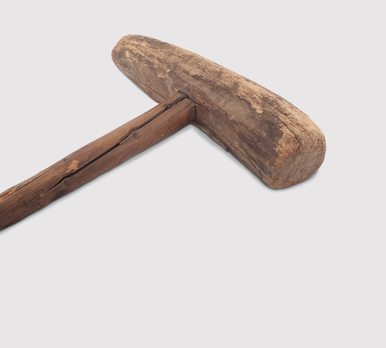
The fibers were divided into short, medium, and long ones: the longer the fiber, the thinner the yarn and the better the quality of the fabric woven on primitive kendyr-tabeg looms. The presented comb, or iron brush, was intended for the first, rough combing.
In Rus, heckling combs have been used since the 11th –12th centuries, as evidenced by archaeological finds. The in-demand profession of a
comber probably appeared at the same time. In different areas, wool and plant
fibers were combed with varying degrees of care. It is believed that repeated
combing was characteristic only of the Middle Volga and northeastern governorates
of Russia.