In the first quarter of the 19th century, chinaware was in great demand in the Russian Empire. The products of the Imperial Porcelain Factory were expensive and unaffordable for most people. As a result, the porcelain manufactured by smaller private enterprises gained immense popularity. They offered high-quality chinaware at prices that were affordable for a wider range of customers.
One of the most successful private manufacturers was the Batenin Factory in St. Petersburg. It produced both everyday chinaware and exquisite luxury porcelain. The factory was best known for its large gilded vases with views of St. Petersburg, as well as its unique cup and saucer sets.
The factory’s products were handcrafted and decorated with delicate painting. Cup and saucer sets were presented as gifts, treasured, and sought after by collectors. For the high quality of its products, the Batenin Factory was awarded the Grand Gold Medal at the 1st All-Russian Industrial Exhibition in St. Petersburg in 1829.
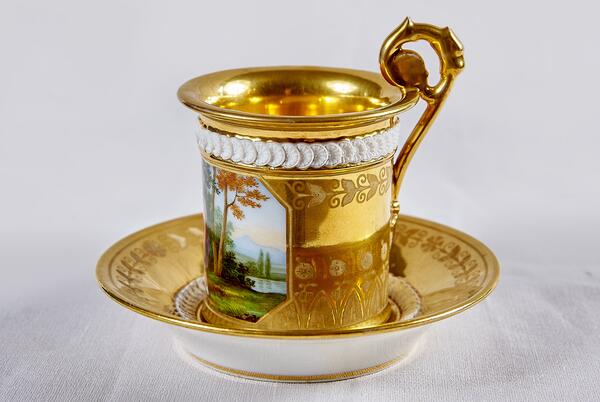
The cylindrical cup with a curved lip and a high handle shaped like a scroll with a relief rosette was one of the most popular designs of the Batenin Factory. The inner and outer surfaces of the cup are gilded, and there is a band of overlapping white biscuit rosettes at the top. The saucer features a similar band.
In a rectangular frame on one side of the cup, the artist painted a kneeling woman. She is depicted in a landscape setting. On one of the trees, there is an inscription in French “à l’amitié”, which means “for friendship”.
The shape and décor of the cup and saucer set bear the influence of the Empire style. The artist’s admiration for the classical ideal is obvious in all the details of the young woman’s image, including her classical profile, her updo hairstyle, and her clothes — a light pale tunic with a high waist, which is accentuated by a blue ribbon.
The artist painted an exquisite landscape showing great knowledge of aerial perspective. He created a colorful foreground by using fine lines to depict detailed tree branches and grass. This alone is a testament to the painter’s talent.
One of the most successful private manufacturers was the Batenin Factory in St. Petersburg. It produced both everyday chinaware and exquisite luxury porcelain. The factory was best known for its large gilded vases with views of St. Petersburg, as well as its unique cup and saucer sets.
The factory’s products were handcrafted and decorated with delicate painting. Cup and saucer sets were presented as gifts, treasured, and sought after by collectors. For the high quality of its products, the Batenin Factory was awarded the Grand Gold Medal at the 1st All-Russian Industrial Exhibition in St. Petersburg in 1829.
The cylindrical cup with a curved lip and a high handle shaped like a scroll with a relief rosette was one of the most popular designs of the Batenin Factory. The inner and outer surfaces of the cup are gilded, and there is a band of overlapping white biscuit rosettes at the top. The saucer features a similar band.
In a rectangular frame on one side of the cup, the artist painted a kneeling woman. She is depicted in a landscape setting. On one of the trees, there is an inscription in French “à l’amitié”, which means “for friendship”.
The shape and décor of the cup and saucer set bear the influence of the Empire style. The artist’s admiration for the classical ideal is obvious in all the details of the young woman’s image, including her classical profile, her updo hairstyle, and her clothes — a light pale tunic with a high waist, which is accentuated by a blue ribbon.
The artist painted an exquisite landscape showing great knowledge of aerial perspective. He created a colorful foreground by using fine lines to depict detailed tree branches and grass. This alone is a testament to the painter’s talent.