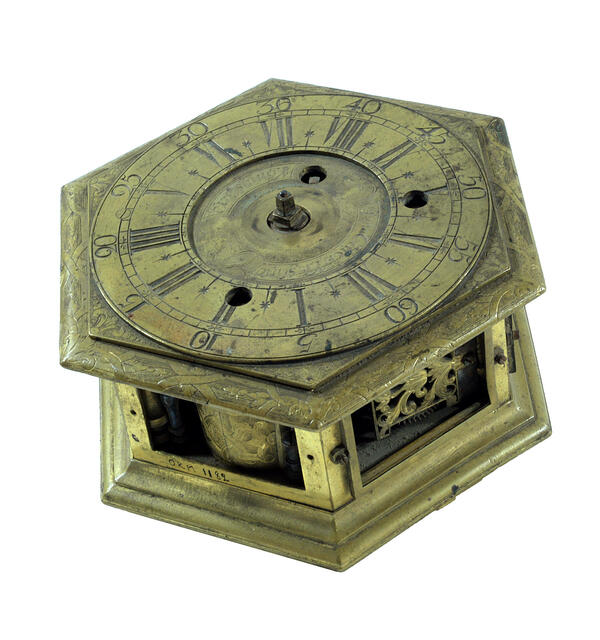
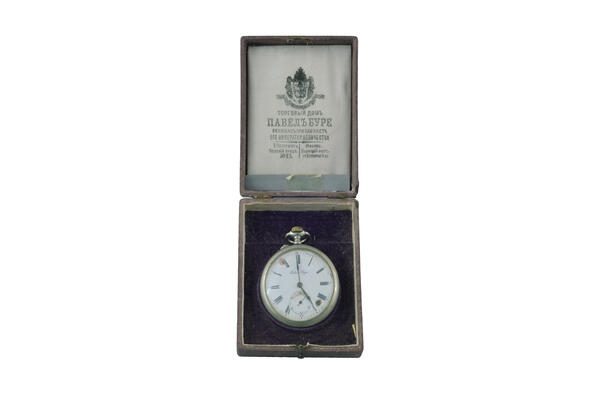
The history of a pocket watch began around 1510. The first watch to have in a vest or trousers pocket was made by a mechanic Peter Henlein from Nuremberg, Germany. It had one hour-hand, so it could only show approximate time. It did not have a glass covering a clock face. Therefore, there was a hummock on each number to determine the time by touch without taking the watch out of one’s pocket. The pocket watch was usually worn on a chain with a breloque.
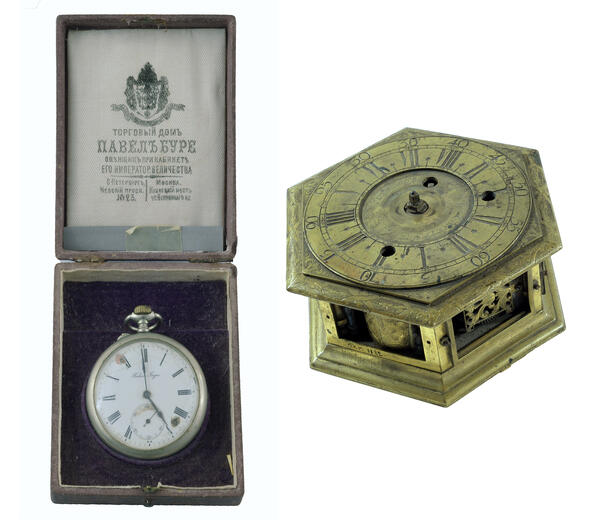
The collection of the Oryol Museum of Local History contains a pocket watch “Paul Buhre” made in the late 19th — early 20th century. On the reverse side of the case is the coat of arms of the Russian Empire and the inscription “Paul Buhre, supplier of His Majesty”s Court”. The inscription “Paul Buhre” has also been preserved on the clock-face.
The Russian watch company “Paul Buhre” was founded in 1874. In 1815, watchmaker Karl Buhre moved to St. Petersburg from Revel and founded a small family watch production in the capital. His son Paul Buhre continued his father’s legacy. From early childhood, his grandson, also Paul, actively helped Buhre in running the family business and, in 1868, became his partner. In 1874, he purchased a large watch factory in the Swiss city of Le Locle. A few years later, Paul Buhre became an official appraiser of watches and other mechanical devices at the emperor’s office and received a right to place the state emblem on his products.
In addition to pocket watches, the company produced travel clocks, wall clocks, wag-on-the-wall clocks. Buhre’s items were commissioned by the War Ministry and the Ministry of Railways.
In 1888, Paul Buhre was forced to retire due to serious health problems. He had no immediate heirs, so he decided to sell the factory in Le Locle to its direct manager, Paul Girard, and his colleague Jean-Georges (Georg) Pfund. The new owners established the trading house ‘Paul Buhre’. In order not to pay high customs duties, only parts were supplied to Russia from Switzerland, and the watches were assembled in the workshops of St. Petersburg.
In 1899, the company received the title of ‘Supplier of the Court of His Imperial Majesty’. At the 1900 World’s Fair in Paris, the company received a gold medal.
In 1892, the company opened its first own store in Moscow, and a little later — a branch in Kyiv. In the same year, Paul Buhre died before he reached the age of 50, and the position of the full-time appraiser of watches and other mechanical products for His Majesty was given to Buhre’s successor Jean-Georges Pfund.
After the October Revolution of 1917, the company’s property was nationalized.