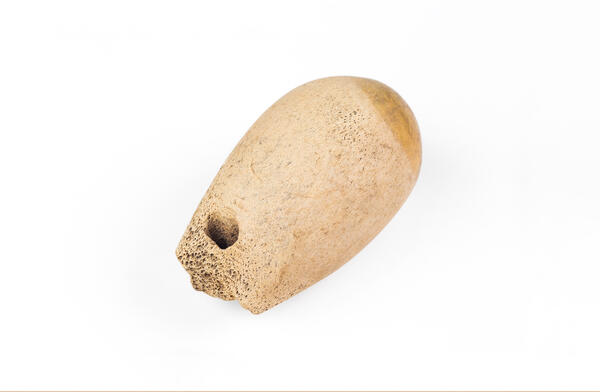
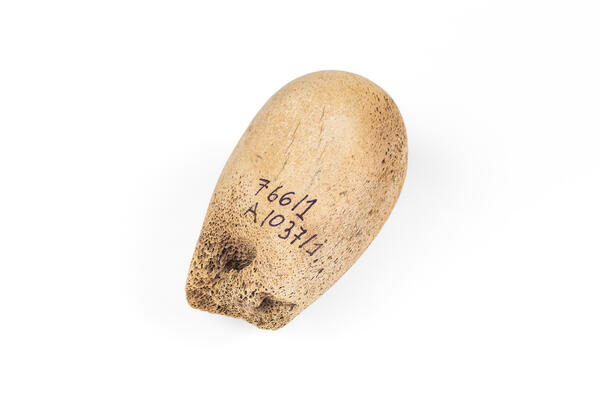
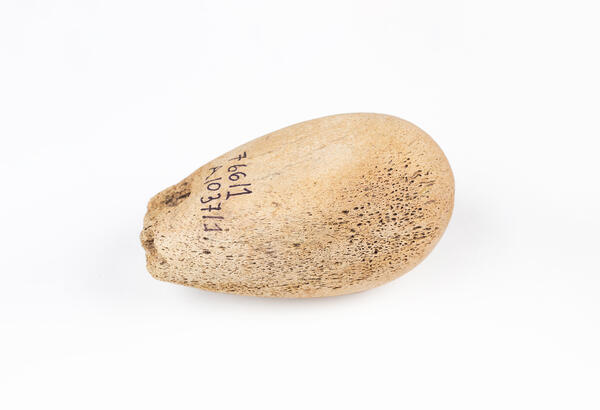
The bone head of the mace was discovered during a survey of a household plot in the village of Beya in the Republic of Khakassia in 2007. This object was excavated by a group of archaeologists from the Beya Expedition of the Institute of the History of Material Culture of the Russian Academy of Sciences. The team was headed by Lyudmila Anatolyevna Sokolova, Doctor of Historical Sciences.
During the research of the site, stone structures were discovered, which scientists attributed to a large burial ground of the Tagar culture. It was named “Beya I.” The main feature of Tagar burials was the megalithic nature of the burial structures, that is, the process of construction involved using large stone blocks.
As a rule, the mounds of this culture were surrounded by stone fences made of Devonian sandstone slabs. Stones up to four meters high were dug into the corners of the fences or into their piers. The grave contained a paired burial of a man and a woman, partially destroyed during the subsequent burial of the third deceased. The male skeleton belonged to an adult of high stature with well-developed muscles, as evidenced by the high relief of the limbs’ bones. At his right forearm lay a pear-shaped bone object with a through hole in the narrow part.
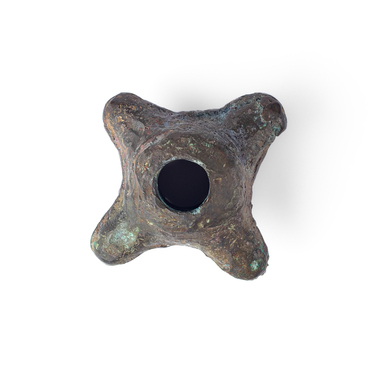
Analogues of this object in Tagar antiquities were not known, but in the European part of the continent there were similar objects made of metal — maces. This artifact is a bone head — a striking part of a mace. A mace was a cold weapon of impact-crushing action with a wooden or metal handle and a spherical head — a striking part, often equipped with spikes.
Maces were used by both
infantry and cavalry, but for horsemen such weapons were made more massive. The
length of the mace, as a rule, ranged from 50 to 80 centimeters, the weight of
the head reached 500 grams. Already in the Stone Age, people began to
manufacture and use this type of weapon. Its construction consisted of a sturdy
stick and a cobblestone attached to its end. Later, the heads were carved not
only from stone, but also from bone. In addition to the usual spherical shape,
they could be biconic, polygonal, barrel-shaped and vertically flattened.