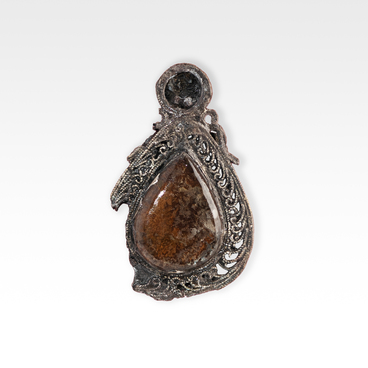
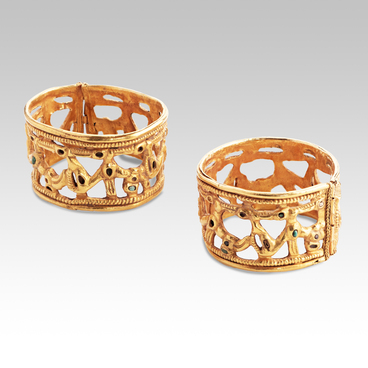
The decoration was discovered during archaeological excavations at the Tanais necropolis in 1975. Researchers identified the burial chamber in which the medallion was found as belonging to a female individual.
The burial site had been looted, but several items remained intact. For instance, an example of Charon’s obol was found: it is a circular object made of gold leaf. In addition, there were fragments of triangular leaves made of gold leaf, which were likely part of a funeral wreath. The medallion featuring a cameo was also found there. These findings indicated that the deceased woman belonged to the elite class of Tanais.
The medallion itself is made of gold with two loops for hanging. Dark blue glass was used to cast the base of the cameo, while opaque white glass was used for the relief image.
The cameo depicts a scene featuring the god of love, Eros, who pulls the skin of the Nemean lion and holds a club.
In ancient Greek mythology, the Nemean lion was a fearsome creature with impenetrable skin. It terrorized the regions surrounding the cities of Nemea, Cleona, as well as the village of Bembina. The first labor of Hercules was to kill this vicious lion.
Hercules pursued the lion and struck it twice with his bow, but the arrows had no effect on its skin. The son of Zeus then stunned the creature with a powerful blow to the head with his club and strangled it with his bare hands.
The Roman poet, Publius Vergilius Maro, wrote in his collection of poems “Eclogues” in 39 BCE as follows, “Love conquers all; let us too yield to Love.” Hence, it is possible that the attributes of Hercules became also associated with the god of love, Eros.
According to the fashion trends that originated in Greece, some female inhabitants of the city of Tanais were known to wear the so-called “apodesmos”, a bandeau made from ribbons that were crisscrossed on the chests. It is likely that the medallion served as the central decoration of these ribbons.
A cameo is a type of carved gemstone with a raised relief image on its surface. Cameos, as miniature decorations, emerged as a form of glyptic art (the art of engraving on hard stone), during antiquity at the turn of the 4th–3rd centuries BCE. During the early centuries of the common era, cameos also began to be produced in glass.
Tanais, where the medallion was discovered, is an archaeological site. It used to be a city located near the modern-day village of Nedvigovka in the Myasnikovsky district of the Rostov region.