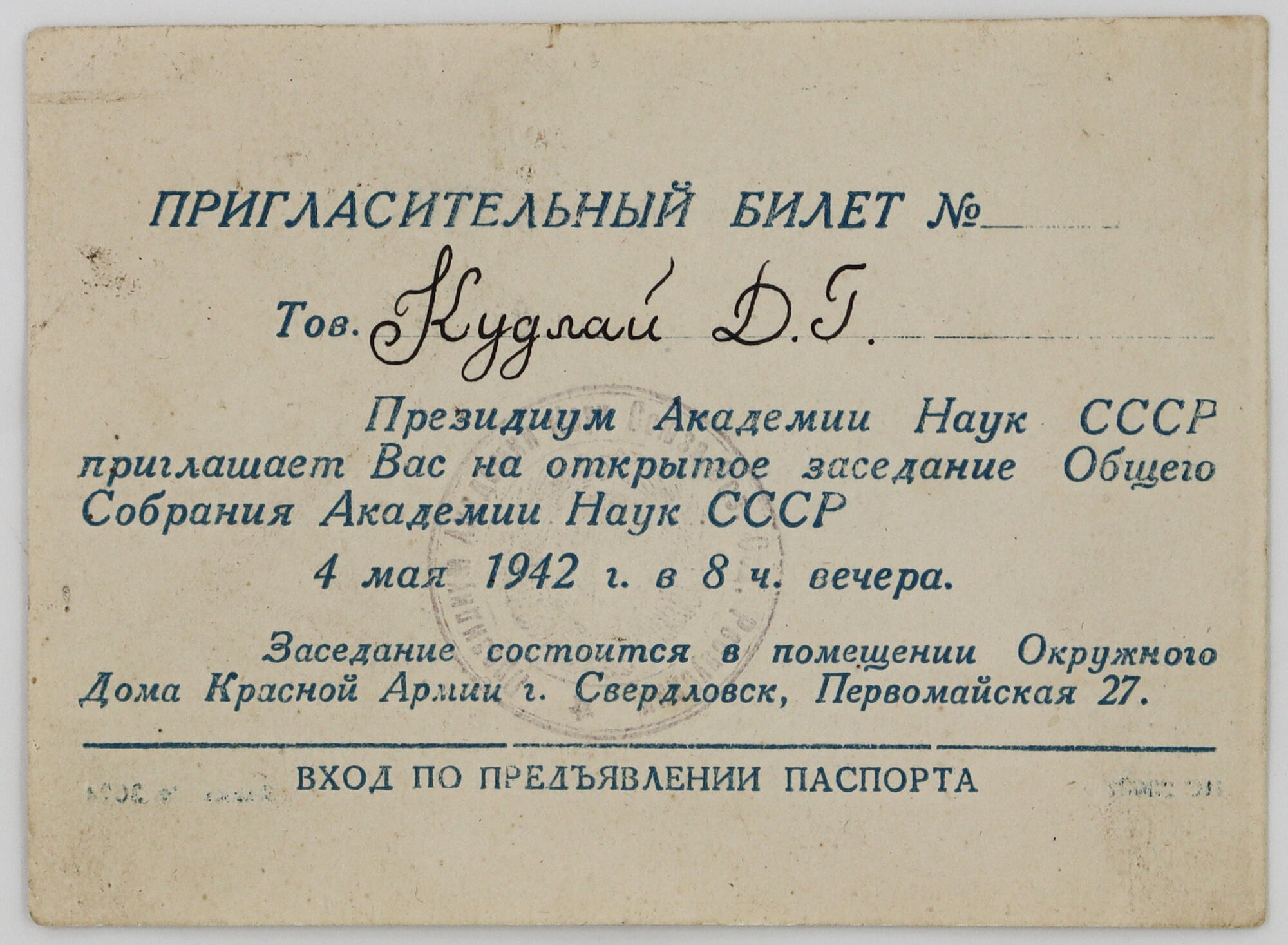


The exhibition houses a written invitation for an open general meeting of the USSR Academy of Sciences addressed to Professor of Microbiology Darya Gavrilovna Kudlay. The meeting was held on May 4, 1942 in the premises of the District House of the Red Army, now the House of Officers, in the city of Sverdlovsk.
During the Great Patriotic War, institutions of the USSR Academy of Sciences were evacuated to Sverdlovsk. There, they were accommodated in the buildings of the Ural Branch of the Academy of Sciences and the Ural Complex Expedition. In the summer of 1941, Sverdlovsk also welcomed the Institute of Metallurgy, the laboratories of crystallography, X-ray chemical and spectral analysis of the Institute of Geological Sciences of the USSR Academy of Sciences. In autumn, the laboratories of the Kharkov Institute of Ferrous Metallurgy of the Academy of Sciences of the Ukrainian SSR and the Institute of Mining were relocated to the facilities of the Sverdlovsk branch. In addition, the defense departments of the Division of Geological and Geographical Sciences (the commission for aerial photography, the commission for strategic raw materials, the commission for preparing military geographical essays, the commission for rare metals and the cave commission) were also relocated to the administrative capital of the Urals.
During the war, the city hosted the Presidium of the Academy of Sciences of the USSR, the Council of Branches and Bases of the Academy, the Council of the Academy for Scientific and Technical Propaganda, the Department of History and Philosophy, the Group on the History of Technology at the Department of Technical Sciences, the Sverdlovsk Department of the Academy’s Publishing House, the seismic station of the Academy’s Seismological Institute, etc.
In early May 1942, a general meeting of the USSR Academy of Sciences was held in Sverdlovsk. 69 full members and 40 associate members of the Academy who arrived in the regional capital from all over the country took part in its activities. As part of the meeting, a resolution was adopted to re-elect the president and six vice-presidents. Those were Academicians Bardin, Baykov, Bogomolets, Volgin, Ioffe and Orbeli.
The issue on top of the agenda, however, was to have the current work of the Academy of Sciences aligned with the practical needs of military production and to focus on discoveries that were of significance for national defense. To this effect, naval and military sanitary commissions were created, which were supposed to provide advisory assistance to the Red Army in matters of navigation, aircraft engineering, strategy and tactics of military operations, etc.
During the Great Patriotic War, institutions of the USSR Academy of Sciences were evacuated to Sverdlovsk. There, they were accommodated in the buildings of the Ural Branch of the Academy of Sciences and the Ural Complex Expedition. In the summer of 1941, Sverdlovsk also welcomed the Institute of Metallurgy, the laboratories of crystallography, X-ray chemical and spectral analysis of the Institute of Geological Sciences of the USSR Academy of Sciences. In autumn, the laboratories of the Kharkov Institute of Ferrous Metallurgy of the Academy of Sciences of the Ukrainian SSR and the Institute of Mining were relocated to the facilities of the Sverdlovsk branch. In addition, the defense departments of the Division of Geological and Geographical Sciences (the commission for aerial photography, the commission for strategic raw materials, the commission for preparing military geographical essays, the commission for rare metals and the cave commission) were also relocated to the administrative capital of the Urals.
During the war, the city hosted the Presidium of the Academy of Sciences of the USSR, the Council of Branches and Bases of the Academy, the Council of the Academy for Scientific and Technical Propaganda, the Department of History and Philosophy, the Group on the History of Technology at the Department of Technical Sciences, the Sverdlovsk Department of the Academy’s Publishing House, the seismic station of the Academy’s Seismological Institute, etc.
In early May 1942, a general meeting of the USSR Academy of Sciences was held in Sverdlovsk. 69 full members and 40 associate members of the Academy who arrived in the regional capital from all over the country took part in its activities. As part of the meeting, a resolution was adopted to re-elect the president and six vice-presidents. Those were Academicians Bardin, Baykov, Bogomolets, Volgin, Ioffe and Orbeli.
The issue on top of the agenda, however, was to have the current work of the Academy of Sciences aligned with the practical needs of military production and to focus on discoveries that were of significance for national defense. To this effect, naval and military sanitary commissions were created, which were supposed to provide advisory assistance to the Red Army in matters of navigation, aircraft engineering, strategy and tactics of military operations, etc.