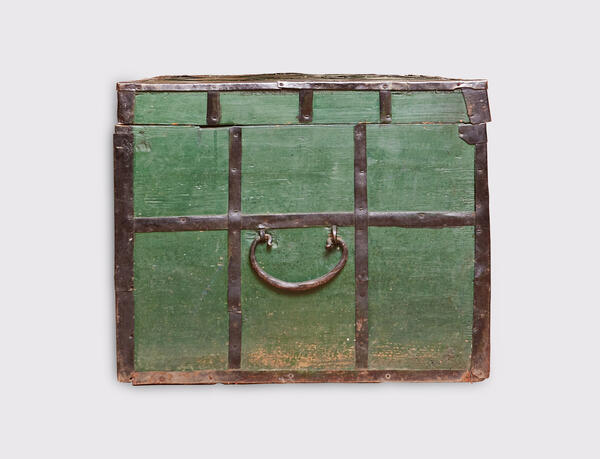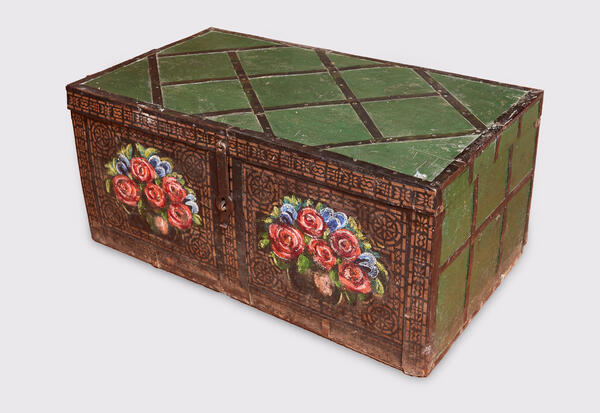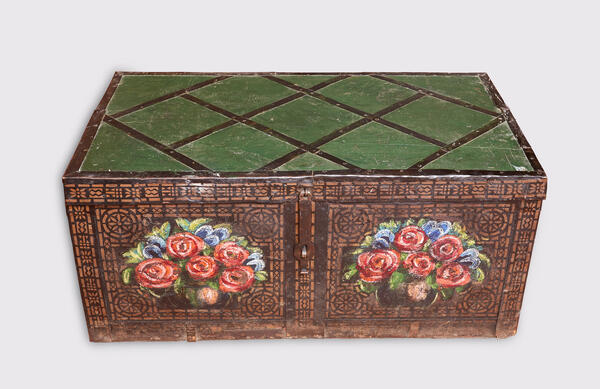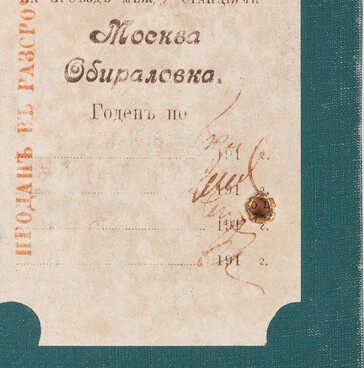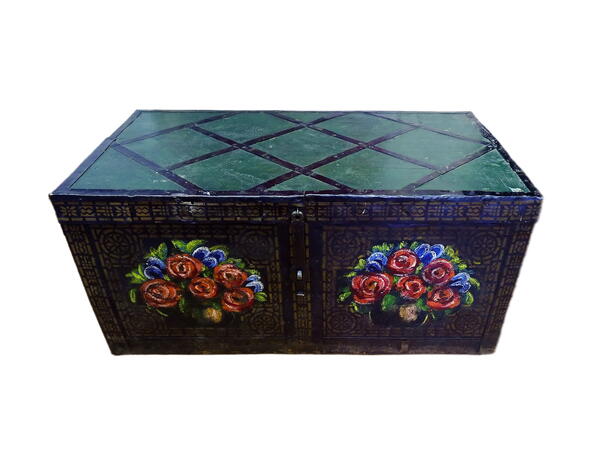
The exhibition of the Zheleznodorozhny Local Lore Museum is adorned with an old chest donated by Augustina Ivanovna Tsvetkova — the daughter of the head of the Obiralovka station. This chest belonged to her great-grandmother. In Rus, chests were usually inherited through the female lineage. The chest was presumably made in Novgorod in the middle of the 19th century.
A chest appeared as a piece of furniture in Rus in the 13th century during the Mongol-Tatar invasion. The Mongols carried their belongings in special boxes called “sandyks” and buried fallen soldiers in them. Until the end of the 19th century, it was the main piece of furniture. During the daytime, the chest was used as a bench, and at night — as a bed. But the main purpose of the chest was still storing things, jewelry and household items. Therefore, the wealth of a Russian family was measured by the number of chests.
Chests were made from various types of wood, mainly oak, beech and ash. As a rule, a chest was always reinforced with metal strips. But Russian craftsmen did not stop there. All sorts of unique locks were invented that would ring and play a melody when they were opened. The chests were covered with seal leather and beautiful fabrics. In the 17th century, the largest centers for the production of iron-bound chests were in Novgorod, Kholmogory, Veliky Ustyug and Moscow. The craftsmen in each of the cities had their own special techniques for covering chests with iron, but together they created that single artistic impression that turned such an everyday thing as a chest into a bright example of Russian decorative and applied art.
At first, chests were painted with scenes copied
from Western European engravings; later, complex compositions were replaced by
floral motifs painted in a free, broad manner. The chests made in Moscow,
Novgorod, Kholmogory and Ustyug were admired by the contemporaries,
compatriots, and foreigners. Russian chests with decorative iron frames,
exhibited at the Kholmogory fair, were exported to Scandinavian countries.