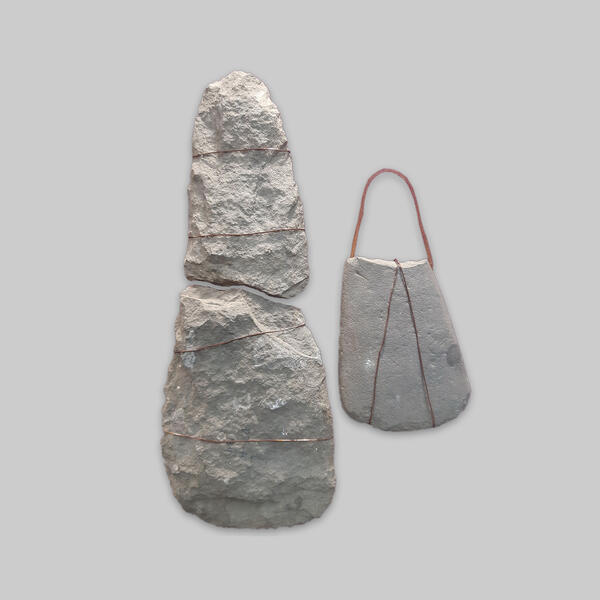
In the late ChalcolIthic Age, people living on the territory of the region were gradually switching from hunting, fishing, and picking to manufacturing activities: agriculture and stock raising. This fact is proven by the discovered stone hoes for the tillage and bones of livestock. The showcased hoe was found at the Razdornaya Two dwelling site, a monument of the Chalcolithic Age of the first half of the second millennium B.C. It is made of stone by chipping and polishing. Today, a hoe of the Chalcolithic Age is replaced with a digging hoe, an agricultural tool for soil loosening.
The Razdornaya II dwelling site is located in the Chastinsky District of the Perm Region, on the right bank of the Kama River. Archaeologist Otto Bader conducted excavation works at the Razdornaya Two dwelling site in 1952.
The earliest way of cultivating land is called hoe farming. Presumably, the ground was loosened manually or with a hoe. Ancient hoes were made of horns, or stones. A stone hoe was perpendicularly attached to a wooden handle. Impact force was required to work with the hoe. It has not been found out yet, when a plough appeared. The first evident marks of a plough or its images refer to the Middle Bronze Age, or the 9th century BC in the region.
The archeologist Otto Bader held a doctorate degree in history and majored in the Stone and Bronze Ages. He was born in the Poltava Governorate in 1903. He graduated from a secondary school in Bely city in the Smolensk Governorate. Otto Bader established the first regional natural history community in the city. Then he studied at the archaeological department of the Faculty of Social Sciences of Moscow State University. Later, the researcher was hired as a specialist-archaeologist in the museum department of the scientific section of the People’s Commissariat for Education. He also participated in creation of archaeological sections for many regional museums.
He resumed field studies in the region between the Volga and Oka rivers and continued working on the ancient history of the Ural and the Volga region. Until 1958, he headed the Kama archaeological expedition. In 1959-1960, he took over a new large expedition on the Kama River called Votkinskaya. His enthusiasm led to the publication of two volumes with illustrated reports. Otto Nikolaevich Bader was a prominent figure for the Russian archaeology of the 20th century.
The Razdornaya II dwelling site is located in the Chastinsky District of the Perm Region, on the right bank of the Kama River. Archaeologist Otto Bader conducted excavation works at the Razdornaya Two dwelling site in 1952.
The earliest way of cultivating land is called hoe farming. Presumably, the ground was loosened manually or with a hoe. Ancient hoes were made of horns, or stones. A stone hoe was perpendicularly attached to a wooden handle. Impact force was required to work with the hoe. It has not been found out yet, when a plough appeared. The first evident marks of a plough or its images refer to the Middle Bronze Age, or the 9th century BC in the region.
The archeologist Otto Bader held a doctorate degree in history and majored in the Stone and Bronze Ages. He was born in the Poltava Governorate in 1903. He graduated from a secondary school in Bely city in the Smolensk Governorate. Otto Bader established the first regional natural history community in the city. Then he studied at the archaeological department of the Faculty of Social Sciences of Moscow State University. Later, the researcher was hired as a specialist-archaeologist in the museum department of the scientific section of the People’s Commissariat for Education. He also participated in creation of archaeological sections for many regional museums.
He resumed field studies in the region between the Volga and Oka rivers and continued working on the ancient history of the Ural and the Volga region. Until 1958, he headed the Kama archaeological expedition. In 1959-1960, he took over a new large expedition on the Kama River called Votkinskaya. His enthusiasm led to the publication of two volumes with illustrated reports. Otto Nikolaevich Bader was a prominent figure for the Russian archaeology of the 20th century.