At the end of the 20th century, not far from the Novy Svet settlement in Sudak Bay, underwater archaeologists discovered the wreck site of a cargo ship. In 1999, employees of Taras Shevchenko University of Kiev began carrying out conservation activities there.
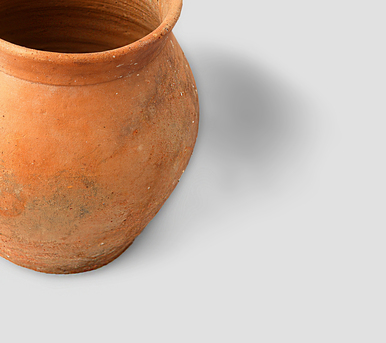
Over the years, because of currents, tides, amateur scuba divers and “illegal archaeologists”, the material was dispersed across the seabed in an area of 120×120 meters. The finds include numerous ceramic vessels (amphorae, pithoi, and smaller dishware), glazed pottery and Venetian glass intended for sale rather than transportation, and a relatively small number of household items made of wood, metal, and stone.
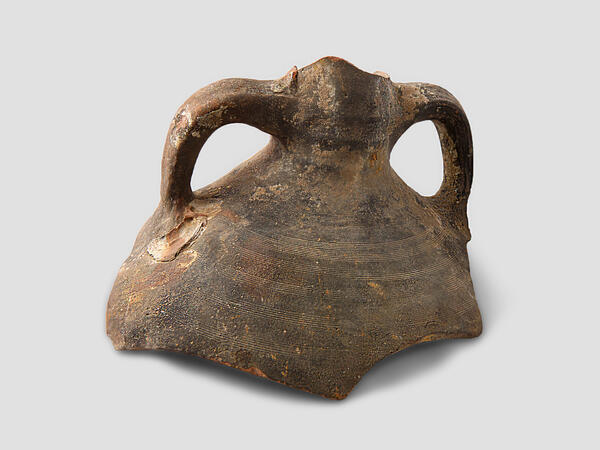
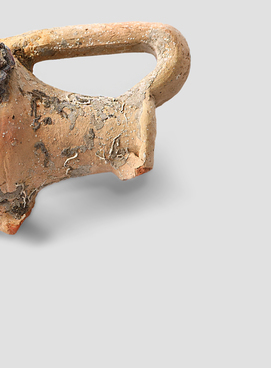
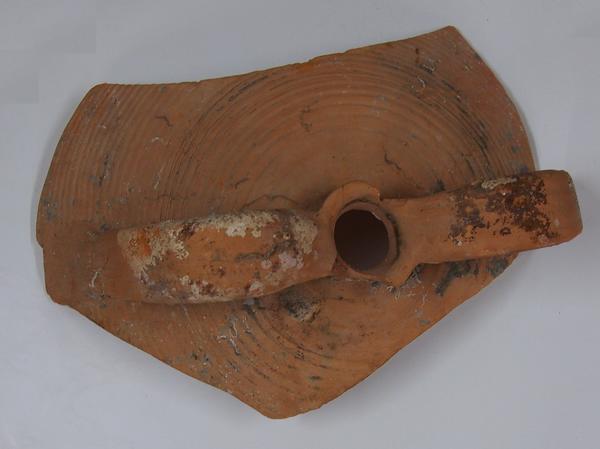
The fragment belongs to the so-called pear-shaped type of amphorae with arched handles, which were common in the Black Sea and Eastern Mediterranean regions in the 12th–13th centuries. Many such vessels or their fragments were covered with a layer of sand and therefore retained common distinctive features. Oftentimes, the amphorae are plugged with pine bark corks, and graffiti in the form of letters, monograms and various symbols are scratched on their surface. Sometimes these markings cover the entire piece.
It cannot be precisely determined where the amphorae of this type were produced. Nergis Günsenin, a professor at Istanbul University and specialist in ceramics, claims that it was Ganos (modern Gaziköy, Turkey), located along the northern shore of the Sea of Marmara. It is there that more potsherds and the remains of pottery kilns have been discovered during excavations.
Igor Viktorovich Volkov, another specialist in the history of ceramics, considers Trebizond and its surroundings to be a production center of such ceramics. Given the abundance of similar objects found in the areas of Azov and Chersonesus, researchers admit the possibility of them being locally produced. This last version is also supported by the fact that the discovered pottery fragments are of different quality: the vessels were manufactured using the same methods yet different raw materials.
The inside of the amphora shows traces of resinification: the vessel was treated with resin at one of the final stages to make it more airtight.
Any liquid or bulk goods could be transported in this type of vessel; most often it was wine and olive oil.