The clay dishware used in the Northern Black Sea region was diverse: molded ware and more widespread pottery, tableware, kitchenware, decorative and palestric dishware, as well as vessels for aromatic oils and various cosmetics.
The latter included amphorettes, or little amphorae, well known in many areas of the ancient world.
Larisa Alekseyevna Golofast, a researcher at the Classical Archaeology Department of the Institute of Archaeology of the Russian Academy of Sciences, distinguishes two groups of amphorettes (the 5th–7th centuries) excavated in Chersonesus that differ in the composition of raw materials, morphological features and sizes.
The first group of amphorettes is represented by red clay potsherds with mica inclusions and is characterized by a grooved body, a massive, flatly cut, roughly sculpted foot and a rim of a non-standard shape. Such vessels were popular throughout the Black Sea region.
Amphorettes of the second group were spindle-shaped vessels “with a small rib on the neck, a smooth body and a flatly cut bottom”. The dense potsherds, which were overburned and acquired a grayish color, contain particles of mica and carbonates.
The British archaeologist John Walker Hayes, who studied similar amphorettes, claimed that they were also widespread in Constantinople, Athens, Corinth, Rhodes and Ephesus and suggested that the center of their production was in Palestine.
Larisa Golofast used Hayes’ observations, as well as her own, to state that Kherson had stable trade relations with Palestine in the 6th — early 7th centuries, as well as with the Eastern Mediterranean region.
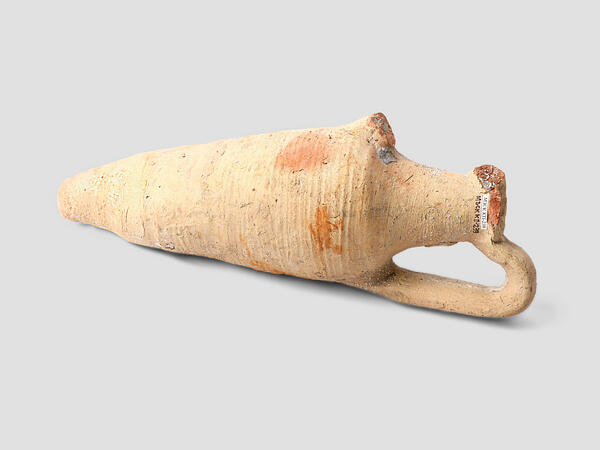
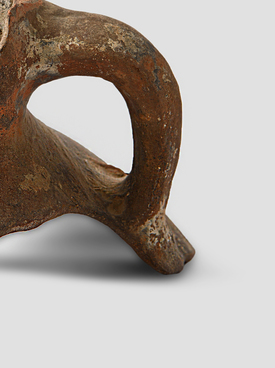
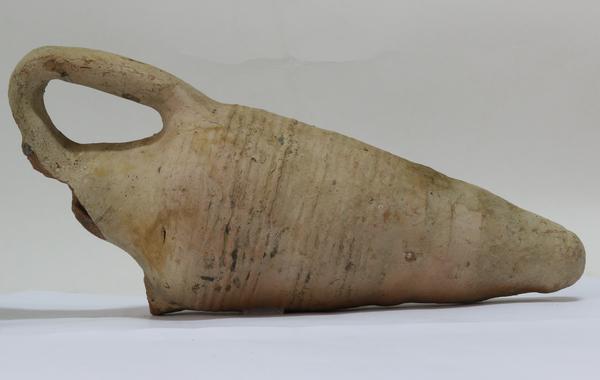
The displayed amphorette of the 10th–13th century (spindle-shaped with a grooved body) does not fit the two descriptions given by Golofast, which suggests that the shapes of amphorettes evolved.
Like the earlier amphorettes of the second group (according to Larisa Golofast’s classification), the exhibit was covered with an engobe.
Engobe is a special coating, 98% consisting of clay mixed with some coloring pigments. It is applied to the surface of the vessel before firing to give it a more aesthetic look and cover the color of unfired clay or rough texture.