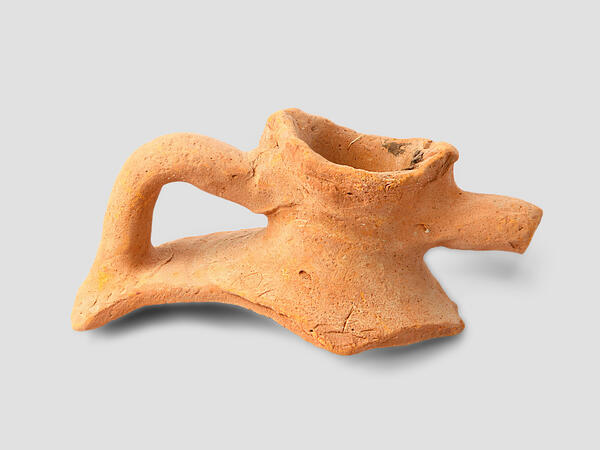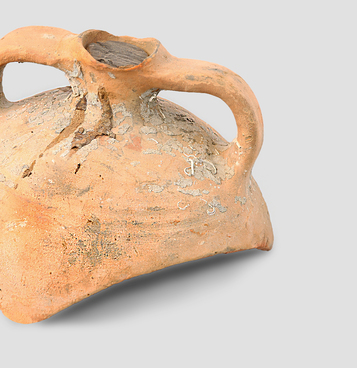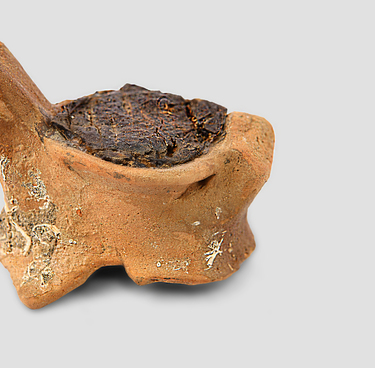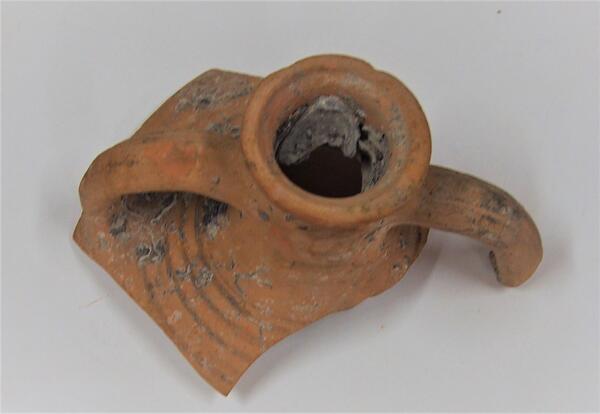
The presented amphora fragment was raised from the bottom of the bay near the Novy Svet settlement, five kilometers from Sudak, by the participants of an underwater archaeological expedition organized by the Center for Underwater Archaeology in 1999.
The bay of Novy Svet caught the specialists’ interest during their work on the coastline between Ai-Foka and Cape Meganom. In the 1960s, underwater exploration in the area of the Novy Svet settlement was carried out by the participants of the expedition led by Professor Vladimir Dmitriyevich Blavatsky. In the 1980s–1990s, based on the results of new research, the archaeologist, antiquity researcher and medievalist Igor Avenirovich Baranov suggested that a shipwreck happened there in the 13th–14th centuries.
According to the results of the seabed inspection, the archaeologists determined a vast area of scattered artifacts. It was divided into two areas: one in the center at a greater depth, the other — in the western part of the bay. The finds were analyzed, and it was established that they date to different periods, therefore, there were two separate shipwrecks in one place.
Then the site under the Koba-Kaya plateau was divided along the bottom by cables into “paths” to indicate the location of the finds. After that, underwater photography and videography were carried out, and the raised artifacts — amphorae, pithoi, glassware and glazed ceramics — were analyzed.
The finds made it possible to draw up a list of areas that were connected with Crimea by trade relations; the patterns of these connections are indicated by the coins of the same time found next to the pottery.
The surface of the amphora’s body is ribbed. This type of decoration serves an aesthetic purpose, as well as helps to classify the products. The historian and archaeologist Yevgeny Vladimirovich Sukhanov came up with two types: less than ten liters in volume with all-round grooved ribbing and over ten liters in volume with fine zonal ribbing. There is no strict correlation between the volume of amphorae and the mineral raw materials they are made of, but there is a certain pattern: “about 2/3 of amphorae [more than 10 liters] are made of one particular type of clay <…> for…the manufacture [of amphorae up to 10 liters], [different] types of clay are used in almost equal measure.” Thus, the prevalence of a particular type of amphorae may indicate the presence of one or several different types of raw materials at the production site.