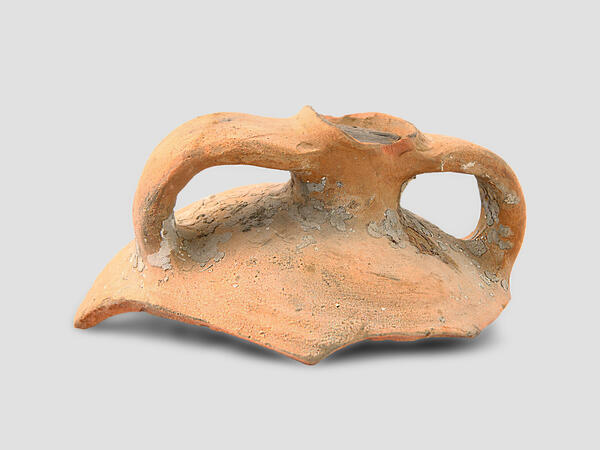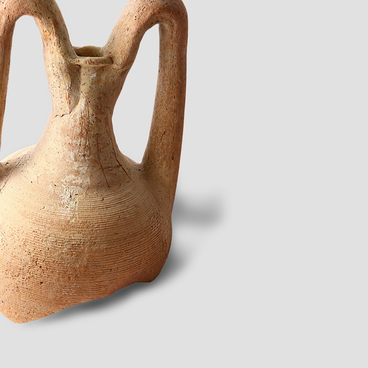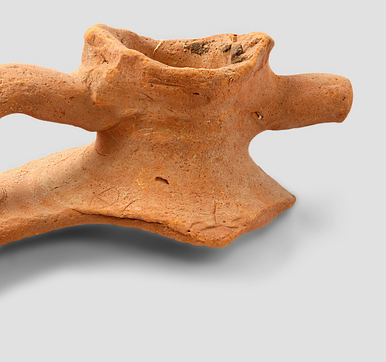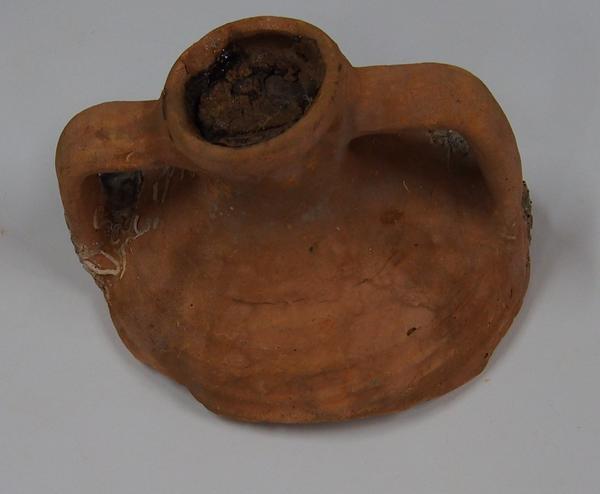
In 1999, underwater excavations in the bay of the Novy Svet settlement were focused on the shipwreck site under Mount Koba-Kaya. The excavated material included pithoi, amphorae, kitchenware, dishware, glassware and glazed ceramics, as well as this fragment of an amphora with a sealed neck.
In antiquity, clay amphorae became the first “standard” vessels for storing and transporting liquids. The shape of an amphora was well thought-out. A raised, rather narrow neck made the vessel more airtight and prevented the product from being spoiled. Two handles, usually designed for two people, made the loading and unloading easier. The amphora dimensions were calibrated depending on the capacity of ships and carts.
The tapered bottom collected sediment; it was also convenient for sea transportation. The holds of cargo ships were filled with sand, in which the amphorae were buried. Thus, a low temperature was maintained in the container during the voyage, and the vessels themselves, firmly fixed, did not collide with each other and served as ballast.
Ancient Greeks made an art of manufacturing amphorae. The Romans introduced standard sizes of containers, and this utilitarian approach persisted until the late Middle Ages. The standardization was aimed at reducing the weight of the containers, increasing the strength of their walls and accommodating as many amphorae filled with goods as possible in the holds and cargo compartments.
Depending on the place of production, the unified amphorae differed in color, structure and mineral composition of raw materials.
The analysis of amphorae helps to establish the place of their production, reconstruct trade routes and date finds. The earliest examples of amphorae with a widened body and a small bottom are attributed to the 6th–5th centuries BC; the tapered forms became widespread in the 4th–2nd centuries BC; after the 2nd century, the widened ones were reintroduced but this time they had ribbing. In the late Middle Ages, three main types of amphorae can be distinguished: spheroid amphorae with a round bottom and tapered ones with a pointed bottom (both types featured ribbing and high handles), as well as flat-bottomed neck amphorae with wavy or linear patterns.