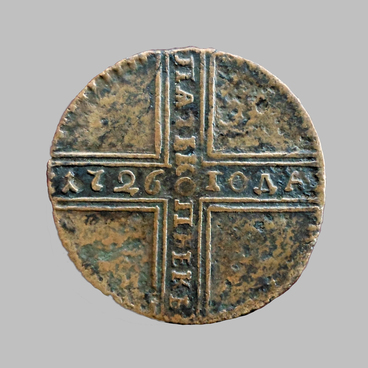
The numismatic collection of the Karasuksky Regional Museum includes a round, solid copper coin, with a face value of five kopeks. The design is from 1765, minted under Catherine II. Despite the striking diameter - 42 millimeters - it is not the largest five-kopek coin in the history of Russian numismatics. A square coin measuring 45×45 millimeters, with a weight of 81.9 grams was minted under Catherine I in 1726. The 1765 model of the five-kopek coin was solid, meaning that the coin could not be divided into parts with purchasing power.
In January 1762, as a result of the dire economic situation in Russia stemming from the Seven Years’ war, Tsar Peter III ordered that all current five-kopek coins should be re-minted into ten-kopek coins, and that the coin to metal ratio for them should change. The ratio determines the exact quantity of coins, of one face value, which could be printed from a pre-determined amount of metal. The copper to coin ratio changed from 16 rubles from 16.3 kilograms of copper, to 32 rubles from the same weight of copper. That meant that the weight of one coin now was the combined weight of two, and a theoretical million rubles morphed into two million. In December of the same year, Catherine II came to the throne and established the minting of five-kopek coins, as well as bringing back the 16 rubles copper to coin ratio. In 1766, this coin would pay for a five verst journey - around five kilometers - on a stage-coach.
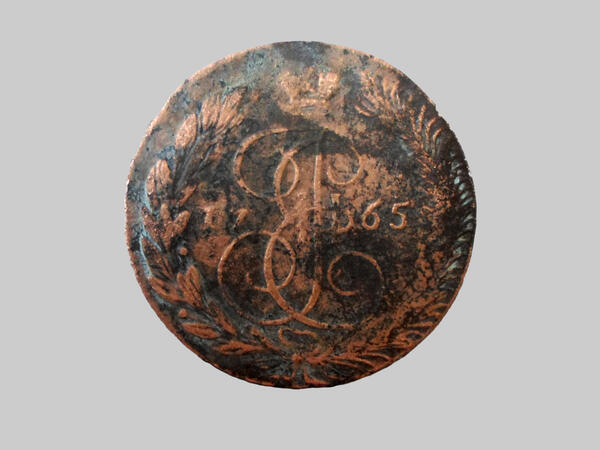
A two-headed eagle with three crowns, an orb and scepter is depicted on the five kopek’s obverse. A shield on the eagle’s chest bears the Moscow coat of arms: Saint George in armor, on a galloping horse, striking a dragon with his spear. Despite the far from perfect state of the exhibit, it is still possible to see the chain of the order of Andrew the Apostle surrounding the shield. The letters ‘E M’ are displayed down the sides of the eagle. This is the designation of the Yekaterinburg Mint. A ribbon and the coin’s face value are displayed above the eagle. The reverse is in a better state. Catherine II’s royal cipher is positioned in the center of the reverse, formed of the Russian letters ‘I’ for Empress and ‘E’ for Catherine and the numbers ‘II’ for ‘The Second’. The date of issuance, 1765, is written on the side of the cipher. The coin’s rim is latticed, meaning that it is formed of little cuts pointing in different directions.
Under Catherine II, copper coins used across the nation were minted at the Yekaterinburg (with the designation EM), Moscow Red (MM or without designation), Sestroretsky (SM or without designation), Saint Petersburg (SPM), Anninsky (AM and without designation), Suzunsky (KM) and Tavrichesky ™ mints.
In January 1762, as a result of the dire economic situation in Russia stemming from the Seven Years’ war, Tsar Peter III ordered that all current five-kopek coins should be re-minted into ten-kopek coins, and that the coin to metal ratio for them should change. The ratio determines the exact quantity of coins, of one face value, which could be printed from a pre-determined amount of metal. The copper to coin ratio changed from 16 rubles from 16.3 kilograms of copper, to 32 rubles from the same weight of copper. That meant that the weight of one coin now was the combined weight of two, and a theoretical million rubles morphed into two million. In December of the same year, Catherine II came to the throne and established the minting of five-kopek coins, as well as bringing back the 16 rubles copper to coin ratio. In 1766, this coin would pay for a five verst journey - around five kilometers - on a stage-coach.
A two-headed eagle with three crowns, an orb and scepter is depicted on the five kopek’s obverse. A shield on the eagle’s chest bears the Moscow coat of arms: Saint George in armor, on a galloping horse, striking a dragon with his spear. Despite the far from perfect state of the exhibit, it is still possible to see the chain of the order of Andrew the Apostle surrounding the shield. The letters ‘E M’ are displayed down the sides of the eagle. This is the designation of the Yekaterinburg Mint. A ribbon and the coin’s face value are displayed above the eagle. The reverse is in a better state. Catherine II’s royal cipher is positioned in the center of the reverse, formed of the Russian letters ‘I’ for Empress and ‘E’ for Catherine and the numbers ‘II’ for ‘The Second’. The date of issuance, 1765, is written on the side of the cipher. The coin’s rim is latticed, meaning that it is formed of little cuts pointing in different directions.
Under Catherine II, copper coins used across the nation were minted at the Yekaterinburg (with the designation EM), Moscow Red (MM or without designation), Sestroretsky (SM or without designation), Saint Petersburg (SPM), Anninsky (AM and without designation), Suzunsky (KM) and Tavrichesky ™ mints.