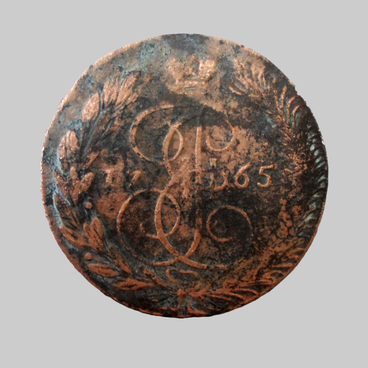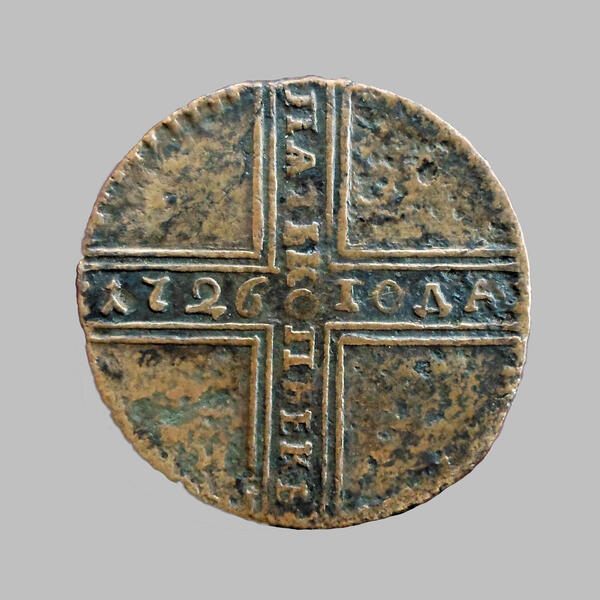
The numismatic collection of the Karasuksky Regional Museum includes a round, solid copper coin, with a face value of five kopeks. It was issued in 1726, and the coin was in circulation during Catherine I’s reign. Catherine I was the second wife of Peter the Great, and came to the throne after his death in 1725. This coin was the only copper coin minted during Catherine I’s reign.
The coin has a patterned rim. The small State coat of arms is positioned in the center of the coin’s obverse, surrounded by five small raised dots. The coat of arms depicts a two-headed eagle under three crowns, with an orb and scepter in its talons. These dots allowed illiterate members of the population to determine the coin’s value. Under the eagle, the letters ‘Н’ and ‘Д’ (N and D) identify that the coin was minted at the Copper Embankment Mint. The coin’s reverse also has a patterned rim. The coin’s face is divided into four parts by a cross, which is bordered by another set of parallel raised lines. A horizontal inscription shows the coin’s value, whilst a vertical inscription shows the year of issuance. The coin’s edge or rim is latticed, meaning that it is covered by smooth cuts pointing in different directions. This edge strengthened the metal and made forgery more difficult.
Between 1723 and 1730, lightweight copper coins were minted at the Moscow Red Mint (with the designation KD), the Kadashyovsky Mint (with the designations MOSCOW, MD, DM, MM or without any designation) and the Copper Embankment Mint (ND or without designation). A 40-ruble ratio was established for these mints, meaning that 16.3 kilograms of copper would be made into exactly 40 rubles of a particular type of coin. Coin ratios allowed the mints to control the number of coins issued and the mass of each coin.
Most of the coins of this type were made with an unusual method for Russian coins - the reverse faces the opposite direction from the obverse. Some of the coins, however, were produced with the usual arrangement of faces. Most of the lightweight kopeks were later re-minted as quarter-kopeks between 1730 and 1735, whilst the five-kopek coins were re-minted as kopeks and other coins between 1755 and 1757. These kopeks were used until February 1731, after which they were accepted according to their weight in copper.
The coin has a patterned rim. The small State coat of arms is positioned in the center of the coin’s obverse, surrounded by five small raised dots. The coat of arms depicts a two-headed eagle under three crowns, with an orb and scepter in its talons. These dots allowed illiterate members of the population to determine the coin’s value. Under the eagle, the letters ‘Н’ and ‘Д’ (N and D) identify that the coin was minted at the Copper Embankment Mint. The coin’s reverse also has a patterned rim. The coin’s face is divided into four parts by a cross, which is bordered by another set of parallel raised lines. A horizontal inscription shows the coin’s value, whilst a vertical inscription shows the year of issuance. The coin’s edge or rim is latticed, meaning that it is covered by smooth cuts pointing in different directions. This edge strengthened the metal and made forgery more difficult.
Between 1723 and 1730, lightweight copper coins were minted at the Moscow Red Mint (with the designation KD), the Kadashyovsky Mint (with the designations MOSCOW, MD, DM, MM or without any designation) and the Copper Embankment Mint (ND or without designation). A 40-ruble ratio was established for these mints, meaning that 16.3 kilograms of copper would be made into exactly 40 rubles of a particular type of coin. Coin ratios allowed the mints to control the number of coins issued and the mass of each coin.
Most of the coins of this type were made with an unusual method for Russian coins - the reverse faces the opposite direction from the obverse. Some of the coins, however, were produced with the usual arrangement of faces. Most of the lightweight kopeks were later re-minted as quarter-kopeks between 1730 and 1735, whilst the five-kopek coins were re-minted as kopeks and other coins between 1755 and 1757. These kopeks were used until February 1731, after which they were accepted according to their weight in copper.