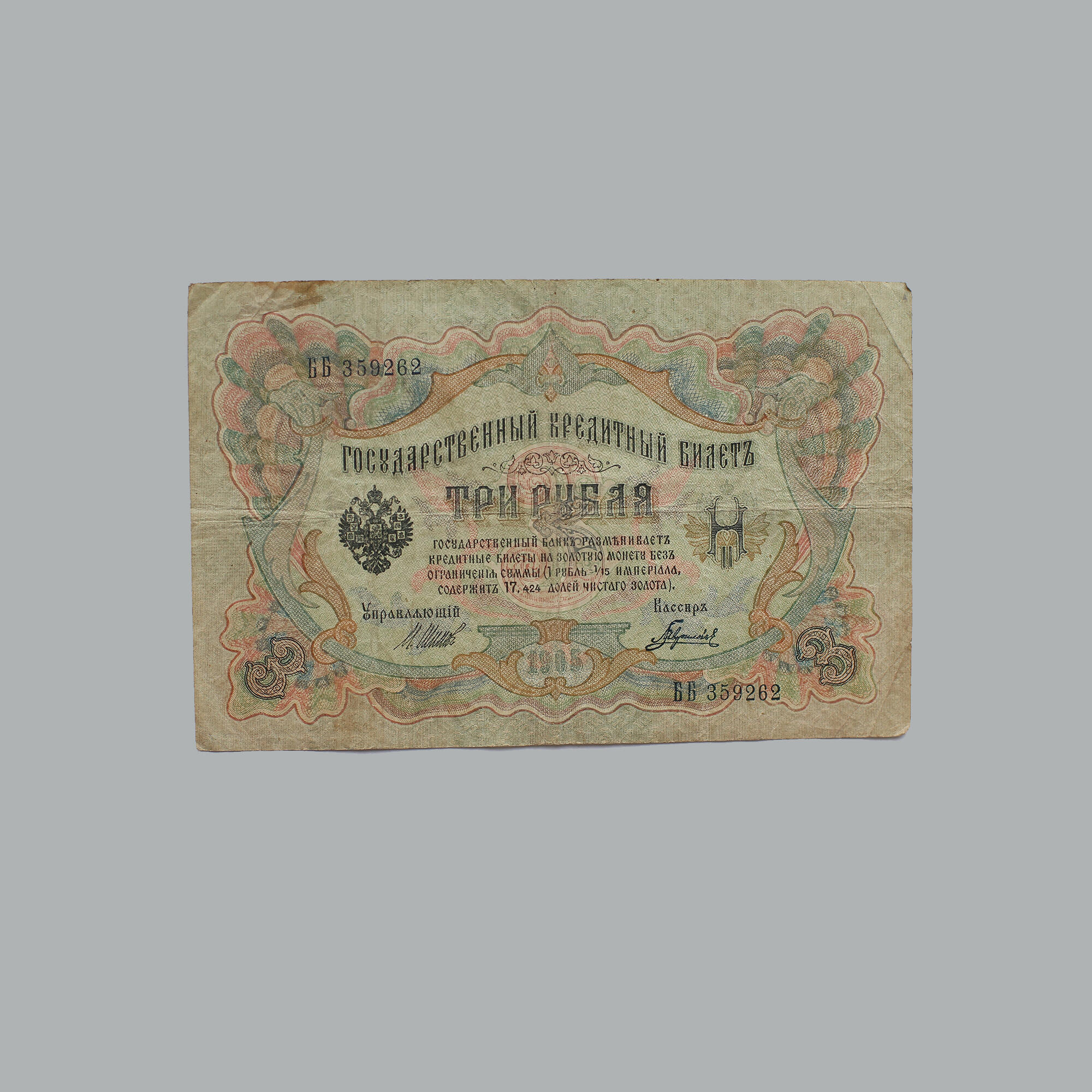


The Karasuksky Regional Museum holds a three-ruble paper banknote, issued in 1905, in its collection. This credit note was printed between 1905 and 1912 as part of a total circulation of 98 million notes. In 1909, in Tomsk, three-rubles would buy you around 16 kilograms of fresh pike or around 48 kilograms of wheat flour.
Banknotes with the new design were introduced in 1905, as printing facilities became more advanced. From 1907, the new banknotes were gradually introduced. 3, 10 and 25-ruble notes were issued until 1919, whilst 100 and 500-ruble notes appeared after 1921. This three-ruble note is printed on white paper with water marks in both usually typography as well as metallographic printing. This technique uses a fairly thick layer of paint on the paper, which, when dry, means you can feel slightly raised elements of the drawing with your fingertips.
They used ‘Orlov printing’ for these banknotes - a method which made it possible to print several different colors from the same printing plate. It was invented by an expert in weaving mills, Ivan Orlov, when he was invited to the Expedition of Storing State Papers to develop silk banknotes. The method worked by ensuring that the paint from each template was transferred to the combined shaft, from which it was then transferred to the printing plate, and then printed onto the paper. This made a perfectly fitted multi-color impression. These printers could use up to five colors on each side, without leaving any gaps or overlays in the drawing. The multicolored notes printed with the Orlov method created banknotes which could not be forged by usual typographic methods.
On the obverse of the three-ruble note, there is a multicolored background and a design, above which the inscription ‘State Bank Note’ is printed. Beneath it the year of issuance - 1905 - is printed. The small state coat of arms is positioned in the center of the note, as well as Tsar Nicholas II’s cipher, the note’s value (‘THREE RUBLES’) and a small four-line inscription: ‘The State Bank exchanges credit notes for gold coins without restrictions for the amount exchanged. One ruble = 1/15 imperial, containing 17.424 shares of pure gold.’ This means that the banknote’s value was equivalent to three minted gold rubles and could be exchanged for them. The note’s reverse, along with its multicolored background and design, also has an inscription taken from the passages of the law referring to the forgery of money. The designer has also positioned a watermark on the reverse, formed of the number three repeated many times in wavy lines.
Banknotes with the new design were introduced in 1905, as printing facilities became more advanced. From 1907, the new banknotes were gradually introduced. 3, 10 and 25-ruble notes were issued until 1919, whilst 100 and 500-ruble notes appeared after 1921. This three-ruble note is printed on white paper with water marks in both usually typography as well as metallographic printing. This technique uses a fairly thick layer of paint on the paper, which, when dry, means you can feel slightly raised elements of the drawing with your fingertips.
They used ‘Orlov printing’ for these banknotes - a method which made it possible to print several different colors from the same printing plate. It was invented by an expert in weaving mills, Ivan Orlov, when he was invited to the Expedition of Storing State Papers to develop silk banknotes. The method worked by ensuring that the paint from each template was transferred to the combined shaft, from which it was then transferred to the printing plate, and then printed onto the paper. This made a perfectly fitted multi-color impression. These printers could use up to five colors on each side, without leaving any gaps or overlays in the drawing. The multicolored notes printed with the Orlov method created banknotes which could not be forged by usual typographic methods.
On the obverse of the three-ruble note, there is a multicolored background and a design, above which the inscription ‘State Bank Note’ is printed. Beneath it the year of issuance - 1905 - is printed. The small state coat of arms is positioned in the center of the note, as well as Tsar Nicholas II’s cipher, the note’s value (‘THREE RUBLES’) and a small four-line inscription: ‘The State Bank exchanges credit notes for gold coins without restrictions for the amount exchanged. One ruble = 1/15 imperial, containing 17.424 shares of pure gold.’ This means that the banknote’s value was equivalent to three minted gold rubles and could be exchanged for them. The note’s reverse, along with its multicolored background and design, also has an inscription taken from the passages of the law referring to the forgery of money. The designer has also positioned a watermark on the reverse, formed of the number three repeated many times in wavy lines.