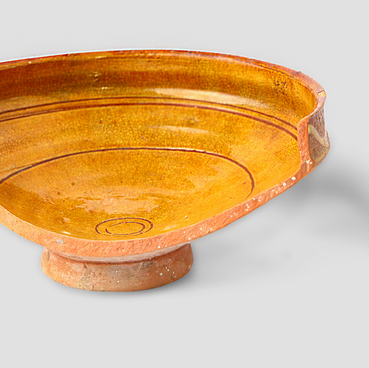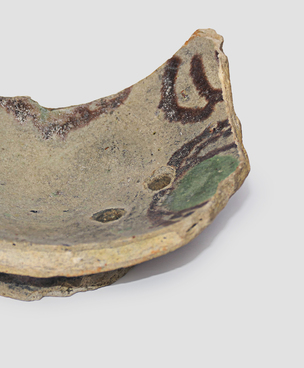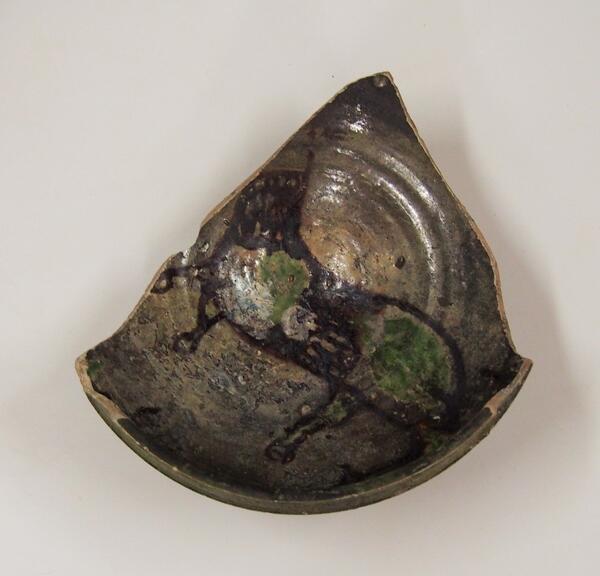
Ceramics occupy the first place among the various archaeological finds from antiquity and the Middle Ages. Vessels that have been preserved intact are rare; as a rule, restorers have to reconstruct them from fragments. Sometimes, specialists have the so-called archaeologically complete profiles or forms when it is possible to accurately “rebuild” the missing fragments even if they are significant.
The exhibit, which lost two-thirds of its volume, is one such profile.
This whiteware bowl is a characteristic example of Byzantine pottery; similar items were regularly imported to the Northern Black Sea Region until the second half of the 13th century. In all probability, the painted ware was expensive and therefore did not spread widely.
Among the distinctive features of such ceramics is a thinly applied layer of transparent glaze, through which the painting is clearly visible. The image is a contour drawing, partially painted with spots of green (sometimes brown) dye. The main decoration is the image of an animal.
The bowl rests on a high foot ring. By the time the exhibit was made, various vessel forms and elements of design had already been actively adopted and copied by potters in different regions. At the same time, researchers believe that the techniques of making foot rings were not yet standardized and were, for a long time, passed by the Black Sea craftsmen only to their students.
Byzantine ceramicists created massive blanks for these parts and later attached them to the already finished wares. For connecting the foot to the body of the vessel, a recess was made in the foot which was later smoothed out with wet hands to mask the “seams”.
Unlike Byzantine pottery, Chersonese wares do not have a convex recess in the foot, so the surface retains its natural curve. Due to the distribution of clay residues on the outer side of the vessel, the wall outside the foot is thicker than inside of it.
Scientists traced the evolution of the foot ring based on the ware found in the Northern Black Sea Region. Gradually, wide, short and hollow feet became narrower, taller and hollower. Later, the recess received a complex profile, and the top of the foot became noticeably thinner than the lower part. Eventually, the foot became short and had a deep recess.