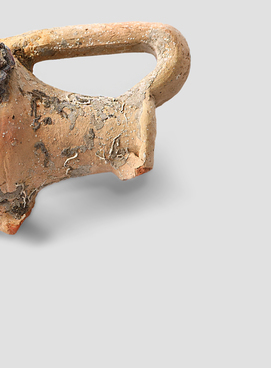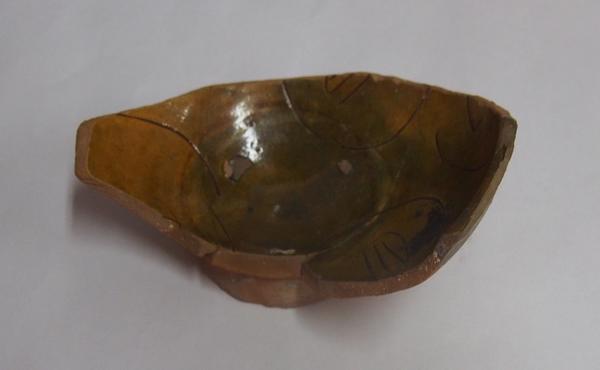
Pottery has always been associated with sedentism. In the Middle Ages, when many artisans roamed the cities in search of new knowledge and profitable orders, potters were the least mobile of them all. Professor Valentin Nikolayevich Danilenko explained it as follows, “a mason or carpenter can easily carry everything he needs for his work in a shoulder bag… his <potter’s> tools (primarily the potter’s wheel) are massive.” The work also requires meticulous study of local raw materials: water, sand, and various clays.
Despite this, some potters still ventured to move and adapt their experience to new places. This led to the establishment of professional techniques, product shapes, and methods of decoration.
The potter’s first task was to select good raw materials. Clay was finely pounded and diluted with water, removing air bubbles at the same time, to achieve a homogenous and pliable mass. To reduce the risk of the product becoming too dry during firing, softeners were added to the clay, such as fine sand, crushed mica and shells.
The second earliest method of making something from clay (after molding from a single piece) was to form the body with threads or large pieces of clay and join them with clay mortar. For a more complex method — modeling — concave or curved molds were made. A layer of clay was pressed into it or smoothed over the surface.
The advent of the potter’s wheel made it possible to mass-produce pottery and finish standardized vessels at a much greater speed.
Polishing and glossing of the surface made the ware more water-resistant and pleasing to the eye. Initially, polishing was done simply with wet hands; then a thin layer of clay — a white or colored engobe — began to be used. Later, products were glazed (an engobe becomes a glaze during firing at high temperatures).
As a rule, firing was done over an open fire. When more heat was required, particularly to bake the glaze, ceramics were placed in special kilns.
The analysis of pottery forms an important part of archaeological research and covers not only the evolution of the wares themselves but also the cultural context of their development.