Pottery, along with stone working, is considered one of the oldest crafts: its origin is attributed to the 5th–3rd millennium BC, the Neolithic era. Clay was distinguished as a material that was readily available and easy to process; it was light and at the same time strong after drying, and it retained moisture well.
The first pottery products were roughly molded containers for storing food and water, but the production was improving rapidly: soon, various types of dishware appeared, not only for the household but also ceremonial purposes, such as oil lamps and funerary urns.
Greek pottery is considered an example of the ancient pottery art. The craftsman achieved perfection in making clay vessels in a variety of shapes even without the use of décor, colored enamels, transparent glaze and complex dyes.
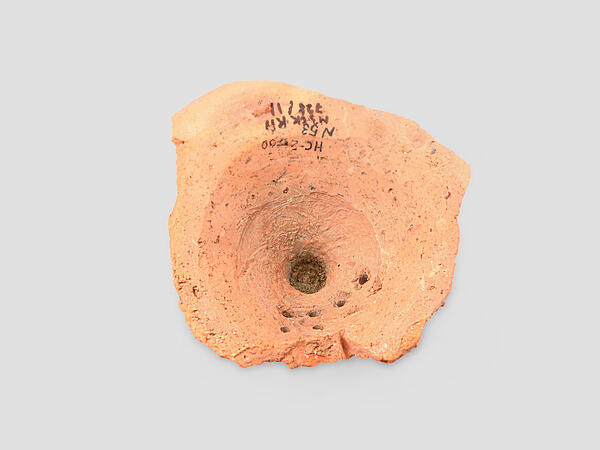
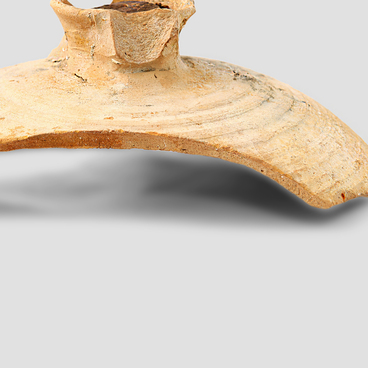
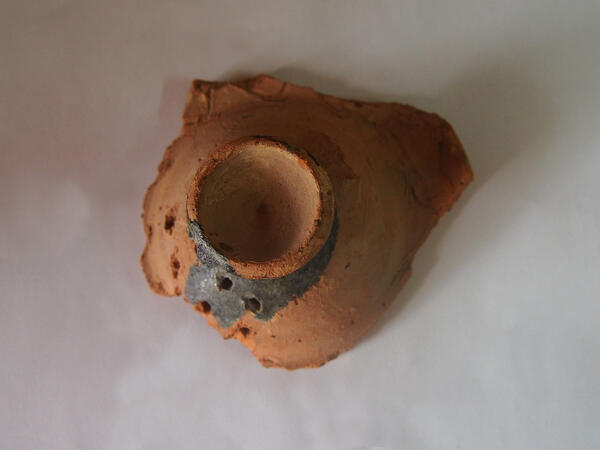
By the 15th–16th centuries, the markets offered sophisticated ceramic cooking dishware, which would inspire modern pots with lids. One such lid — a cone-shaped object with a massive handle with a round knob — is presented in this collection.
Eight holes are drilled in one side of the object, which were intended to release steam and liquid during cooking. The bent wide rim made the lid rather airtight. When turned upside down, the lid could be used as a colander to strain broth. It could also be used as a plate for cooked meat or fish.
The lid was raised from a depth of about six meters by scuba divers of the underwater archaeological expedition at Cape Ai-Foka.
Archeologists call the artifacts recovered from the bottom “wet” and, after raising the objects, process and conserve them. The maritime archaeology specialist Sergey Fokin admitted in an interview that there is no universal “method of preserving ‘wet’ objects… But the first step is to get rid of salt.” In order to do that, the find is soaked in fresh water for a long time. This way, the salt gradually comes to the surface, while the structure of the object is left intact.