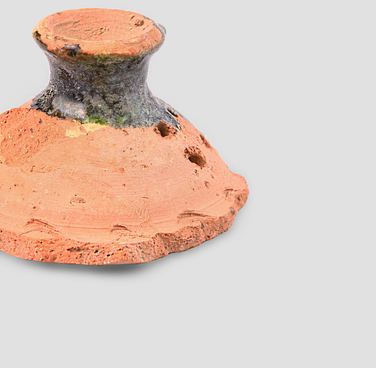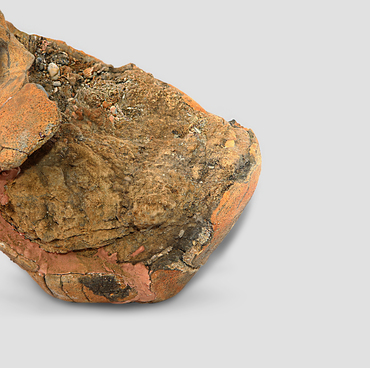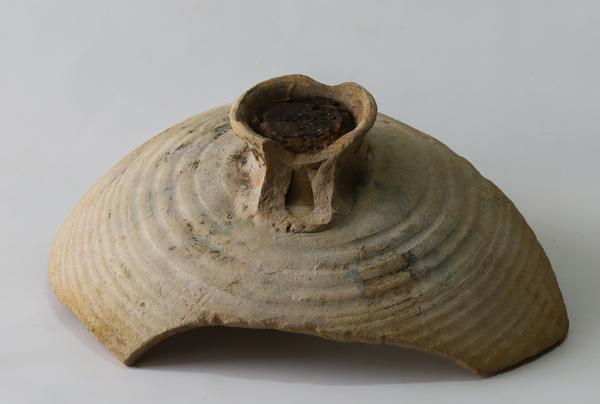
The presented fragment belongs to the widespread “pear-shaped” type of amphorae.
Such vessels were made from the 5th to the 8th centuries; their mass production began in the 10th century. The archaeologist Valery Viktorovich Bulgakov and the specialist in geochemistry and physics of minerals Nikolay Kirillovich Kramarenko point to the connection of Byzantine amphorae “with the southern Black Sea regions of the empire, through the agricultural transit… to the Mediterranean and Black Sea regions.”
A team of authors who studied the amphorae of Chersonesus from the Middle Ages (Irina Aleksandrovna Antonova, Valentin Nikolayevich Danilenko, L.P. Ivashuta, Vladimir Ivanovich Kadeyev and Alla Ilinichna Romanchuk) mentioned pear-shaped vessels in describing several stages in the development of amphorae.
According to research, large-sized amphorae with rounded bottoms, massive handles and high straight necks were common in the 5th–6th centuries. Products of the 6th–7th centuries were characterized by a wider neck, which was completed by a half-round rim, a pointed bottom and a surface decorated with fine ribbing.
The examples of the 10th–11th centuries are characterized by light yellowish-brown or brick-purple fragments with admixtures of straw or crushed coquina. The wide, thick-walled body is somewhat shortened, with a rounded bottom on one side and a narrow neck with a funnel-shaped rim on the other.
Handles, which previously began at about the middle of the amphora neck, were now attached directly under the rim, noticeably elevated above the neck and steeply bent, joining the shoulders of the vessel. Valery Bulgakov and Nikolay Kramarenko attribute the appearance of a characteristic curve, making the body resemble a pear, to the 11th century.
The researchers also indicate the evolution of the amphora rim from being massive to becoming more exquisite and later flattened.
The pear-shaped amphorae were last produced in the 12th–14th centuries. The later examples were made of well-mixed and dense clay, which helped to apply even, well-defined grooves to the product.The vessels had thick walls, and massive high handles were still attached directly to the rim. At this time, pear-shaped amphorae were widespread in the Northern Black Sea region, as well as in the Dnieper and Don regions and some parts of Bulgaria.