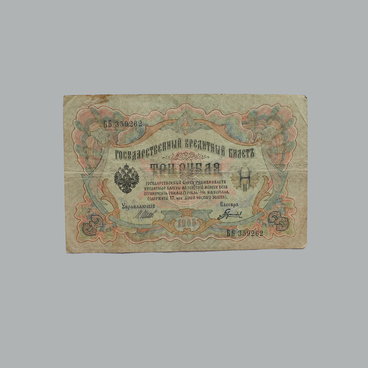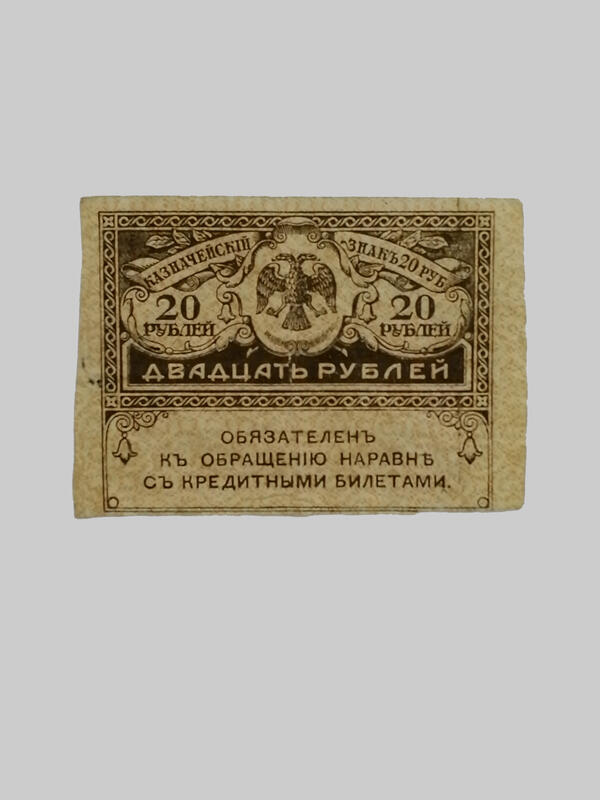
One of the items in the Karasuksky Regional Museum’s collection is a square-cut paper treasury banknote from 1917, with a face value of 20 rubles. In 1918, this note would buy you a pound of butter or four pounds of petrol.
There were a number of different issues facing the country: growing inflation caused by the events of the First World War and the February Revolution, driven by military expenditure, had already become an imminently pressing issue; the banknotes did not have collateral gold; there were crises in industry and agriculture; political upheavals were ongoing within the country whilst the value of golden coins and Tsar-era credit notes had slumped. All of these aspects required the issuance of new money with greater face values. The Ministry of Finance said that it was necessary to issue “simple” banknotes to reduce the deficit. The issuing of these treasury banknotes started under the Provisional Government in September 1917, but the main bulk of the notes were produced under the Soviet authorities. The last of these notes were issued in 1921.
The treasury banknotes were printed in sheets of 40 notes (five wide and eight high) and then cut by hand. They did not have any different varieties or dates, or even an authentic gold backing. Since the decision about the beginning of the issuing was signed by Alexander Kerensky, these notes earned the nickname “Kerenki”. The forty ruble treasury bank notes issued in 1917 are in the same category. In total, 22 million rubles of kerenki notes were issued. They were replaced before 1 October 1922.
The design on the museum’s kerenki note is colored in pink and brown. It was trimmed by hand. The note’s obverse has a patterned background, with an ornamental frame divided into two. The following text is positioned below: “REQUIRED TO BE ACCEPTED ON A PAR WITH CREDIT NOTES” On top of the frame is another decorated figured frame with a two-headed Bilibin eagle in the middle. As all of the eagle’s royal symbolism had been removed from it, the people called the eagle ‘stripped’ and ‘plucked’.
The reverse’s background is in the form of a geometric pattern. Small guilloche rosettes are positioned in the corners with the number “20”. A three-line inscription is written the bottom of the central oval, warning that forgery will lead to prosecution. However, during the civil war, kerenki notes were often printed illegally, in underground printing houses, using unsuitable paper and inks. These notes didn’t inspire confidence amongst the general population. They lost their purchasing power on 8 September 1922. The exchange of treasury banknotes for RSFSR banknotes occurred at a ratio of 10,000:1.
There were a number of different issues facing the country: growing inflation caused by the events of the First World War and the February Revolution, driven by military expenditure, had already become an imminently pressing issue; the banknotes did not have collateral gold; there were crises in industry and agriculture; political upheavals were ongoing within the country whilst the value of golden coins and Tsar-era credit notes had slumped. All of these aspects required the issuance of new money with greater face values. The Ministry of Finance said that it was necessary to issue “simple” banknotes to reduce the deficit. The issuing of these treasury banknotes started under the Provisional Government in September 1917, but the main bulk of the notes were produced under the Soviet authorities. The last of these notes were issued in 1921.
The treasury banknotes were printed in sheets of 40 notes (five wide and eight high) and then cut by hand. They did not have any different varieties or dates, or even an authentic gold backing. Since the decision about the beginning of the issuing was signed by Alexander Kerensky, these notes earned the nickname “Kerenki”. The forty ruble treasury bank notes issued in 1917 are in the same category. In total, 22 million rubles of kerenki notes were issued. They were replaced before 1 October 1922.
The design on the museum’s kerenki note is colored in pink and brown. It was trimmed by hand. The note’s obverse has a patterned background, with an ornamental frame divided into two. The following text is positioned below: “REQUIRED TO BE ACCEPTED ON A PAR WITH CREDIT NOTES” On top of the frame is another decorated figured frame with a two-headed Bilibin eagle in the middle. As all of the eagle’s royal symbolism had been removed from it, the people called the eagle ‘stripped’ and ‘plucked’.
The reverse’s background is in the form of a geometric pattern. Small guilloche rosettes are positioned in the corners with the number “20”. A three-line inscription is written the bottom of the central oval, warning that forgery will lead to prosecution. However, during the civil war, kerenki notes were often printed illegally, in underground printing houses, using unsuitable paper and inks. These notes didn’t inspire confidence amongst the general population. They lost their purchasing power on 8 September 1922. The exchange of treasury banknotes for RSFSR banknotes occurred at a ratio of 10,000:1.