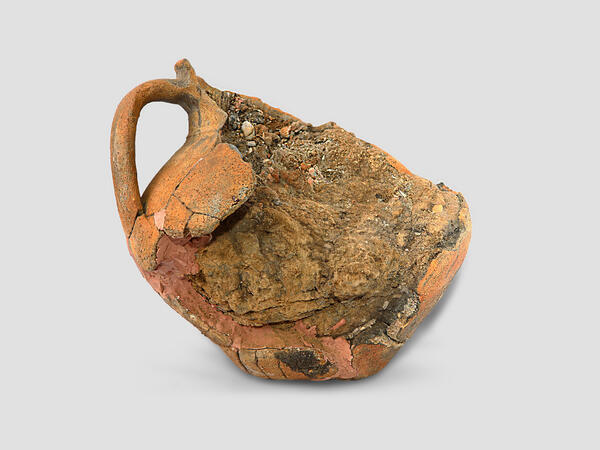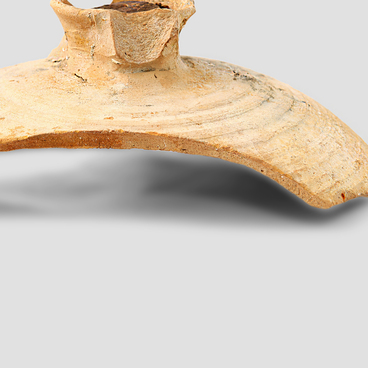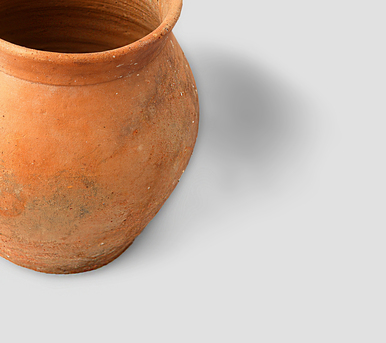
The presented fragment is probably part of a pot from the ship’s equipment that was intended for storing and cooking food.
In the 13th–14th centuries, the Black Sea navigation was predominantly coastal. The route of sailors lay through the bays; at night the crew left the ship and stayed on the shore. There they had the opportunity to hunt, fish, and gather various fruits and roots. So, coastal voyages were the most comfortable in terms of food.
The work of the Venetian geographer and statesman Marino Sanudo the Elder (1260–1338) provides some insight into what food the sailors of Venetian galleys had during long voyages. The list of essentials included meat, bread, vegetables, legumes, cheese and alcohol.
According to Sanudo, Fridays and Saturdays were fast days, so the crew usually had some vegetable stew. From Monday through Thursday, each crew member received an ounce and a half (about 60 grams) of meat, usually corned pork. The meat was mixed with beans or other legumes and vegetables to make soups or stews. However, the sailors received pieces of meat in turns: half of the team on even-numbered days and the other half — on odd-numbered days. “Thus, ” the author summarizes, “<sailors> had meat three times a week, and meat broth — five days a week.” On Sundays, the meat ration was doubled and did not depend on whose turn it was.
At the same time, usual fasting days were also observed, so if such a day fell at the beginning of the week, the portion of pork was postponed till the next feast day.
It was not uncommon for disputes to arise while the food was distributed: sailors could be dissatisfied with the fact that sometimes portions were unjustly increased for some of the crew at the expense of the rest of the team. To avoid such situations, Marino Sanudo proposed a system of duty assignments. According to his plan, three crew members were entrusted with serving simultaneously: one stood at the bow, another at the aftercastle, and the third (the main one in the group) in the middle of the deck. The three servers were regularly rotated.
The norms of provisioning the crew were fixed by Venetian laws of the early 14th century and were strictly monitored.