This solid round copper coin with a face value of two kopeks, from the Numismatic collection of the Karasuksky Regional Museum, is poorly preserved, so it is quite difficult to determine exactly where it was minted.
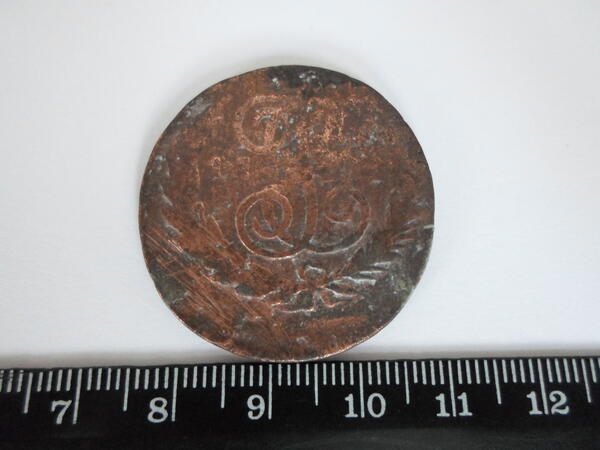
From the information which has been preserved, researchers have ascertained that this coin was in circulation during the reign of Catherine II, as the royal cipher (formed of two letters) is embossed in the center of the coin’s reverse. The numbers ‘17’ and ‘65’ have been preserved on either side of the cipher. This means that the coin was issued in 1765, three years after Catherine took to the throne. The cipher is surrounded by a wreath made of laurels and palm branches, tied together by a ribbon at the bottom. This is shifted up and to the right of the coin, meaning that there wasn’t space for the crown on the coin. The design on the coin’s rim cannot be distinguished.
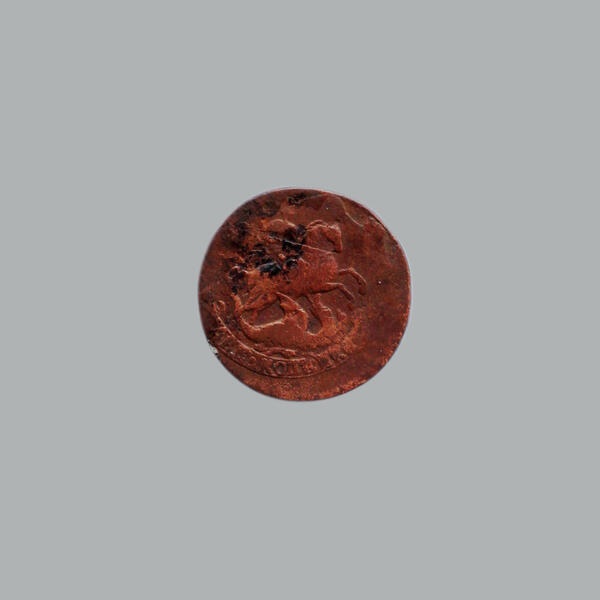
The Moscow coat of arms is depicted on the obverse of the coin- the Great Martyr Saint George, without a mantle, gallops on horseback, striking a dragon with his spear. Beneath this there is an inscription: ‘TWO • KOPEKS’. Beneath the horse’s left leg, it is possible to see the coin’s previous value. The practice of re-coining or re-minting was widespread in 18th century Imperial Russia. This is where a new image is applied to old coins using newer stamps.
1765 two kopek-coins were minted in three different mints: Yekaterinburg (with the designation EM), Moscow Red (with the designation MM) and Saint Petersburg (with the designation SPM). Later, the so-called re-minted coins were released with the EM stamp, but without the mint designation. These re-minted coins are essentially fake coins. However, there is a crucial difference between fake coins and re-minted coins, which is that the re-minted coins are produced at a State Mint. To re-mint the coins, they would either use the original tools and stamps or specially-made tools for a specific order. These types of re-minted coins were made at a later date than the one indicated on the coin.
There are two theories as to what exactly this coin is. Vladimir Bitkin’s two-volume ‘Composite Catalogue of Russian Coins’ suggests that it could be a re-minted coin, but without a mint designation. At this time re-minting took place at the Yekaterinburg mint. This mint produced coins with a smooth or cord-like rim - that is, the cuts are located at an equal distance from each other and are tilted to the right. According to Bitkin, the rarity of a coin like this is rated as R2 - Very Rare. There are only between nine to twenty examples of such a coin.
The second theory suggests that this re-minted coin was fairly common. Catherine II came to the throne as a result of a coup d’état after the death of her husband, Peter III. At the beginning of her reign, a significant proportion of coins were repurposed. Almost all of the two-kopek coins minted between 1763 and 1767 at the Yekaterinburg Mint, all the two-kopek coins minted at the Saint Petersburg and Moscow Red Mint and coins without designations were re-minted from four-kopek coins issued in 1762, which had the cipher of Peter III. In this case, it is a fairly common coin.
From the information which has been preserved, researchers have ascertained that this coin was in circulation during the reign of Catherine II, as the royal cipher (formed of two letters) is embossed in the center of the coin’s reverse. The numbers ‘17’ and ‘65’ have been preserved on either side of the cipher. This means that the coin was issued in 1765, three years after Catherine took to the throne. The cipher is surrounded by a wreath made of laurels and palm branches, tied together by a ribbon at the bottom. This is shifted up and to the right of the coin, meaning that there wasn’t space for the crown on the coin. The design on the coin’s rim cannot be distinguished.
The Moscow coat of arms is depicted on the obverse of the coin- the Great Martyr Saint George, without a mantle, gallops on horseback, striking a dragon with his spear. Beneath this there is an inscription: ‘TWO • KOPEKS’. Beneath the horse’s left leg, it is possible to see the coin’s previous value. The practice of re-coining or re-minting was widespread in 18th century Imperial Russia. This is where a new image is applied to old coins using newer stamps.
1765 two kopek-coins were minted in three different mints: Yekaterinburg (with the designation EM), Moscow Red (with the designation MM) and Saint Petersburg (with the designation SPM). Later, the so-called re-minted coins were released with the EM stamp, but without the mint designation. These re-minted coins are essentially fake coins. However, there is a crucial difference between fake coins and re-minted coins, which is that the re-minted coins are produced at a State Mint. To re-mint the coins, they would either use the original tools and stamps or specially-made tools for a specific order. These types of re-minted coins were made at a later date than the one indicated on the coin.
There are two theories as to what exactly this coin is. Vladimir Bitkin’s two-volume ‘Composite Catalogue of Russian Coins’ suggests that it could be a re-minted coin, but without a mint designation. At this time re-minting took place at the Yekaterinburg mint. This mint produced coins with a smooth or cord-like rim - that is, the cuts are located at an equal distance from each other and are tilted to the right. According to Bitkin, the rarity of a coin like this is rated as R2 - Very Rare. There are only between nine to twenty examples of such a coin.
The second theory suggests that this re-minted coin was fairly common. Catherine II came to the throne as a result of a coup d’état after the death of her husband, Peter III. At the beginning of her reign, a significant proportion of coins were repurposed. Almost all of the two-kopek coins minted between 1763 and 1767 at the Yekaterinburg Mint, all the two-kopek coins minted at the Saint Petersburg and Moscow Red Mint and coins without designations were re-minted from four-kopek coins issued in 1762, which had the cipher of Peter III. In this case, it is a fairly common coin.