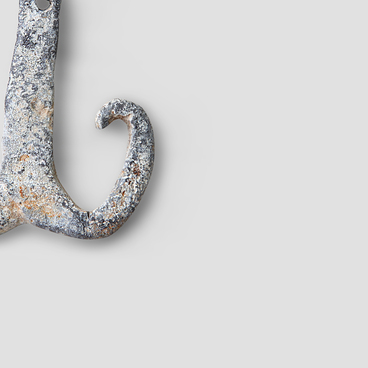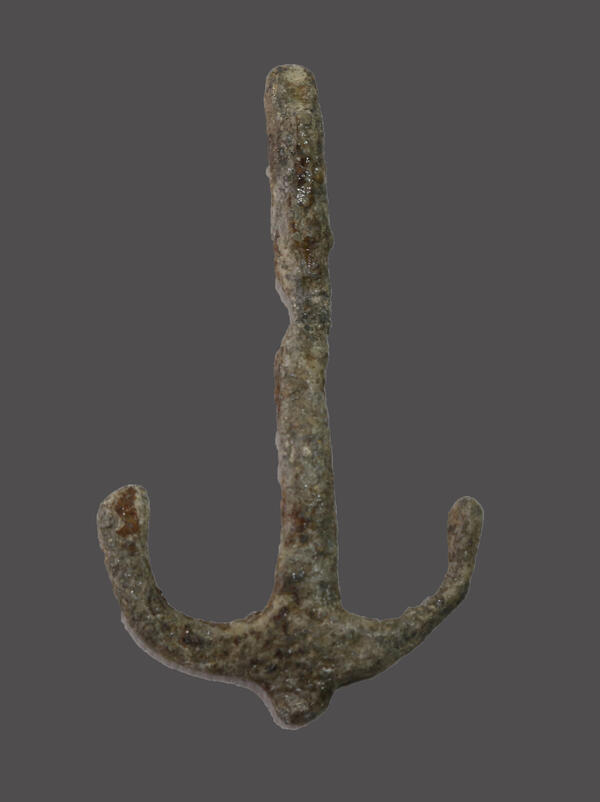
Archaeologists have found many miniature lead anchors in the coastal area of Sudak Bay. Although such items could be worn by sailors as amulets, most of them were probably thrown into the water before the voyage as votive offerings to the sea deities.
The tradition of votive offerings or ex-votos originated in pre-Christian times and was adopted by Christian culture during the early Middle Ages. The term comes from the Latin expression “ex voto suscepto” (from the vow made) which includes the word “votum” meaning “a promise, a vow”.
Mikhail Maizuls, a scholar of medieval history, indicated that this tradition is directly connected with two Latin sayings. The first one, “do ut des” (I give so that you may give) is a legal formula. It is relevant if the giver expects something in return. The second one, “votum solvit libens merito” (discharges the vow freely, as is deserved) is the formula of gratitude and performance of obligation. It applies if the offering is made after the fulfillment of a request.
Mikhail Maizuls identified that hagiographies often include scenarios in which a person “brings [or promises to bring] an offering that is supposed to hasten a miracle.” In some cases, two offerings are mentioned: one is made when praying for something or asking for help, while the other one is more valuable and is made only after the wish is fulfilled.
The form of the votive offering may reveal the nature of the request. Offerings could include tablets with paintings, wax, wood, or metal models of the afflicted part of the body, figures of babies or animals, and other obvious “hints” as to what was being asked for.
If the giver asked for a successful journey or battle, the votive offering could be represented by miniature “toy” copies of such paraphernalia as weapons, ships, and anchors.
Alexander Vasilyevich Okorokov and Andrey Valeryevich Kulagin noted that in the pre-Christian Mediterranean world, the image of an anchor was associated with Neptune (Poseidon) — the god of waters and seas, Amphitrite — the patroness of sailors and the mother of dolphins, and their son Triton — a half-human, half-fish.
After the adoption of Christianity, the anchor was usually associated with a cross.