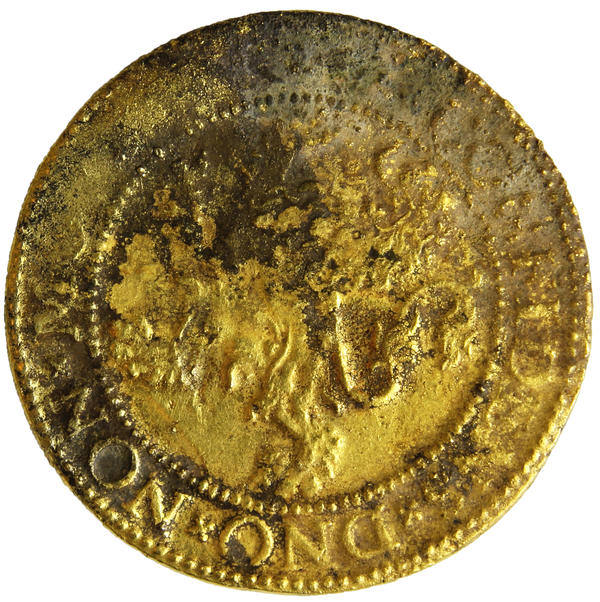
The golden leeuvendaalder, or the thaler with the lion, is a 15-ducat coin, minted in the Netherlands in 1589 from Spanish gold. It was found on the territory of the historical and architectural complex Arkhangelsk Gostiny Dvory (the merchant court) during archaeological excavations in 2009. Until now, only silver leeuvendaalders were known, which allows us to consider the Arkhangelsk gold coin as unique of its kind.
Silver thalers with a lion were first minted in the Netherlands in 1575, during the war for independence from Spain. Initially, the lion thaler was issued only for internal circulation, but soon became one of the most famous trading coins, receiving local names in many countries. In Russia, the coin was called ‘levok’, ‘levok taler’ (from ‘lev’, ‘lion’). Silver leeuvendaalders in the 17th century and even later were very popular in Ukrainian and Belarusian lands, while in Russia they were used mainly in jewellery.
The gold coin probably came to Arkhangelsk with one of the Dutch merchants who traded with Russia. Until 1713, Arkhangelsk was the only international commercial port of the country.
The coin bears traces of fire. It could be lost during a fire or burned many years after it had been lost. During its existence, Arkhangelsk burned out almost completely several times. Built in 1684, the stone Gostiny Dvor, as well as wooden buildings located next to the complex — benches, barns, and marinas — were repeatedly affected by fires. That is why it is difficult to say in which fire the golden leeuvendaalder suffered.
The coin is made of 986 gold. Its mass is 46.9 grams, diameter — 4.1 centimetres. On the obverse (the front, main side) of the coin the figure of a man dressed in knightly armour is minted. With his left hand, the knight holds the shield at his feet with the image of the coat of arms of the province — a reared lion. Along the coin edge, there is an inscription in Latin and the date ‘1689’. On the reverse of the coin the same heraldic lion is minted as on the shield, there is also an inscription in Latin along the edge.