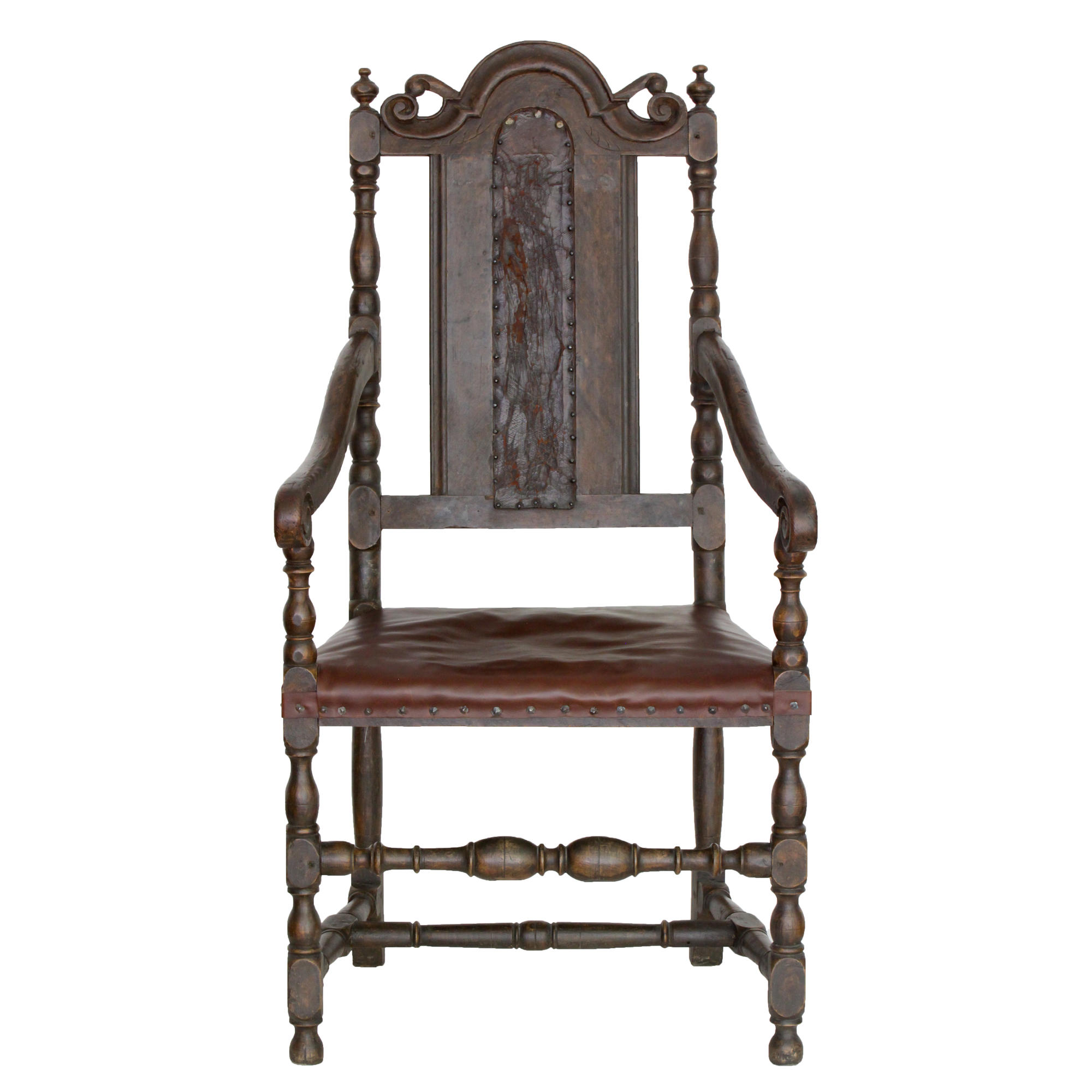


The object comes from the Antonievo-Siysky Monastery. According to the legend, the chair belonged to Filaret, whose secular name was Fedor Romanov (c. 1554-1633), a political and church figure, the patriarch of Moscow and All Russia (1608-1610; from 1619), the father of Tsar Michael.
The object got the museum thanks to the decision of Alexander II on the restoration of the old sovereign’s court and the creation of the Chambers of the Romanov Boyars in Moscow in 1856. Circulars were sent to all the provincial towns of the Russian Empire in search of items belonging to representatives of the Romanov dynasty. In the Arkhangelsk province, only the Antonievo-Siysky Monastery monastery sent an answer confirming having a Romanov relic. While the correspondence continued in search of finding means to transfer the chair to the capital, a message came that the Chambers had been restored and that there was no longer a need for new items. So the chair remained in Arkhangelsk.
This unique object took its rightful place in the collection of the museum of the Arkhangelsk Statistical Committee, and later — the Arkhangelsk Regional Museum. Currently, the chair is displayed in the permanent exhibition of the Arkhangelsk Regional Museum. In 2013, the relic was exhibited at the State Historical Museum in Moscow at the “Romanovs. The beginning of the dynasty” exhibition.
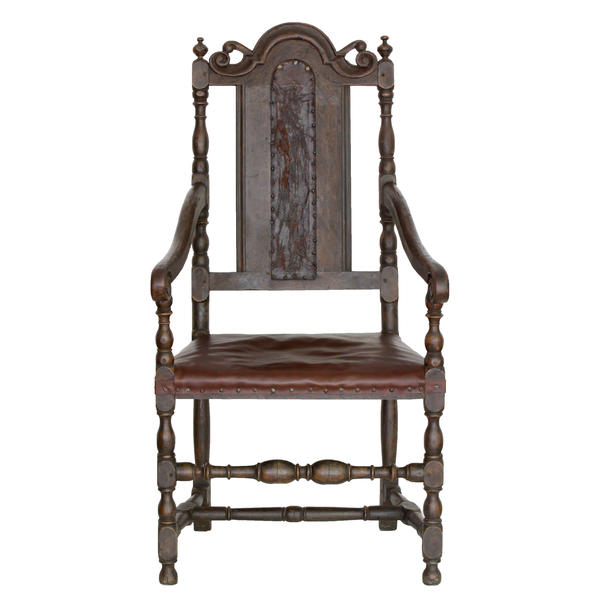
Filaret’s chair in appearance and quality is not inferior to European models of the late 16th — 17th centuries. Its chiselled legs are connected by hand loops. The seat is upholstered in brown leather. In the front the upholstery is covering the underframe and is nailed to it. The armrests — smooth, curved, with graceful ends in the shape of volutes (curls) — are attached to the chiselled stands. The back of the chair is high, straight, with chiselled side posts, ending with small phials. In the upper part of the back is a protruding semicircular top, on both sides of it, there are through-thread ornaments in the form of two adjoining curls. The middle part of the back is upholstered in leather.
Fyodor Romanov was forcibly tonsured a monk under the name of Filaret when he fell into disgrace under Boris Godunov and was exiled to the distant Antonievo-Siysky Monastery. During the reign of False Dmitry I, Filaret was returned to Moscow and elevated to the rank of Metropolitan of Rostov. In 1608, under False Dmitry II he was proclaimed the Moscow Patriarch. Since 1610, Filaret headed the Great Embassy to the Polish King Sigismund III. He was arrested by Polish interventionists and in 1611 sent to Poland as a prisoner of war. In 1619, Filaret returned to Russia and was made patriarch on June 24, received the title of ‘Great Sovereign’ and became co-rulers with his son, Tsar Michael.