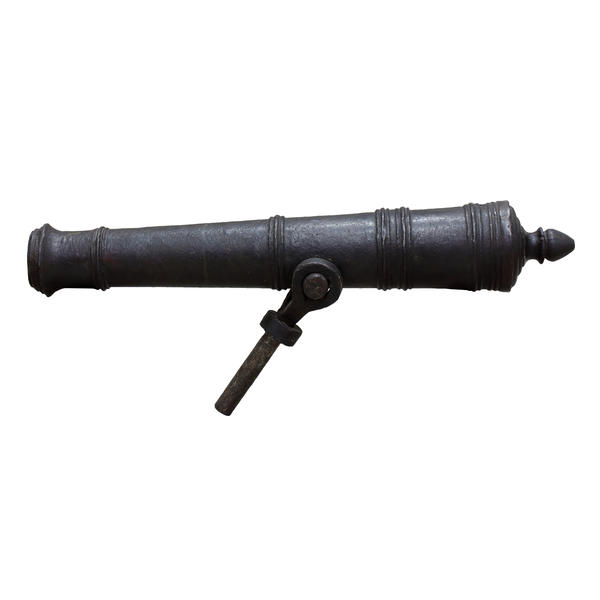
The Falconet cannon is one of the cannons of the Swedish ship captured during the Novodvinsk battle on June 25 (July 6), 1701. This is a small stationary rotary artillery cannon mounted onboard a vessel with a swivel, which provided free rotation of the cannon in two planes. The inner diameter of the barrel is 47 mm, which corresponds to the calibre of the cannonball — 74 zolotniks (315 g).
On June 25 (July 6), 1701, the first naval battle of the Northern War (1700-1721) with the vanguard of the Swedish squadron took place in the delta of the Northern Dvina River near the walls of the Novodvinsk fortress which was under construction. The plans of the Swedes to capture and defeat Arkhangelsk, the only seaport through which strategically important goods came to Russia from Western Europe, were known in Russia in advance. To cover the fairway of the Berezovsky (Ship) branch of the Northern Dvina River, artillery batteries were installed on the banks, the walls of the Novodvinsk fortress were erected hastily, all pilot marks were removed from the channel.
In mid-June 1701, the Swedish squadron entered the throat of the White Sea. They captured the Pomor boat off Sosnovets Island, whose helmsman Ivan Sedunov (Ryabov) was forced to become a pilot in order to navigate the ships to Arkhangelsk along the complex fairway of the Northern Dvina since the distance from the sea to Arkhangelsk was about 40 km. An inspection team under the command of Grigory Zhivotovsky was sent to meet them from the fortress. An alarm has been raised. The Swedes fired at the Russian carbasses, and then, in an attempt to catch them, they ran aground, which was not mentioned by the pilot Ivan Sedunov. The Swedes fell under the fire of coastal batteries and retreated under the threat of boarding. Two ships with all the equipment and weapons were captured by the Russian troops.
Peter the Great presented three captured Swedish cannons to Archbishop of Kholmogory and Vaga Athanasius for his contribution to organizing the defence of Arkhangelsk from the Swedish attack on June 25, 1701. After the death of the archbishop, the cannons continued to be kept in the bishop’s chambers. And after the construction of the Holy Trinity Cathedral in Arkhangelsk, they were transferred there for public viewing. After the liquidation of the cathedral in 1929, they were transferred to the Arkhangelsk Regional Museum.