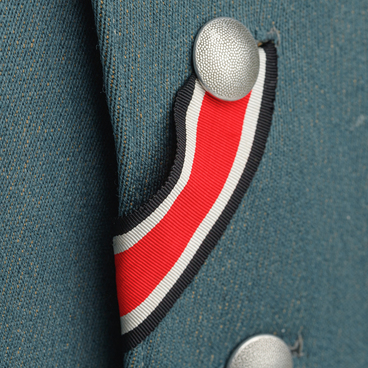
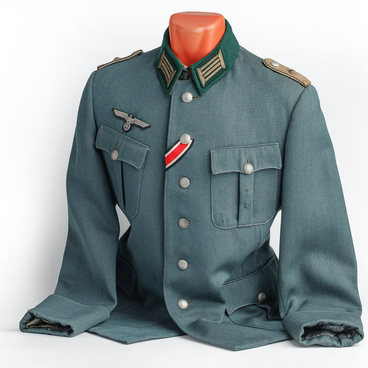
The Museum of Intelligence Officer Nikolai Kuznetsov houses a German Wound Badge (Verwundetenabzeichen) of the 1939 model. This badge belonged to Oberleutnant Paul Siebert — the operational pseudonym adopted by the legendary Soviet intelligence officer Nikolai Ivanovich Kuznetsov during his covert missions behind Nazi lines in the Great Patriotic War.
The Wound Badge was instituted on September 1, 1939, to honor military and police personnel wounded in combat. From 1943 onward, it was also awarded to civilians injured in air raids. In September 1944, eligibility was extended to foreign military personnel serving alongside German forces.
The badge featured an oval shape framed by a laurel wreath. At its center were crossed swords, overlaid by a profile view of the M1935 steel helmet bearing a swastika. The inner field of the wreath was textured with a dotted relief.
The black grade of the badge — awarded for one or two wounds — was initially stamped from thin sheet copper and later from base metal, then coated with matte black paint. Hence, over time, many such badges corroded.
According to the carefully constructed legend, Oberleutnant Paul Siebert had served in occupied Poland until March 1940, after which his unit was transferred west to take part in battles in France. On June 23, 1940, he suffered a concussion and shrapnel wounds from a grenade explosion. Following several weeks of hospitalization, he was assigned to a convalescent unit in Berlin. By then, he had already been promoted to Leutnant (lieutenant) on April 20, 1940.
For health reasons, he was discharged from active service that autumn and returned to the estate of Prince Schlobitten — where, according to his cover story, his father worked. On August 4, 1940, he was awarded the Iron Cross, 1st Class, and on August 26, the Wound Badge.
After Germany’s invasion of the USSR in June 1941, Siebert was recalled to service. Due to his incomplete recovery, however, he was assigned to a non-combat role: as an officer in the Wirtschaftskommando — the Wehrmacht’s economic command responsible for exploiting the material resources of occupied Soviet territories. Around this time, he was promoted to Oberleutnant.
His official duties involved organizing timber supplies along the Chernigov–Kiev–Ovruch–Dubno–Rovno route. In practice, Kuznetsov occasionally adapted his legend to suit operational needs: after settling in Rovno, he told German officers that he had fought near Moscow and been wounded there — a detail that enhanced his credibility.
Siebert’s fictional military record placed him in a division commanded by Lieutenant General Maximilian de Angelis. The general’s forged signature even appeared on Siebert’s Iron Cross award certificate. This fabricated combat background was crucial: frontline soldiers often distrusted rear-echelon quartermasters, but Siebert’s supposed frontline experience earned him respect and access. The role allowed Kuznetsov to travel throughout occupied territories, and ensured his freedom of movement, and gave him control over substantial funds — assets he used masterfully in the service of Soviet intelligence.