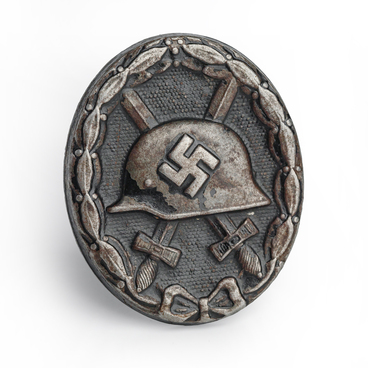
An interesting artifact in the collection of the Museum of Intelligence Officer Nikolai Kuznetsov is a German 1939-model ribbon. Such a ribbon was worn by Oberleutnant Paul Siebert — a persona that, in reality, concealed Nikolai Ivanovich Kuznetsov, a Soviet intelligence officer and partisan who operated deep behind enemy lines under this false identity.
The Iron Cross was re-instituted on September 1, 1939, at the outbreak of World War II. It was awarded to members of the German armed forces for acts of bravery or distinguished service in a specific combat engagement. By the end of the war, more than three million individuals had received the Iron Cross, making it one of the most widely distributed German military decorations.
According to Wehrmacht regulations, the Iron Cross 2nd Class was worn as a full medal only on the day it was awarded and during formal parades in full dress uniform. On all other occasions, recipients displayed only the ribbon — threaded through the second buttonhole of the tunic. Notably, the award was not limited to German citizens; it was also granted to foreign volunteers and collaborators who fought alongside Nazi Germany. Among the recipients were 39 women. The youngest known awardee was 12-year-old Alfred Czech, honored in March 1945 for rescuing twelve wounded German soldiers under heavy artillery fire near the Oder River.
On October 19, 1942, Nikolai Ivanovich Kuznetsov — posing as Oberleutnant Paul Siebert — first appeared on the streets of Rovno in full German officer’s uniform. According to legend, he had two high decorations awarded for his service: the Iron Cross 1st Class and the ribbon of the Iron Cross 2nd Class in his buttonhole. That ribbon, with its distinctive black-white-red stripes echoing the colors of the Nazi-era German flag, signaled to all who saw it that “Siebert” was a decorated and battle-tested officer. This carefully crafted detail of his cover identity played a crucial role in gaining the trust of high-ranking German officials and allowed Kuznetsov to move freely within enemy circles.
Operating as Siebert, Kuznetsov carried out daring sabotage missions, gathered vital intelligence, and personally eliminated key figures of the Nazi occupation apparatus in Ukraine. His actions significantly disrupted German operations and contributed to Soviet strategic planning — particularly in the lead-up to the Battle of Kursk. Nikolai Ivanovich Kuznetsov was killed in combat in 1944. For his extraordinary courage and service, he was posthumously awarded the title Hero of the Soviet Union.