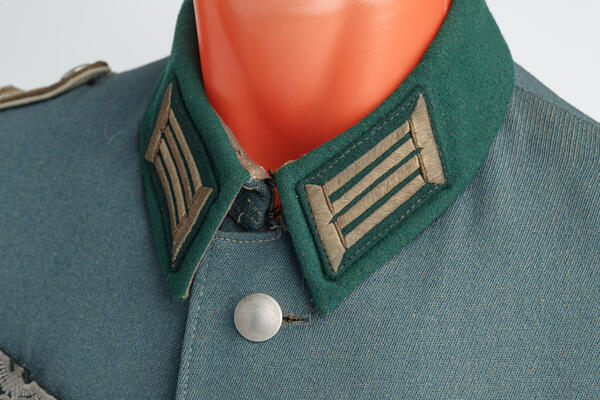
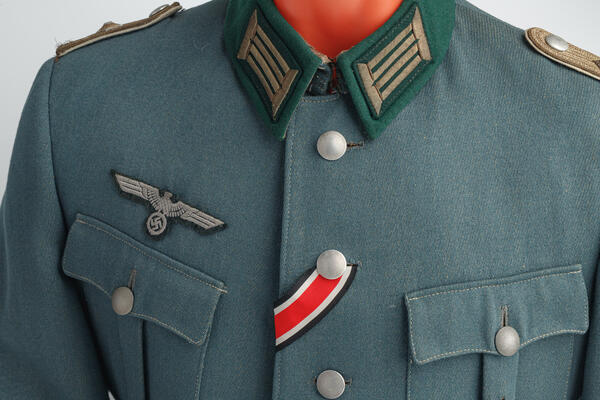
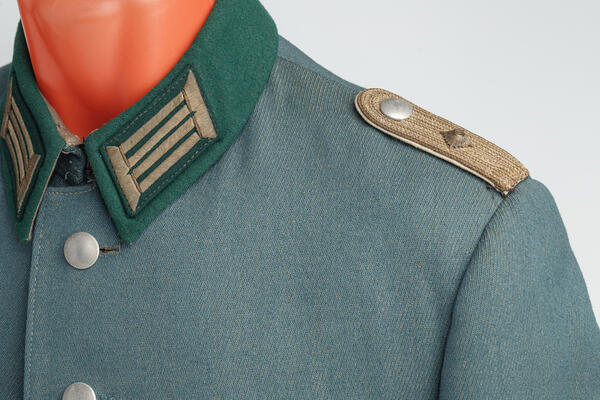
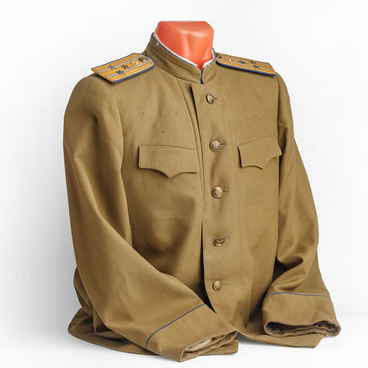
The tunic of a German officer is on display at the Museum of Intelligence Officer Nikolai Kuznetsov. It was in this tunic that Nikolai Ivanovich Kuznetsov operated in the occupied city of Rovno during World War II.
The German officers’ tunics closely resembled those worn by enlisted personnel and non-commissioned officers in cut and color but were made of higher-quality wool and featured distinctive wide, straight Litzen (collar tabs). These collar tabs were sometimes used as hidden compartments: official papers that were not too bulky were often concealed within them rather than carried in pockets or held in hand.
The tunic had four external patch pockets with a central pleat and was fastened with five gray metal buttons. The same buttons secured the pocket flaps. The collar was trimmed with dark blue-green Waffenfarbe (branch-of-service color), which also formed the backing for the national emblem (eagle and swastika) worn on the right side of the chest and for the officer’s collar insignia.
The tunic could be worn with either standard-issue trousers and laced ankle boots or with riding breeches and high cavalry boots. A brown leather officer’s belt was part of the uniform, though it was typically worn only in peacetime or during the early stages of the war.
Headgear varied according to season, duty, and personal preference: officers could wear the service cap (Schirmmütze), the field cap (Feldmütze, model 1934 or 1943), or a steel helmet. In the final months of the war, regulations were relaxed, and officers were permitted to wear a collared shirt and tie beneath the tunic, with the top button and collar hooks undone to display the shirt and tie.
On October 19, 1942, Kuznetsov first appeared on the streets of Rovno under the alias Oberleutnant Paul Wilhelm Siebert of the 230th Infantry Regiment, 76th Infantry Division. According to his elaborate cover story, Siebert was the son of a forester from the estate of Prince Schlobitten near Elbing in East Prussia.
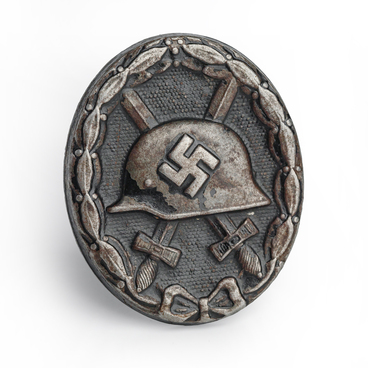
The fabricated biography claimed that Siebert had graduated from a non-commissioned officer school in Berlin, fought in the campaigns against Poland and France, earned the rank of Oberleutnant (First Lieutenant), and been awarded both classes of the Iron Cross. He was also said to have been wounded in combat, earning the Wound Badge. His cover role was that of a commissioner for an economic command (Wirtschaftskommando) responsible for exploiting the material resources of occupied Soviet territories for the benefit of the Wehrmacht. This position granted Kuznetsov frequent access to Rovno, freedom of movement across occupied zones, and control over substantial funds — essential assets for his intelligence and sabotage operations.