Font
Color
Graphics
Изображение точки

To see AR mode in action:

1. Install ARTEFACT app for iOS or Android;

2. Find the exhibition «Motifs of Tatar Patterns in National Costumes»

3. Push the «Augmented reality» button and point your phone's camera at the exhibit;

Скрыть точки интересаПоказать точки интереса
Показать в высоком качестве

Kalfak, Women’s vest, Women’s bib

0
Open in app
#1
Kalfak
#5
The kalfak has always occupied a special place among the traditional women’s headdresses widespread among the Tatars. The oldest surviving kalfak dates back to the 18th century, and scientists claim that the headdress had appeared even earlier. Today, a kalfak is a kind of decoration: it is worn on stage, used during photo shoots, national events, and in everyday life. Many women wear its variation of the skullcap type called takyya.

Nikolay Vorobyov, a well-known specialist in Tatar history, ethnographer and teacher, wrote about the importance the Tatars attached to kalfaks. In 1953, he published the fundamental study “Kazan Tatars”, in which he dwelled in detail on the history of this headdress, described its appearance and the rules that Tatar women followed when wearing it. Kalfaks were common primarily among the Kazan Tatars. They became widespread among other groups of Tatars in the end of the 19th century.

Kalfak patterns were inspired by nature and most often featured floral motifs. Images of mountain ash, wild rose and juniper were believed to bring happiness. Roses were embroidered to attract love and preserve beauty. The tulip, which was often featured in Tatar embroidery, symbolized renewal. Various wishes, amulets, and prayers were often depicted on ancient kalfaks, which gave the headdress some magical meaning. At the end of the 18th century, women wore high pyramidal hats that were completely studded with coins. The forehead part of the headdress was embroidered with silver and gold threads. There were diverse types of embroidery: satin stitch, tambour stitch, carpet technique, gold embroidery, pearl embroidery, and “ear” technique (much less common than pearl embroidery). The headdress made in the “ear” technique turned out to be elegant, but very expensive since the manufacturing process was laborious, the skill level had to be extremely high and the cost of the fabric was high.

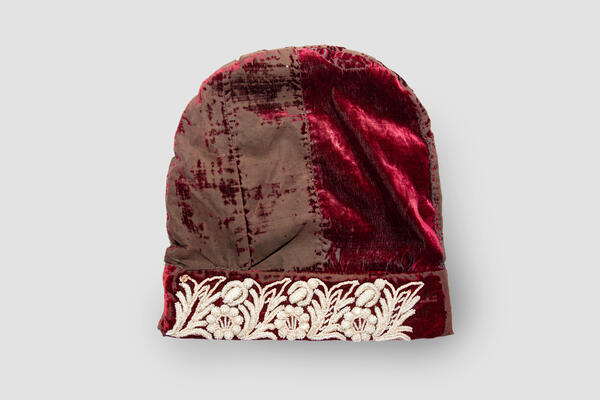
At the bottom of the burgundy velvet kalfak is a luxurious embroidery of stylized flowers, leaves and buds. The embroidery is made with white beads.
#2
Name: Kalfak
№: 21208542
Date of creation: the late 19th — early 20th century
Technique: sewing, embroidery
Dimensions: 15×9 cm
#7
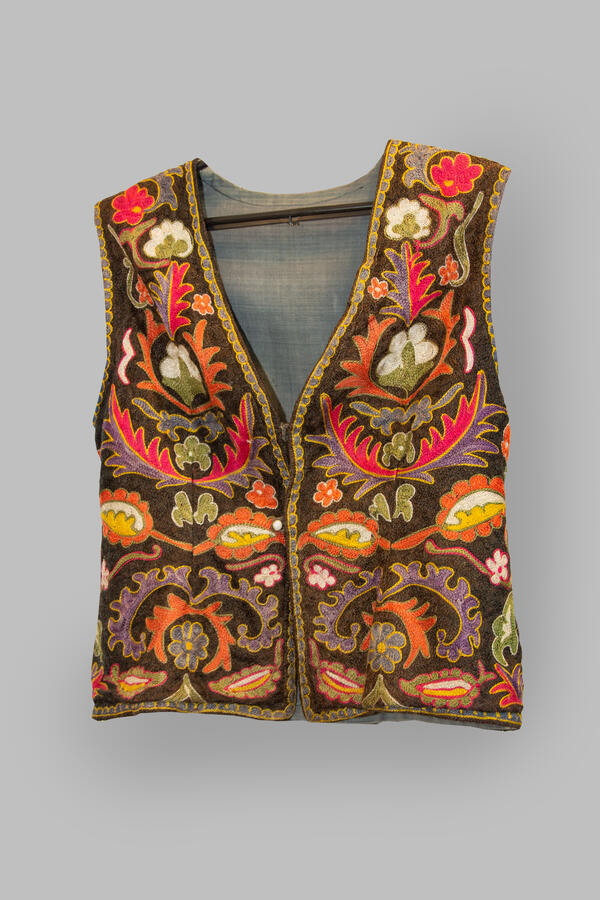
Women’s vest
#8
The story of the Tatar national costume dates back to the middle of the 18th century, but the outfit that has survived to this day was formed a little later, around the 19th century. The Tatar costume was influenced by the Volga Tatars and the traditions of the peoples of the East.

From a young age, Tatar women learned to sew and embroider. When making clothes, they applied all their skill and patience, and as a result, obtained beautiful and feminine costumes. Like a mirror, the costume reflected the occupations of the ancestors — those who tilled the ground and raised cattle. It also contained allusions to the climate, trade routes, ideals of beauty, religion, changing socio-economic conditions, and contacts with other peoples.

At the turn of the 20th century, the fashion for short sleeveless waistcoats spread among young people under the influence of European costume. Young men began to wear vest-type coats, girls — tightly fitted waistcoats with an open chest neckline and non-wrap front parts, which were sometimes fastened with hooks, and sometimes with a beautiful buckle called “captyrma”. Both men and women wore the waistcoat, mainly as a festive costume, on top of a shirt.

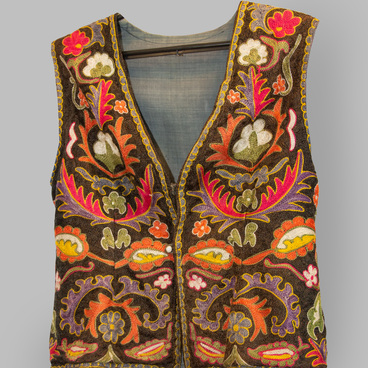
The exhibition features a women’s vest made in the early 20th century. A short and narrow sleeveless jacket tightly fitting the body was wrapped on the left side and fastened with buttons or hooks. It always had a lining and, like other clothes of this kind, was sewn from factory fabrics of a dark, mainly black color. The vest had no pockets. A floral pattern was embroidered with tambour technique all over the vest, and the edges were embroidered with a zigzag. The lining was often made of fabric — mainly expensive materials (velvet, brocade, plush, cloth, and silk) were used, less often — fur.

The cut of the men’s waistcoat differed from the women’s — it had an additional small stand-up collar and it was not fitted as tightly. Usually, a women’s vest was cut so that it tightly fitted the waist, and the inserted wedges formed wide coattails towards the hip line. According to the number of wedges, there were three-seam and five-seam waistcoats. Along the edges, hem and armholes, the women’s vest was decorated with cords, applied woven braids, or swan’s down.
#3
Name: Women’s vest
№: 21570502
Date of creation: the first half of the 20th century
Technique: fabric, velvet, trimming, embroidery
Dimensions: 82×45×55 cm
#9
Women’s bib
#10
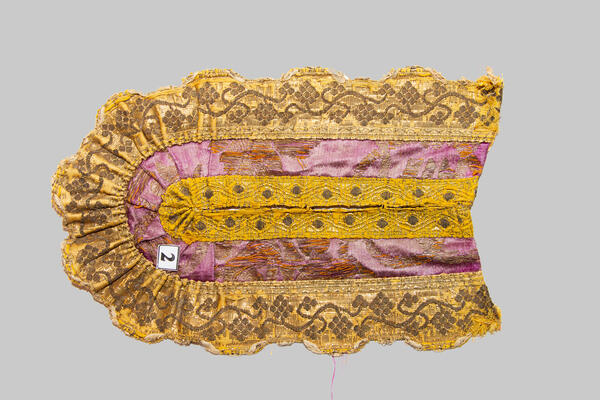
Women’s bibs called “izyu” were a very common type of Tatar adornments. They were made of a shovel-shaped piece of dense, often quilted cloth. An izyu was worn on the front of women’s shirts and it originated in the middle of the 19th century in the form of stripes and arch-shaped strips of multi-colored fabric. Initially, young girls wore them only on festive occasions. Then a new custom was introduced — at the wedding, the bride was to give an izyu to her mother-in-law.

This piece of clothing is not used by representatives of other nationalities. Its more common name is “izyu”, in some Siberian regions it is called “tukeshlek”. Like all other components of national costumes, the izyu had its own practical purpose — it covered the deep neckline of a dress or shirt and served as some kind of a breast apron. While breastfeeding a baby, a woman could use the bib to cover her child from prying eyes. Later, the bib became a fanciful decoration.

Each izyu is unique, since each woman would usually make it on her own, applying her skill, imagination, and a sense of style. She would use a wide ribbon and trim the edge with coins, ribbons, and glass beads. The izyu could be decorated with silver and corals, embroidered with satin stitch and beads. Then it was attached to the dress — usually women would sew the bibs on the dress, but over time the sewn-on bib was abandoned, because changing it was inconvenient. Therefore, traditionally izyu decorations were tied around the neck with ribbons. An izyu could testify how rich the woman was, since it was decorated with everything that was available at home. The izyu’s design could provide clues about the class, age, marital status, and ethnic differentiation among various groups of Tatars.

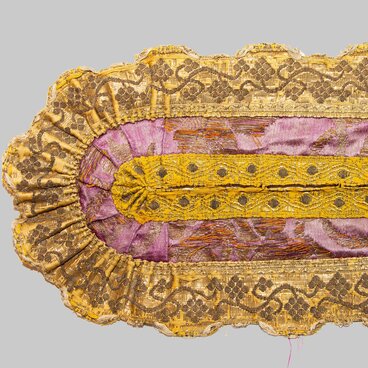
The museum displays an izyu of semi-oval shape. It has three different widths, and the fabric is decorated with braided ribbons. The ribbons and the braid feature a pattern in the technique of gold embroidery. These things are valuable and unique in that they belonged to an old resident of the Embaevo village, a Bukharan elderly woman Bibikamal Muslimova. When she got married, she had 26 dowry chests. She was a pupil of the local merchant Murtazin Kabir. The outfits she wore as a girl have survived to this day.
#4
Name: Women’s bib
Author: Bibikamal Muslimova
Date of creation: the late 19th century
№: 20298314
Technique: satin, cloth, silk, gold and silver threads, silk threads
Dimensions: 33×27 cm
#6
read morehide
00:00
00:00
1x

Kalfak, Women’s vest, Women’s bib

0
Point your smartphone camera to open in the app
Share
VkontakteOdnoklassnikiTelegram
Share on my website
Copy linkCopied
Copy
Open in app
To see AR mode in action:
  1. Install ARTEFACT app for 
  2. iOS or Android;
  3. Find and download the «Paintings in Details» exhibition
  4. Push the «Augmented reality» button and point your phone's camera at the painting;
  5. Watch what happens on your phone screen whilst you flip through the pictures.
 
We use Cookies
Cookies on the Artefact Website. We use cookies to ensure that we give you the best experience on our website. If you continue without changing your settings, we'll assume that you are happy to receive all cookies on the Artefact website. However, if you would like to, you can change your cookie settings at any time.
Learn more about useHide
Content is available only in Russian

X

Нашли опечатку?...

%title%%type%