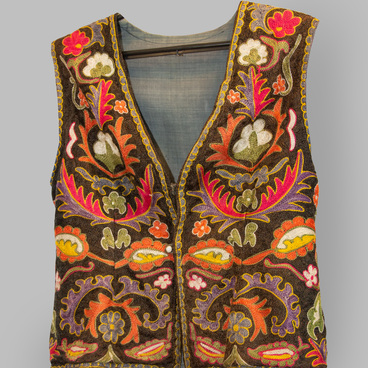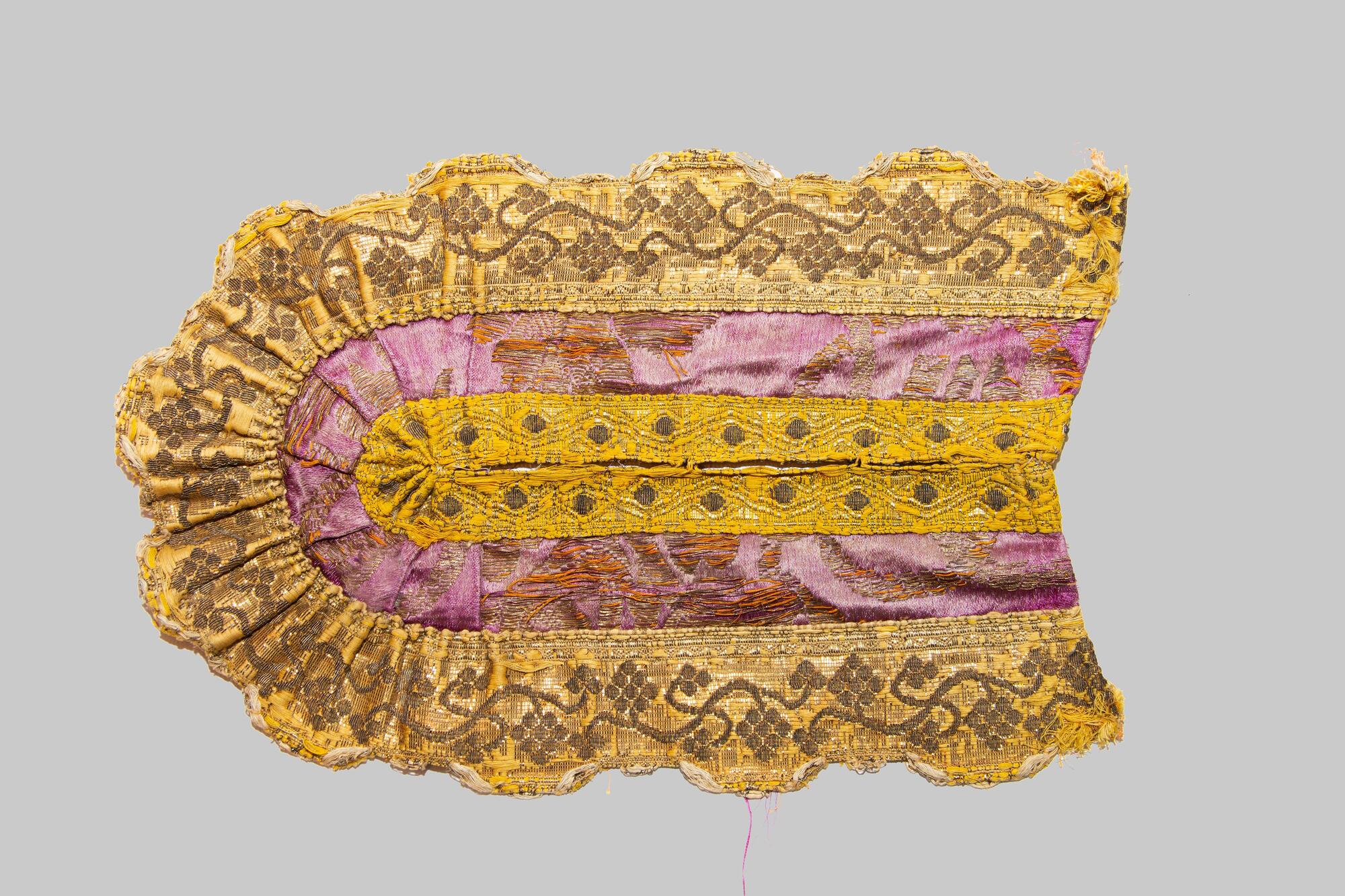


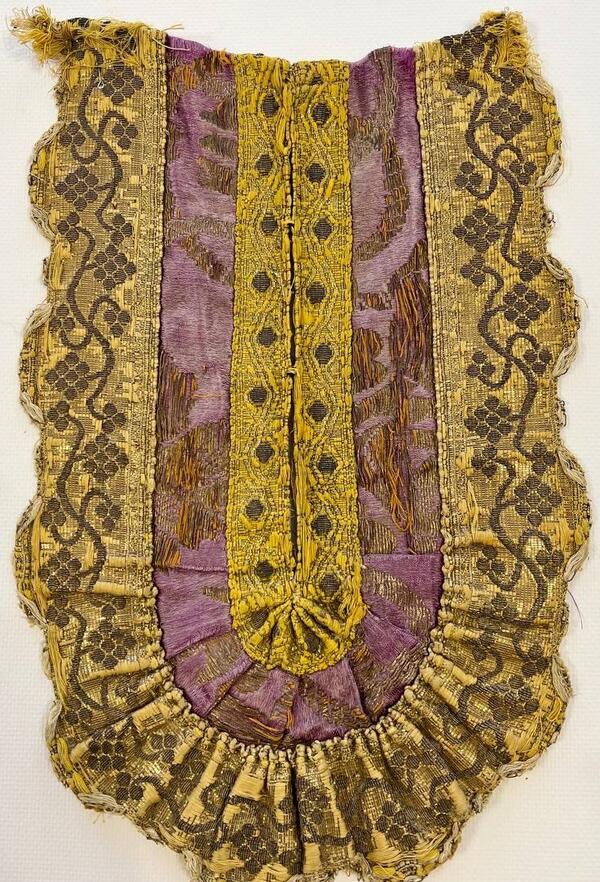
Women’s bibs called “izyu” were a very common type of Tatar adornments. They were made of a shovel-shaped piece of dense, often quilted cloth. An izyu was worn on the front of women’s shirts and it originated in the middle of the 19th century in the form of stripes and arch-shaped strips of multi-colored fabric. Initially, young girls wore them only on festive occasions. Then a new custom was introduced — at the wedding, the bride was to give an izyu to her mother-in-law.
This piece of clothing is not used by representatives of other nationalities. Its more common name is “izyu”, in some Siberian regions it is called “tukeshlek”. Like all other components of national costumes, the izyu had its own practical purpose — it covered the deep neckline of a dress or shirt and served as some kind of a breast apron. While breastfeeding a baby, a woman could use the bib to cover her child from prying eyes. Later, the bib became a fanciful decoration.
Each izyu is unique, since each woman would usually make it on her own, applying her skill, imagination, and a sense of style. She would use a wide ribbon and trim the edge with coins, ribbons, and glass beads. The izyu could be decorated with silver and corals, embroidered with satin stitch and beads. Then it was attached to the dress — usually women would sew the bibs on the dress, but over time the sewn-on bib was abandoned, because changing it was inconvenient. Therefore, traditionally izyu decorations were tied around the neck with ribbons. An izyu could testify how rich the woman was, since it was decorated with everything that was available at home. The izyu’s design could provide clues about the class, age, marital status, and ethnic differentiation among various groups of Tatars.
The museum displays an izyu of semi-oval shape. It has three different widths, and the fabric is decorated with braided ribbons. The ribbons and the braid feature a pattern in the technique of gold embroidery. These things are valuable and unique in that they belonged to an old resident of the Embaevo village, a Bukharan elderly woman Bibikamal Muslimova. When she got married, she had 26 dowry chests. She was a pupil of the local merchant Murtazin Kabir. The outfits she wore as a girl have survived to this day.
This piece of clothing is not used by representatives of other nationalities. Its more common name is “izyu”, in some Siberian regions it is called “tukeshlek”. Like all other components of national costumes, the izyu had its own practical purpose — it covered the deep neckline of a dress or shirt and served as some kind of a breast apron. While breastfeeding a baby, a woman could use the bib to cover her child from prying eyes. Later, the bib became a fanciful decoration.
Each izyu is unique, since each woman would usually make it on her own, applying her skill, imagination, and a sense of style. She would use a wide ribbon and trim the edge with coins, ribbons, and glass beads. The izyu could be decorated with silver and corals, embroidered with satin stitch and beads. Then it was attached to the dress — usually women would sew the bibs on the dress, but over time the sewn-on bib was abandoned, because changing it was inconvenient. Therefore, traditionally izyu decorations were tied around the neck with ribbons. An izyu could testify how rich the woman was, since it was decorated with everything that was available at home. The izyu’s design could provide clues about the class, age, marital status, and ethnic differentiation among various groups of Tatars.
The museum displays an izyu of semi-oval shape. It has three different widths, and the fabric is decorated with braided ribbons. The ribbons and the braid feature a pattern in the technique of gold embroidery. These things are valuable and unique in that they belonged to an old resident of the Embaevo village, a Bukharan elderly woman Bibikamal Muslimova. When she got married, she had 26 dowry chests. She was a pupil of the local merchant Murtazin Kabir. The outfits she wore as a girl have survived to this day.