

The traditional Tatar coat of the old cut (“Adäp kamzuly”) was long and had a slit neckline. The Kryashens (baptized Tatars) used it for a long time as part of everyday clothes. Young women usually wore it during the first year of their marriage as a sign of modesty and good manners. In the village, it was used as outerwear and worn over a shirt.
Traditional coats were sewn from plain velvet and silk or colorful Uzbek satin. The coats varied in length: they were long (up to the knees) or short (up to the hips). The sleeves could also be short (to the elbows) or absent. The coat could have a stand-up collar or a deep slit neckline. The front parts of the coat could be wrapped from right to left, had a hook-and-eye closure or were fastened with an elegant buckle — a piece of jewelry called “kaptyrma”. The back of the women’s coat was cut from two halves for a better fit. The women’ coats flared towards the hips thanks to additional side wedges. The central and two lateral wedges formed coattails.
The coat was decorated along the side edges, hem and armholes, as well as in the lower part of the front. Along the edge, they were decorated with a cord, woven braid, swan’s down, trimming, and coins. The front of the coat was decorated with embroidery, patterns were created with the help of a cord or braid. Traditionally, in such decorations, the floral pattern was of major importance combining real and fantastic flowers, fruits and leaves. Tatar embroidery is polychrome — the same motif is repeated in different colors. Geometric patterns play a secondary role: these are primarily meanders, waves and hearts. Ancient Tatar outfits were sometimes decorated with Arabic script.
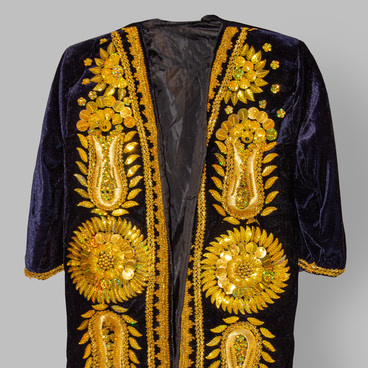
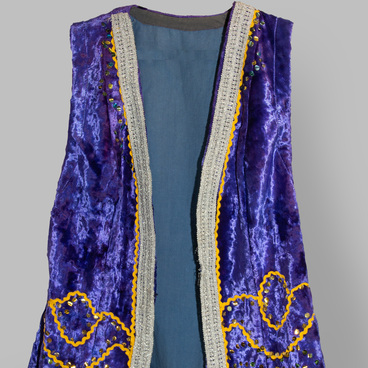
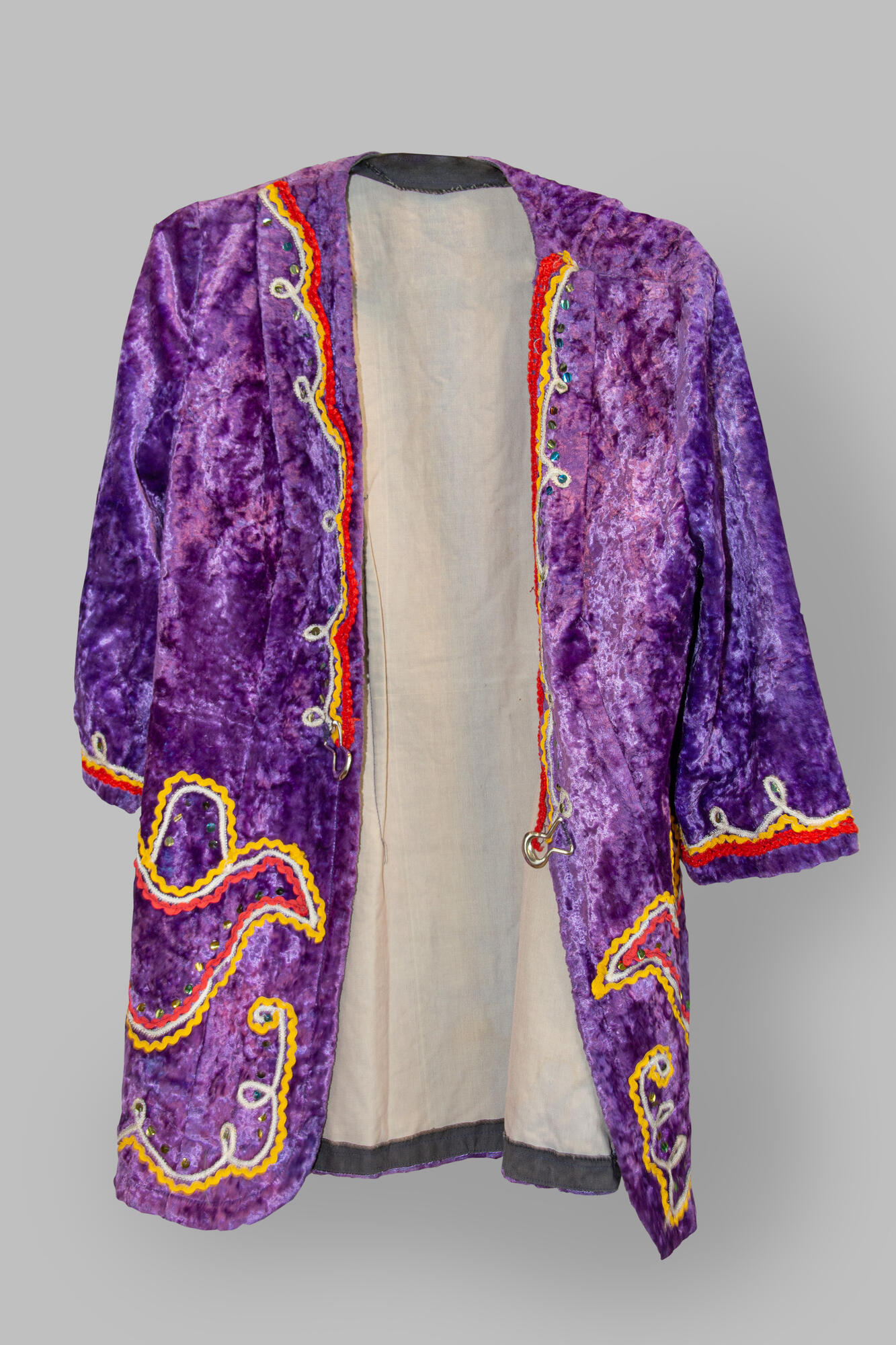
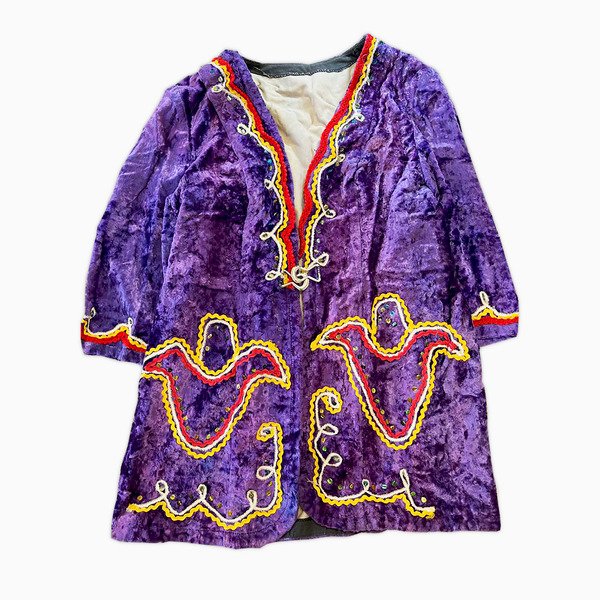
This coat was donated to the museum by its founder Venera Biktimirova, a resident of the Embaevo village. The top part is made of purple velvet, and the lining is made of cotton. The coat has a wide hem, and the sleeves reach the elbows; the edges of the sleeves and neckline, the front parts and their edges are decorated with braid. In the front, there are sequins and a pattern in the form of a tulip, which often appeared in Tatar embroidery and served as a symbol of renewal. The front parts are joined end-to-end with an elegant jewelry buckle called “kaptyrma”.
Traditional coats were sewn from plain velvet and silk or colorful Uzbek satin. The coats varied in length: they were long (up to the knees) or short (up to the hips). The sleeves could also be short (to the elbows) or absent. The coat could have a stand-up collar or a deep slit neckline. The front parts of the coat could be wrapped from right to left, had a hook-and-eye closure or were fastened with an elegant buckle — a piece of jewelry called “kaptyrma”. The back of the women’s coat was cut from two halves for a better fit. The women’ coats flared towards the hips thanks to additional side wedges. The central and two lateral wedges formed coattails.
The coat was decorated along the side edges, hem and armholes, as well as in the lower part of the front. Along the edge, they were decorated with a cord, woven braid, swan’s down, trimming, and coins. The front of the coat was decorated with embroidery, patterns were created with the help of a cord or braid. Traditionally, in such decorations, the floral pattern was of major importance combining real and fantastic flowers, fruits and leaves. Tatar embroidery is polychrome — the same motif is repeated in different colors. Geometric patterns play a secondary role: these are primarily meanders, waves and hearts. Ancient Tatar outfits were sometimes decorated with Arabic script.
This coat was donated to the museum by its founder Venera Biktimirova, a resident of the Embaevo village. The top part is made of purple velvet, and the lining is made of cotton. The coat has a wide hem, and the sleeves reach the elbows; the edges of the sleeves and neckline, the front parts and their edges are decorated with braid. In the front, there are sequins and a pattern in the form of a tulip, which often appeared in Tatar embroidery and served as a symbol of renewal. The front parts are joined end-to-end with an elegant jewelry buckle called “kaptyrma”.