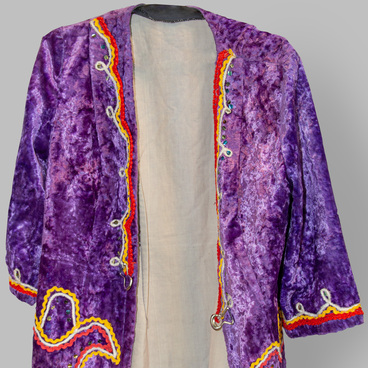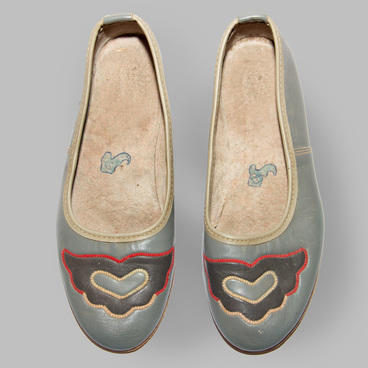


The origin of the Tatar national costume dates back to the middle of the 18th century. The outfit that has survived to this day developed a little later, around the 19th century. The Siberian Tatar attire was influenced by the Volga Tatars and the traditions of the peoples of the East. Tatar women learned sewing and various types of embroidery from a young age. They applied their skills and put a lot of patience into making clothes.
The main decorative element of the Tatar costume is a vest. A vest was a light, open knee-length clothing item that was either sleeveless or had short sleeves reaching the elbow. Both men and women wore it over a shirt. Women’s vests were cut so that they tightly fitted the body, and additional side wedges formed coattails. According to the number of wedges, there were three-seam and five-seam vests. They were sewn mainly from expensive materials (velvet, brocade, plush, cloth, and silk) on a fabric lining, less often on fur.
Unlike middle-aged or elderly women, young girls wore vests of brighter colors. Even women from poor families had festive vests decorated with embroidery. Floral patterns were in the focus of attention. Tatar floral ornament was distinguished by a large variability of flower and leaf motifs, the elegance of the compositional solution, and the rich colors.
Shortened vests appeared in the Tatar costume at the turn of the 20th century under the influence of the European costume. Young people were the first to adopt the new fashion: the traditional men’s coat turned into a kind of vest, the girls began to wear nicely fitted sleeveless jackets with an open chest neckline. These vests were not wrapped around the body, but rather fastened with hooks or a beautiful buckle called “kaptyrma”.
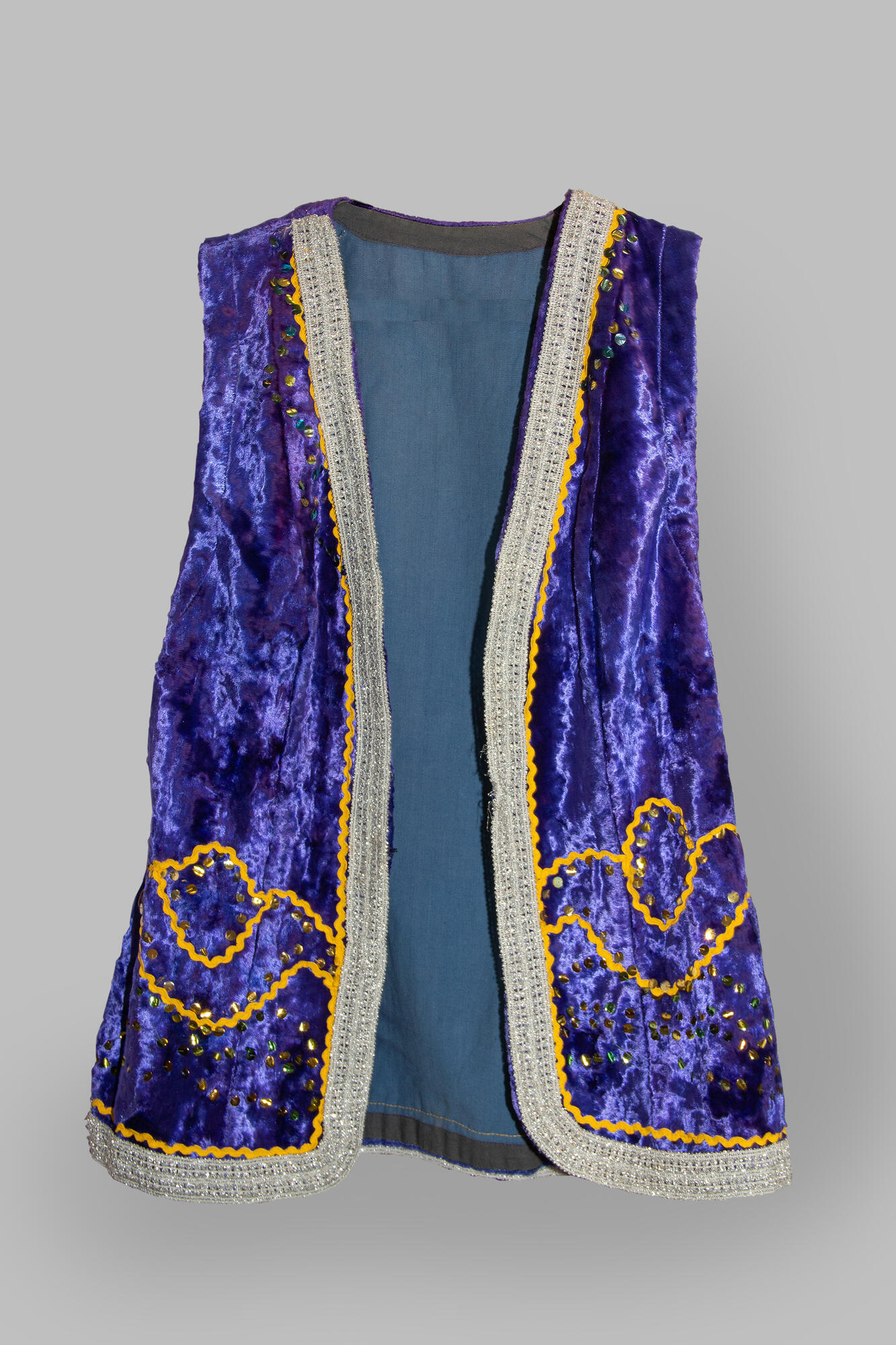
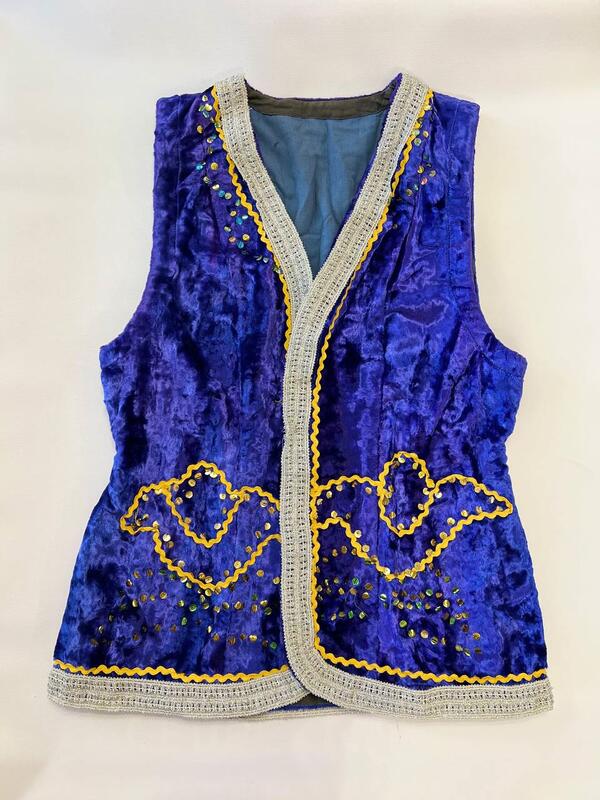
The women’s cropped vest is made of dark blue velvet fabric, decorated with a white knitted trimming along the edges, stitched over the entire surface with a wavy yellow gimp trim, which forms the basis of the pattern in the form of tulips.
Tatars most often featured tulip, chrysanthemum, and dahlia. A prominent place in the floral ornament is occupied by the trefoil motif.
The main decorative element of the Tatar costume is a vest. A vest was a light, open knee-length clothing item that was either sleeveless or had short sleeves reaching the elbow. Both men and women wore it over a shirt. Women’s vests were cut so that they tightly fitted the body, and additional side wedges formed coattails. According to the number of wedges, there were three-seam and five-seam vests. They were sewn mainly from expensive materials (velvet, brocade, plush, cloth, and silk) on a fabric lining, less often on fur.
Unlike middle-aged or elderly women, young girls wore vests of brighter colors. Even women from poor families had festive vests decorated with embroidery. Floral patterns were in the focus of attention. Tatar floral ornament was distinguished by a large variability of flower and leaf motifs, the elegance of the compositional solution, and the rich colors.
Shortened vests appeared in the Tatar costume at the turn of the 20th century under the influence of the European costume. Young people were the first to adopt the new fashion: the traditional men’s coat turned into a kind of vest, the girls began to wear nicely fitted sleeveless jackets with an open chest neckline. These vests were not wrapped around the body, but rather fastened with hooks or a beautiful buckle called “kaptyrma”.
The women’s cropped vest is made of dark blue velvet fabric, decorated with a white knitted trimming along the edges, stitched over the entire surface with a wavy yellow gimp trim, which forms the basis of the pattern in the form of tulips.
Tatars most often featured tulip, chrysanthemum, and dahlia. A prominent place in the floral ornament is occupied by the trefoil motif.