#1

Grindstone, hunchback scythe
#9
#2

#4
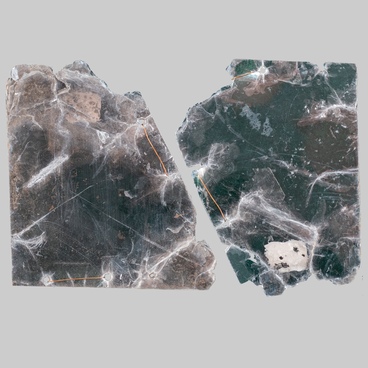
The upper grindstone from the museum collection is movable. It is one of the pair of stones used in a hand mill to grind grain into flour. It was cut out of one piece of hard grey mountain rock, in the shape of an irregular disk. In the center of the grindstone there is a 3.5 cm through-hole. It was necessary to install a shaft or a stem into, combining both grinds of the mill. At the side of the upper surface there is a round cavity for a handle used to turn the upper grindstone.
In all countries where baked bread was a base food product, the grains of wheat and, to a less extent, rye, were made into flour. The flour was not only used for baking bread but also, for making pasta and pastry. Some flour was also made of barley, corn, oats, buckwheat, peas, soya and sorgo. It was used in food, textile, fermentation and other industries.
Flour production is one of the oldest world industries. It originated about 6-10 thousand years ago. The tools, and later, machines that man used to grind grains into flour were called mills. The same name was given to the entire grain grinding enterprises. Currently, all governmental mills are called milling plants.
Grinding the grain into a powder-like product required significant efforts. After the impact and attrition mills appeared, the process became much simpler. The flour resulting from grinding was of dark colour. The bread baked of such flour was also dark as that milling method involved all parts of the grain into making the flour, the dark colour grain hulls among them. If you put the flour through a fine capronic or silk sieve, you can easily see that it consists of particles of various sizes. Larger particles that remained in the sieve usually contained the grain hulls.
The flour put through the sieve was of a lighter colour, but still contained some hulls. That is why the bread crumb of such flour remained grey. White bread with light crumb, could only be made of endosperm flour. It was obtained by fully cleating the grains from hulls.
#5
Full name Upper grindstone of hand mill
Date XVII century
Place Russia
Technique stonecutting
Dimensions 39×8,5×3,5 cm
Collection XVII – XVIII cent. Kuznetsk ostrOg — the town of Kuznetsk. Excavations of various years
Copyright Kuznetsk fortress
Goskatalog Number 5488345
Date XVII century
Place Russia
Technique stonecutting
Dimensions 39×8,5×3,5 cm
Collection XVII – XVIII cent. Kuznetsk ostrOg — the town of Kuznetsk. Excavations of various years
Copyright Kuznetsk fortress
Goskatalog Number 5488345
#8
Hunchback scythe
#3

#6
Scythe is an agricultural hand tool for grass cutting: to make hay, cattle fodder or to trim the lawn. The hand scythe consists of a chisel – a metal blade with a stick attached to its base – a scythe shaft, a snath. In the middle of the shaft of Lithuanian scythe there is a bow – a handle to comfortably hold of the tool. The scythe blade is attached to the shaft by a wooden wedge and a metal ring, less frequently, by two rings.
Indoor maintenance of cattle typical for the Russian population of Siberia required stocking up enough fodder, including hay. The hunchback scythe was an important agricultural tool. Living in a border town, Kuznetsk residents did not always have an opportunity to select convenient meadow plots and preferred the nearest ones. The hunchback scythe was convenient for working at small meadow plots with high grass which are many in the city neighbourhood even now.
The hunchback scythe is a cutting agricultural tool used for grass cutting. It is a northern type of scythes. In the classification of the Russian historian and archaeologist Boris Kolchin, typical for northern scythes are a lengthened narrow blade and an oblong shaft. The scythe was attached to a wooden handle with its stick part, using a metal ring.
The scythers worked with hunchback scythe in a bent-down position moving the tool on both sides of the body – and that made the tool different from the scythe with a long handle – a Lithuanian scythe. The latter was more difficult to manufacture and required more metal. It was more hazardous in work and required special skills, but at the same time its productivity was higher than that of the hunchback scythe.
The museum collection only contains fragments of the tanged hunchback scythe, its surface is distorted. The working part is bent arc-wise, the back is flattened and smoothly changes into the shaft. The usual length of the hunchback scythe in XVII century was 40 cm from the shaft to the blade end. Manufacturing technique was simple, comprising hot metal forging methods. Carbon steel was used as feedstock. The ready tool was thermohardened in cold water. As the result the steel became very hard but at the same time, fragile, that being the reason behind the blade breaking while working with it.
#7
Full name Hunchback scythe
Date XVII century
Technique forging
Place Russia
Dimensions length 25 cm, blade width - 3 cm, blade thickness - 0,3 cm, handle width - 2,4 cm
Collection XVII – XVIII cent. Kuznetsk ostrog — the city of Kuznetsk. Excavations of various years
Copyright Kuznetsk fortress
Restorers Scheglakov A.P.
Goskatalog Number 4792854
read morehide
00:00
00:00
1x
0
 Point your smartphone camera to open in the app
Open in app
Share