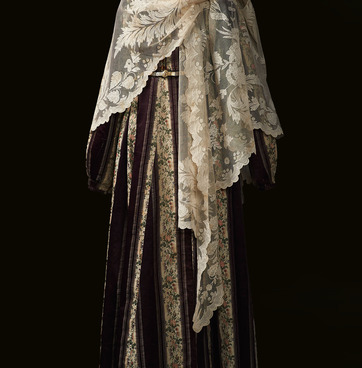
Until the 1730s the land in the Vesiegonsky Uyezd of the Tver Governorate was owned by the Musin-Pushkins. The area was called Pushkarshchina after their name, and the peasants were nicknamed “Pushkars”. When they became free and got the status of state peasants, they kept this name for centuries. It is from this area that the ancient women’s costume with a sarafan originated. A peasant woman would go to church on Sunday in such a costume, so the whole complex and the items it included were often called a Sunday costume.
The festive costume of a Pushkar woman consists of a linen shirt, a “rukava” upper part and a“stannic” lower part, as well as a “gorbun” pinafore dress, a braided belt, and a “soroka” headdress, tied with a towel.
Some of the cut and decor details of the Pushkar women’s clothing differed from that of the peasants living in neighboring areas. Thus, the Pushkar shirt was sewn with a round insertion at the collar, decorating it with embroidery, woven pattern and braid; the sleeves were ornamented with two vertical strips of embroidery, patterned fabric or chintz, called “prostafkas”. The sarafan pinafore dress made of nankeen, a blue cotton cloth, was cut from one piece of the front and back panels with armholes, although most sarafans of the first half of the 19th century were cut with oblique panels and had a slit along the front panel with buttons or its imitation (also with buttons).
The women’s headdresses included such an archaic element of the East Slavic women’s costume as a towel that was tied or draped over the soroka. The headdress with a towel relates the Pushkar girls’ costume to those of South Russian and Belorussian women. The main part of the headdress consists of a kichka, steganets, pozatylnik and soroka with a front piece densely embroidered with metal sequins and braid.
An important supplement to the Sunday costume of a Pushkar girl is a “osheinik” — a neck ornament, threaded with glass beads, resembling a wide collar.
This archaic clothing set was preserved in Pushkarshchina until the last third of the 19th century. Old Pushkar women were still wearing clothes from this set in the early 1920s.